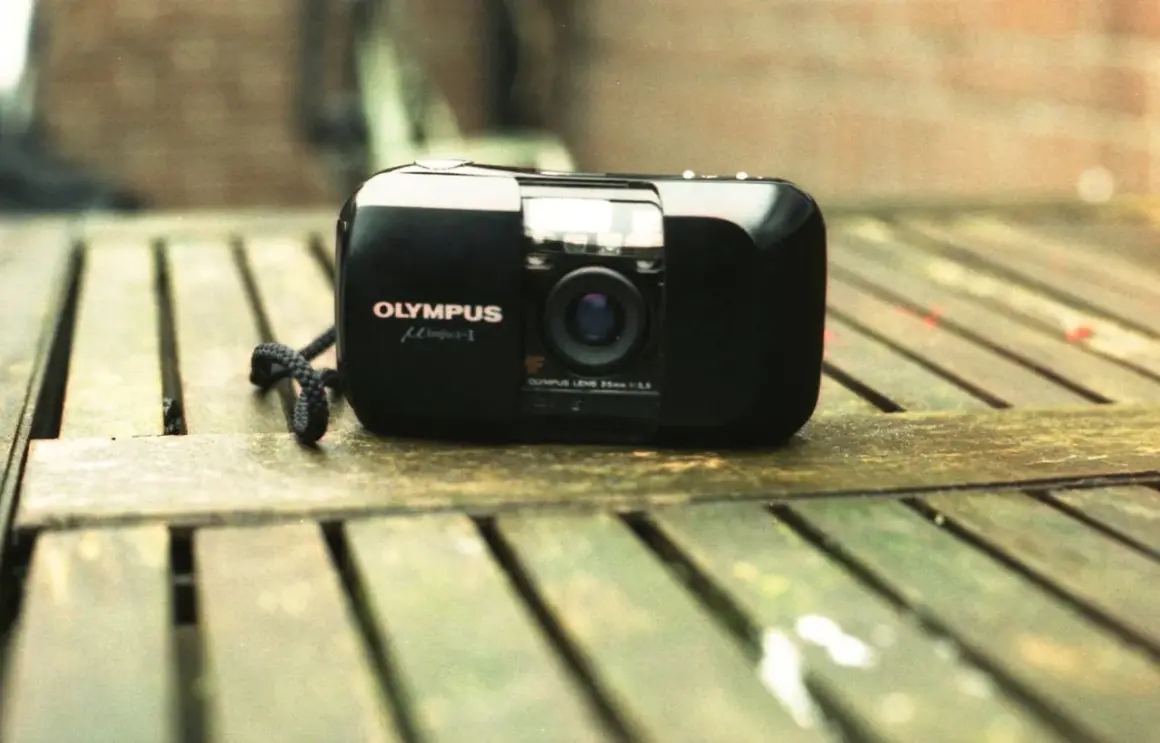
An Olympus Stylus works best when the film does some of the heavy lifting for you. The best film for Olympus Stylus is usually a forgiving color-negative stock in the ISO 200 to 400 range, because the camera’s fully automatic exposure system rewards latitude, consistent DX coding, and a film that still looks good when the light is not perfect. I would treat it as a compact everyday tool: simple to load, simple to meter, and happiest with a roll that gives you usable negatives even when you shoot quickly.
The safest bet is a forgiving 35mm color-negative roll in the ISO 200 to 400 range
- Kodak Gold 200 is the easiest daylight choice if you want warm color and a classic point-and-shoot look.
- Kodak Ultramax 400 is the stronger all-rounder for mixed light, flash snapshots, and cloudy days.
- Ilford HP5 Plus is the black-and-white option I would trust first because it is flexible and forgiving.
- CineStill 800T makes sense only when you want a night or tungsten look and accept more grain.
- Most Stylus bodies use standard 35mm DX-coded film, so compatibility is broad, but speed still matters.
What the Olympus Stylus actually needs from film
Most Stylus bodies were built around standard 35mm DX-coded cartridges, not APS or medium format. On the Stylus Zoom 170 Deluxe manual, Olympus lists DX-coded speeds from ISO 50 to 3200, and non-DX film defaults to ISO 100, so the camera is happiest with normal cartridge speeds like 100, 200, 400, 800, or 1600. DX coding is the barcode-like pattern on the cassette that tells the camera what ISO to use automatically.
That automatic behavior is why film choice matters more than many people expect. Exposure latitude, meaning how much room the film gives you before highlights blow out or shadows block up, is often more important here than chasing the finest grain. Because the camera is doing the metering for you, I think of the film as the real control surface.
That pushes the decision away from “Can it fit?” and toward “Which stock gives the camera the most room to succeed?”
The rolls I would shortlist first
If I had to narrow the shelf to a handful of rolls that genuinely make sense in a Stylus, these are the ones I would keep in rotation. I am not choosing them only for image quality; I am choosing them because they match what a fully automatic compact actually needs in real use.
| Film | ISO | Why it works in a Stylus | Best for | Typical U.S. price |
|---|---|---|---|---|
| Kodak Gold 200 | 200 | Warm color, broad latitude, and an easy daylight balance | Travel, family, outdoor snapshots | About $8.99 per 36-exp roll |
| Kodak Ultramax 400 | 400 | More speed for cloudy weather, indoor flash, and faster grab shots | Everyday carry, mixed light, street | About $9.99 per 36-exp roll |
| Kodak Portra 400 | 400 | Clean tones and very forgiving negatives for scanning and portraits | Portraits, color-critical work, travel | About $15.99 per 36-exp roll |
| Ilford HP5 Plus | 400 | Wide latitude, medium contrast, and strong pushability | Black and white, documentary, low-light B&W | About $8.99 per 36-exp roll |
| CineStill 800T | 800 | High speed for night scenes and tungsten light, with a deliberate cinematic look | City nights, interiors, creative color | About $17.99 per 36-exp roll |
| Kodak Ektar 100 | 100 | Very fine grain and vivid color, but less forgiving than 200/400-speed film | Bright daylight, saturated landscapes | About $13.99 per 36-exp roll |
Note: Those are approximate single-roll U.S. street prices, and they move with retailer stock and pack size. My practical read is simple: Gold 200 is the easiest default, Ultramax 400 is the better all-rounder, and Portra 400 is the splurge roll when you care more about negative quality than cost.
That gets us to the part most Stylus owners actually feel in the field: speed. The camera is not demanding, but it does reward the right ISO.
Why ISO 200 to 400 is the sweet spot
ISO 200 when the day is doing most of the work
ISO 200 gives you a clean balance of grain, color, and exposure flexibility. In bright daylight, Gold 200 is the easy answer because it keeps the look warm and familiar without becoming too contrasty. If you are shooting travel, family, or casual outdoor scenes, this is the range where the Stylus feels most effortless.
ISO 400 when the light starts changing
ISO 400 is where the camera becomes less fragile. Ultramax 400 and HP5 Plus let the Stylus cope better with shade, interiors, and quick flash shots. On the Stylus Zoom 170 Deluxe, Olympus lists a wide-angle flash range of about 0.8 to 5 m at ISO 100 and about 0.8 to 10 m at ISO 400, which is a real difference when you are trying to photograph people across a table or in a dim room.
ISO 800 when you really need the speed
High-speed film is useful at night or in tungsten interiors, but it is not my default answer for a Stylus because grain rises and the look gets more stylized. That is fine if you want the effect on purpose, especially with CineStill 800T, but it is a choice you make deliberately rather than the safest everyday option.
Once you settle on speed, the next question is film family: color negative, black and white, or slide.Color negative, black and white, or slide
I usually rank the three film families in this order for a Stylus: color negative first, black and white second, slide third. That is not a statement about which one looks best. It is about which one gives the camera the most margin for error when everything is automatic.
Color negative gives you the most margin
C-41 color negative film is the easiest match for a Stylus because it has generous latitude, scans cleanly, and forgives small metering mistakes. If you want one roll that works in daylight, shade, backlight, and flash, this is the lane to stay in. Kodak Gold 200, Ultramax 400, and Portra 400 all live here, and they solve the same problem at different price points and speeds.Black and white turns simplicity into a strength
Ilford HP5 Plus is the black-and-white film I would reach for first. Ilford positions it as a high-speed, wide-latitude film, and that is exactly why it behaves well in a compact automatic camera. It keeps the negatives usable in mixed light, takes pushing well, and gives you enough contrast control to feel intentional instead of limiting.
Read Also: Hasselblad 500C - Still Worth It? Your Guide to Buying & Using
Slide film is compatible, but not the easiest default
Yes, Ektachrome E100 fits the camera, and the look can be excellent when you nail exposure. The tradeoff is that slide film is far less forgiving than negative film, so a half-stop miss shows up much faster. I would choose it only if I specifically wanted the transparency look and was comfortable paying for a more exacting workflow through E-6 processing.That means the real mistake is not incompatibility. It is choosing a film that fights the camera’s automatic design.
Mistakes that waste good film in a Stylus
- Choosing ISO 100 for a night-out camera and then expecting it to behave like 400-speed film indoors.
- Loading non-DX film casually and assuming the camera will read your intent correctly.
- Picking slide film for a first test roll when a color-negative stock would be easier and cheaper to learn with.
- Buying very slow film for a casual compact setup unless you know most of your shots will be in strong daylight.
- Ignoring the flash, which is part of the exposure strategy on a Stylus, not just an emergency button.
- Using expired film without a plan for color shifts, extra grain, and more misses.
When you avoid those mistakes, the camera stops feeling unpredictable and starts feeling like a very competent pocket system.
The three-roll kit I would keep in the bag
If I were building a simple, practical kit for this camera, I would keep it brutally small:
- Gold 200 for bright daylight, travel, and the classic warm point-and-shoot look.
- Ultramax 400 for mixed light, cloudy days, indoor candids, and flash-heavy shooting.
- HP5 Plus or CineStill 800T when I want either black-and-white flexibility or a deliberate night-time color character.
If you want the shortest answer, buy Gold 200 first, Ultramax 400 second, and only move to Portra 400, HP5 Plus, Ektar 100, or 800T once you know the look you want. That keeps the Stylus doing what it does best: making simple exposure decisions and giving you negatives that scan well, print well, and do not need rescue work later.