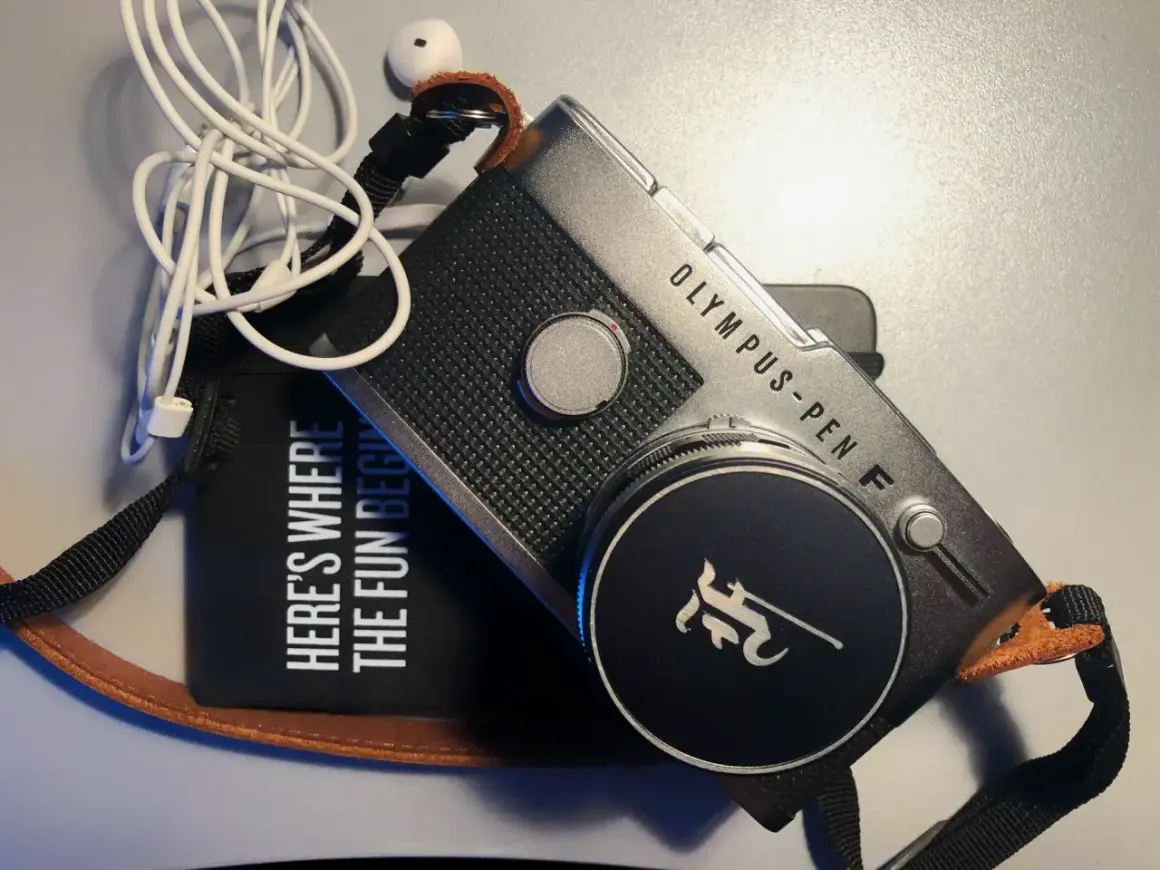
The Olympus Pen FV is a compact half-frame 35mm SLR that rewards deliberate shooting rather than quick, automatic habits. It sits in the classic Pen F family, not the later digital PEN-F, and it gives you interchangeable lenses, a fully mechanical body, and a format that turns one roll of film into far more frames than a normal 35mm camera. In this guide I cover what makes the camera distinctive, how to meter it, how it compares with the F and FT, and what to check before buying one.
The FV rewards careful metering and a compact shooting style
- Half-frame format means 24x18 mm images, so a 36-exposure roll can deliver about 72 frames.
- Mechanical operation keeps the body usable without relying on a battery to fire the shutter.
- No built-in meter is the main tradeoff, so a handheld meter, phone app, or clip-on accessory matters.
- Single-stroke advance makes it quicker to use than the original Pen F.
- Lens choice matters because the standard Pen lenses behave more like short telephotos than classic 50mm glass.
What the FV actually is and why it still feels fresh
The FV is the meterless member of Olympus' Pen F line, introduced in the mid-1960s as a half-frame SLR with interchangeable lenses. The format is the big story here: each frame uses roughly half the area of a standard 35mm negative, which is why a 36-exposure roll can yield 72 images. That is a practical advantage if you like to shoot more, but it also changes the look and feel of the camera, because the usual Pen standard lenses act more like short telephotos on a full-frame camera.
What I find distinctive is how much engineering ended up in such a small body. The original manual describes a rotary metal focal-plane shutter with speeds from 1 second to 1/500 second plus bulb, a finder with microprism focusing aid, and a fully automatic diaphragm system that keeps the lens wide open until the exposure. In real use, that means the camera is small but not casual. It asks you to focus carefully, set exposure consciously, and accept that the frame counter advances in fours, which is a reminder that this is a half-frame system, not a normal 35mm SLR. That unusual rhythm is also why metering becomes the first real decision, not the last.
How I meter it in practice
The FV does not give you a built-in meter, so exposure is entirely your responsibility. The original manual recommends a clip-on dual-range CdS meter that couples directly to the shutter speed dial, but in 2026 I would treat that as a collector accessory rather than a requirement. A modern handheld meter or a good phone app is usually easier to live with, especially if you are moving between negative film, slide film, and mixed lighting.
My practical approach is simple. I meter for a midtone, then decide whether the scene wants more depth of field or more shutter speed. With color negative film, I am comfortable giving the film a little extra light because the format is forgiving enough for that. With slide film, I am much stricter, because the smaller negative area already gives you less room to hide exposure mistakes. If I am shooting flash, the FV is oddly reassuring, because its electronic flash sync works at all shutter settings. That makes ambient-plus-flash work much easier than on many older focal-plane SLRs.
- Set the film speed on your meter or app before you leave home.
- Use the meter on a midtone, not on the brightest highlight in the frame.
- For negative film, protect shadows and do not underexpose out of habit.
- For slide film, bracket more often if the light is changing fast.
- If you use flash, take advantage of the all-speed sync to balance ambient and subject light.
Once metering feels natural, the next question is which body in the Pen F family actually fits your working style.
How it compares with the Pen F and Pen FT
This is where buyers usually get stuck, because the three bodies look very similar until you start shooting them. The easiest way to separate them is by metering and film advance. The original Pen F is the most stripped-down body and uses a double-stroke advance. The FT adds a built-in meter and a single-stroke advance. The FV keeps the single-stroke advance but drops the meter again, which is why many people see it as the cleanest manual version of the system.
| Model | Meter | Film advance | What it feels like | Best for |
|---|---|---|---|---|
| Pen F | No built-in meter | Double-stroke | Light, simple, and very tactile | Shooters who do not mind metering externally and want the earliest body |
| Pen FT | Built-in meter | Single-stroke | Most convenient if the meter is healthy | People who want one-body convenience inside the Pen F system |
| FV | No built-in meter | Single-stroke | Clean mechanical middle ground | Buyers who want the simplest body and are happy to meter externally |
In practice, I would not choose the FT just because it has a meter. Older meters can drift, fail, or become a maintenance problem. If you want the least complicated ownership experience, the FV makes a lot of sense. If you want the brightest, most stripped-back feel, the original Pen F still has a charm of its own. That leads directly to the part most buyers underestimate, which is condition.
What to check before buying one in 2026
I would treat any Pen F-series body as a mechanical collectible first and a bargain second. A CLA, meaning clean, lubricate, and adjust, can be worth it, but only if the price leaves room for service. Even a camera that looks clean can hide slow shutter speeds, stiff lubrication, or finder haze, and those problems matter more than cosmetic wear.- Test every shutter speed, especially the slow speeds and 1/500 second.
- Listen for even shutter travel and look for obvious drag or sticking.
- Check the mirror, focusing screen, and viewfinder for haze, dust, or fungus.
- Make sure the advance lever returns cleanly and the frame counter advances correctly.
- Inspect the lens mount and aperture blades, especially if a lens is included.
- Replace degraded light seals or foam if they have turned sticky or crumbly.
- If a clip-on meter is included, verify that it still reads consistently and that its battery setup is practical.
- Be cautious with listings marked untested unless the price is low enough to absorb a repair.
My rule is simple: I would rather buy a slightly tired body with clean mechanics than a pretty example that has been sitting unused for years. Once the body passes those checks, lens choice becomes the next lever that changes how the camera feels.
Which lenses and accessories make the biggest difference
The Pen F lens range is compact, sharp, and more opinionated than many people expect. Because the format is half-frame, the usual Pen standard lenses behave more like short telephotos on a full-frame camera. A 38mm lens on this system feels roughly like a 76mm equivalent, while a 25mm lens behaves much closer to a normal 50mm view. That is important, because it changes which lens you should treat as your everyday choice.
- The 38mm f/1.8 and 40mm f/1.4 are great if you like a subject-forward look and do not mind a tighter field of view.
- The 25mm f/4 is the lens that makes the system feel more natural for street, travel, and general use.
- The 100mm f/3.5 or 150mm f/4 are useful when you want portraits or stronger background compression.
- A clip-on meter changes usability the most if you want a period-correct workflow.
- A handheld meter or phone app is the simplest modern substitute if the original accessory is missing.
- Close-up lenses, extension tubes, or bellows matter if you want product details, texture studies, or compact macro-style work.
- An eye correction lens can be worth buying if your eyesight is not perfect, because the finder is usable but not huge.
If you are building a small, intentional film kit, I would start with one good standard lens, one reliable way to meter, and then only add accessories that solve a real problem. That keeps the camera useful instead of turning it into shelf hardware.
Why the FV still makes sense for deliberate film work
If I were choosing a Pen F body for a personal project in 2026, I would reach for the FV when I wanted the cleanest, most disciplined shooting experience. Half-frame is a creative constraint, but it is not a weak one. It gives you more frames per roll, encourages sequencing, and makes the camera feel like a notebook rather than a one-shot machine. That is especially useful for street fragments, travel diaries, visual essays, and portrait studies where the relationship between frames matters as much as any single image.
I would not choose it for fast action, low-light event work, or any situation where I need exposure automation and speed above all else. The FV asks for a meter, a little patience, and a willingness to work around a smaller negative. If those tradeoffs fit the way you shoot, it is still one of the most characterful compact SLRs Olympus ever made. For me, that is the real appeal: it is small, mechanical, and just particular enough to push better decisions without feeling precious.