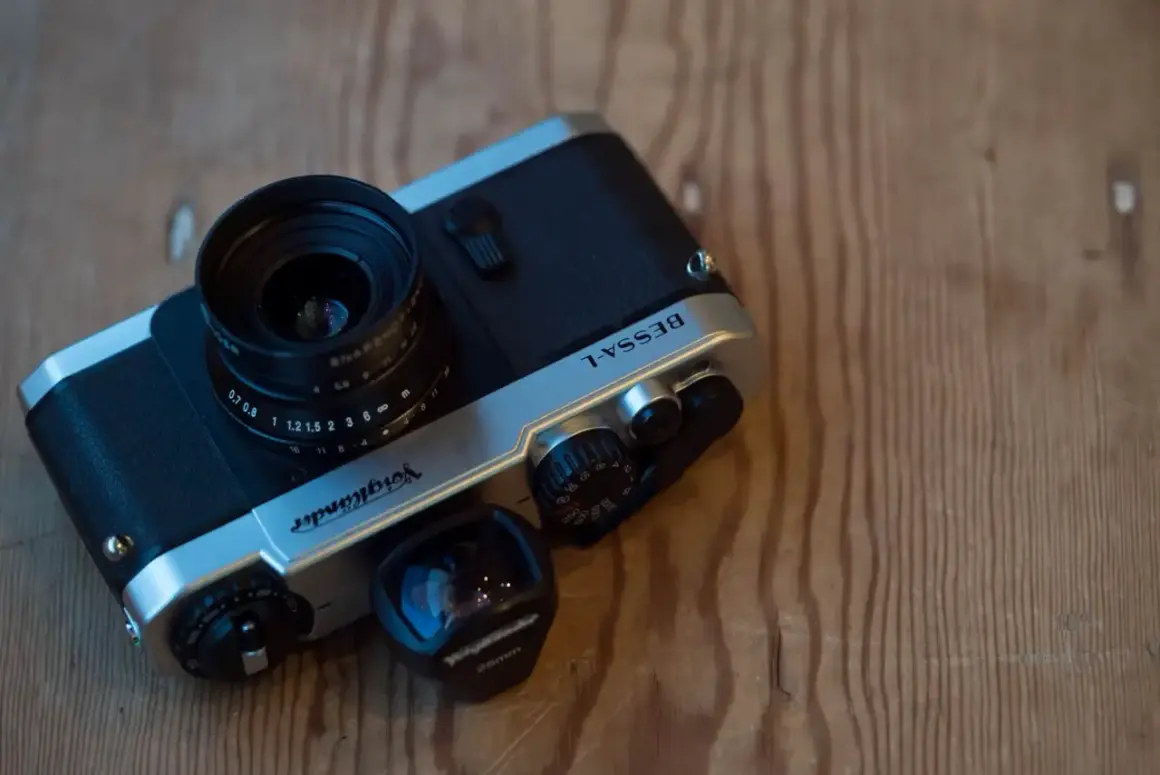
The Voigtlander Bessa L is one of those film cameras that makes far more sense once you stop treating it like a normal rangefinder. It was built as a lightweight Leica screw-mount body for wide-angle lenses, with TTL metering, a fully mechanical shutter, and no built-in finder getting in the way. That unusual formula is exactly why it still interests film photographers who want something compact, deliberate, and very usable for street, travel, and landscape work.
What matters most before you buy or shoot one
- It is a scale-focus Leica thread mount body, not a true built-in rangefinder.
- Its strongest match is wide-angle glass, especially 15mm to 35mm lenses.
- The shutter is fully mechanical, from B to 1/2000s, so the body still works without batteries.
- The TTL meter is center-weighted, with ISO 25-1600 in 1/3 steps and two LR44 or SR44 cells.
- Clean body-only prices in the U.S. usually sit around $100-200, while complete kits rise fast.
- If you want a general-purpose 50mm rangefinder experience, another Bessa body makes more sense.
What the Bessa L actually is
The first thing I would clarify is simple: this is not a traditional rangefinder camera. It is a scale-focus 35mm body with an LTM/M39 lens mount, so you set distance on the lens barrel and compose with an external finder if the lens needs one. That design choice sounds limiting on paper, but it is the whole point of the camera. Cosina built it for photographers who cared more about compactness, meter accuracy, and wide-angle shooting than about a coupled rangefinder patch.
In practical terms, that makes the camera feel stripped down in a good way. There is less to break, less to align, and less bulk in the hands. I think that is why the body still has a following: it behaves like a modernized, no-frills film tool instead of trying to be an all-purpose nostalgia piece.
| Feature | What it means | Why it matters |
|---|---|---|
| Film format | 35mm | Easy film availability and familiar handling |
| Lens mount | Leica thread mount, also called LTM or M39 | Wide ecosystem of screw-mount lenses and adapters |
| Focusing | Scale focus, no built-in rangefinder | Best suited to wide lenses and zone focusing |
| Shutter | Mechanical focal-plane shutter, B to 1/2000s | Works without batteries and handles bright light well |
| Metering | TTL, center-weighted, LED readout | Fast manual exposure checks without a separate meter |
| Battery | 2 x LR44 or SR44 | Powers only the meter, not the shutter |
| Weight | About 320 g | Easy to carry all day, especially with a small lens |
That spec sheet is the foundation, but the real reason the camera works is how those pieces support a wide-angle shooting style. That leads directly to the way I would actually use it in the field.
Why it works so well for wide-angle film photography
The Bessa L makes sense when you pair it with lenses that naturally forgive small focusing errors. At 15mm, 21mm, 25mm, or even 28mm, depth of field is generous enough that scale focus becomes fast rather than fussy. That is the logic behind the camera: if you are shooting landscapes, architecture, interiors, travel scenes, or street frames where you want context instead of tight portrait framing, a rangefinder mechanism adds less value than most people expect.
In other words, this body rewards a very specific discipline. You are not chasing precision through a rangefinder patch. You are learning to pre-visualize distance, aperture, and depth of field. When it clicks, the camera feels almost invisible. You lift it, set the distance, meter quickly, and shoot. There is very little ritual between seeing and making the frame.
- For street photography, it is fast because wide lenses are forgiving and the body stays small.
- For travel, it is easy to pack and does not tempt you into overthinking every frame.
- For architecture and interiors, the wide-angle bias is a real advantage, not a compromise.
- For landscapes, the quiet shutter and simple handling keep the camera out of the way.
That strength has a boundary, though: once you move toward normal or short telephoto focal lengths, the lack of a built-in rangefinder becomes more noticeable. That is where lens choice and finder setup start to matter.
Lenses and viewfinders that make the camera work
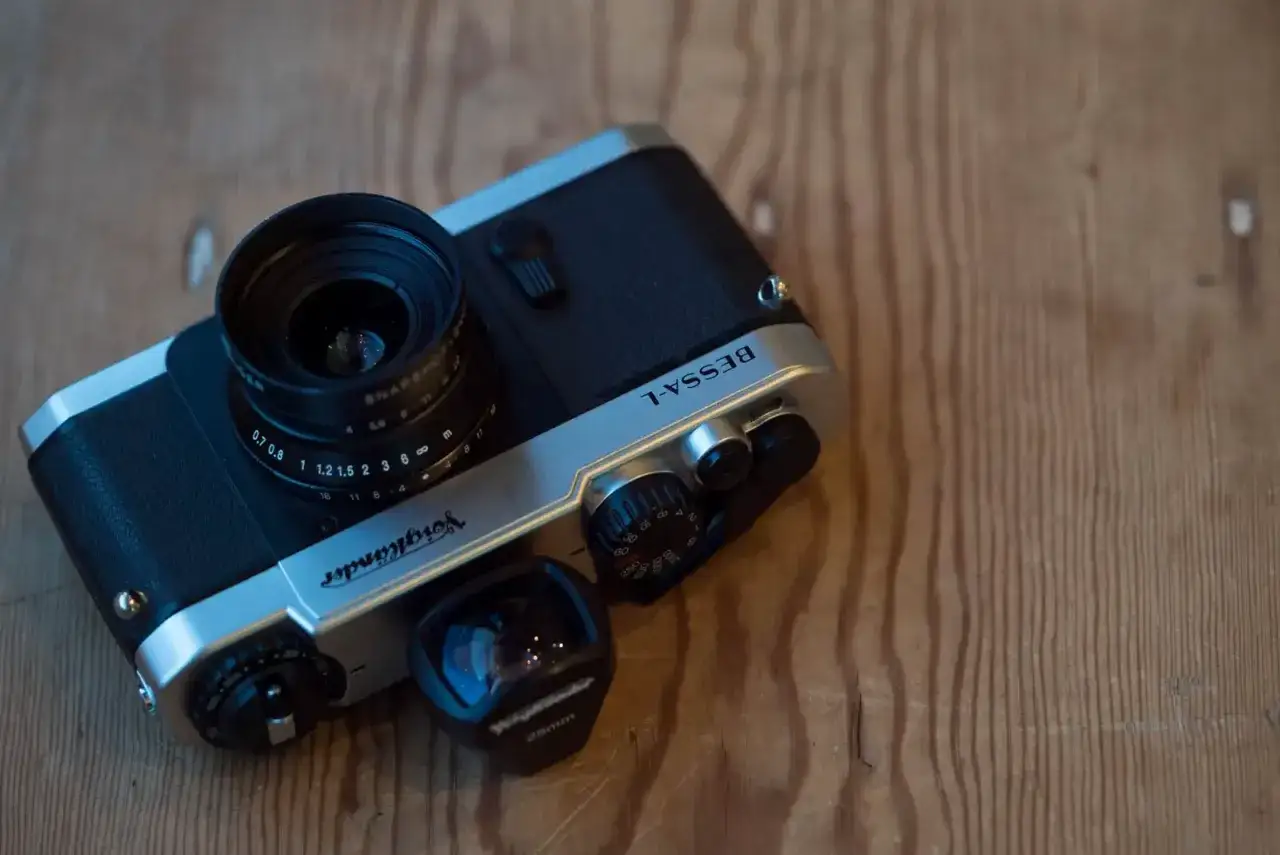
The Bessa L is an LTM camera, so it lives in the Leica screw-mount world. That is good news, because there is a long list of compatible lenses and plenty of adaptation options. The body was especially designed around ultra-wide and wide lenses, and that is still the sweet spot. If I were setting one up today, I would think in terms of focal length first and brand second.
The most natural combinations are 15mm, 21mm, 25mm, 28mm, and 35mm lenses. The wider you go, the more the camera behaves like a point-and-shoot with manual control. The longer you go, the more you feel the absence of a coupled rangefinder and a built-in frame finder. External viewfinders solve the composition problem, but they add cost and bulk, so the whole package can stop being as elegant as the body alone suggests.
- 15mm is the classic match: dramatic field of view, easy scale focusing, and a natural fit for the body’s design.
- 21mm and 25mm are the practical sweet spot for travel and documentary work.
- 28mm still works well, but I would want a good accessory finder for confident framing.
- 35mm is usable, yet the camera starts to feel less specialized and more like a workaround.
One detail that matters in real life: some lenses come with their own finder, and some do not. If you buy a body-only copy, check the cost of the lens plus finder before assuming you found a bargain. That leads naturally into how the camera meters and focuses once everything is mounted.
How to meter and focus without slowing down
The meter is one of the nicest parts of the camera because it keeps the shooting process efficient without turning the body into an electronic trap. It is a TTL, center-weighted meter, so it reads through the lens rather than through an external handheld meter. The exposure display uses LEDs, which is a practical fit for a camera that does not try to automate the whole experience. I like that balance: enough guidance to move quickly, but not so much automation that you stop thinking about light.
My basic workflow with a Bessa L would be this:
- Set the film speed on the dial, which runs from ISO 25 to 1600 in 1/3-step increments.
- Pull the advance lever into the ready position so the shutter is unlocked.
- Set a starting shutter speed, then lightly press the release to wake the meter.
- Adjust aperture or shutter speed until the LED indicates a correct exposure.
- Set distance on the lens scale and use the depth-of-field markings to keep the frame sharp where it matters.
For everyday shooting, I would lean on zone focus. At wider apertures, you can work quickly, but at f/8 or f/11 the lens becomes much more forgiving. That is especially useful in bright daylight, where the manual recommends shutter speeds in the 1/125 to 1/2000 range for common outdoor scenes. In low light, the meter still helps, but you are outside the camera’s comfort zone faster than you would be with a modern fully automatic body.
Two caveats matter here. First, the meter’s useful range is not endless; in very dim or very extreme bright conditions, you may need to rely on experience or a handheld meter. Second, the camera’s value comes from manual control, so if you want a body that does the thinking for you, this is the wrong tool. The reward for accepting that tradeoff is speed, reliability, and a shooting rhythm that feels calm rather than mechanical.
How it compares with a Bessa R or a classic Leica screw-mount body
When people compare this camera to other Bessa models, they are usually trying to answer one question: should I buy the stripped-down wide-angle body or move to something with a built-in rangefinder? I think that depends less on status and more on lens habits. If your default lens is 28mm or wider, the Bessa L has a strong case. If you keep reaching for a 50mm, it does not.
| Camera | What changes | Best for |
|---|---|---|
| Bessa L | No built-in rangefinder, scale focus, TTL meter | Wide-angle work, compact travel kit, deliberate zone focusing |
| Bessa R | Built-in rangefinder and viewfinder | General-purpose shooting, normal focal lengths, faster framing |
| Classic Leica screw-mount body | Older mechanical design, more vintage character | Collectors, classic handling, and a slower, more traditional workflow |
The important takeaway is that the Bessa L is not a cheaper version of a rangefinder body. It is a different tool with a narrower but very coherent purpose. If I wanted one camera to cover everything from 35mm to 50mm with minimal accessories, I would look elsewhere. If I wanted a small body that disappears behind a wide lens, this one starts to look smart very quickly.
What to check before buying one in 2026
The used market still moves these bodies, and in the U.S. I would expect a clean body-only example to fall roughly in the $100-200 range, with nicer kits rising much higher once a good lens and finder are included. That is still affordable by film-camera standards, but it is cheap enough that buyers sometimes focus on cosmetics and forget the parts that actually matter. I would do the opposite.
- Test the meter LEDs and make sure they respond consistently.
- Check the battery compartment for corrosion or a damaged door.
- Inspect the shutter curtains for pinholes, uneven travel, or obvious wear.
- Look at the advance lever and shutter lock action to make sure the body cycles cleanly.
- Examine the light seals and back door for cracks, leaks, or poor closure.
- Factor in the cost of a finder if the lens package does not include one.
- Check the lens for fungus, haze, and stiff focus, because the lens often matters more than the body.
There is also one listing trick I would watch for: sellers sometimes describe the camera as a rangefinder because that is what buyers expect to hear. It is better to be precise. If the listing does not clearly say scale focus, LTM mount, and no built-in finder, I would read it carefully before paying. That kind of clarity is what separates a good purchase from an impulsive one.
Who should choose this camera and who should skip it
The Bessa L is best for photographers who already know they like wide lenses and do not want a bulky body getting in the way. It is a strong fit for travel, landscape, architecture, and street work where speed comes from simplicity rather than automation. If that sounds like your style, the camera can feel almost ideal: light, mechanical, and honest about what it is.
I would skip it if you want a single do-everything film body, if you rely on 50mm or longer lenses, or if you need a built-in rangefinder for precise close work. In those cases, a Bessa R or another rangefinder body gives you more flexibility with less accessory juggling. The Bessa L is not the universal answer, and that is exactly why it remains interesting.
What makes it endure is the clarity of the design. It does one job well, it does not pretend to do the others, and it rewards photographers who enjoy that kind of discipline. If your idea of film photography includes careful lens choice, quick meter checks, and a wide-angle way of seeing, this little body still earns its place.