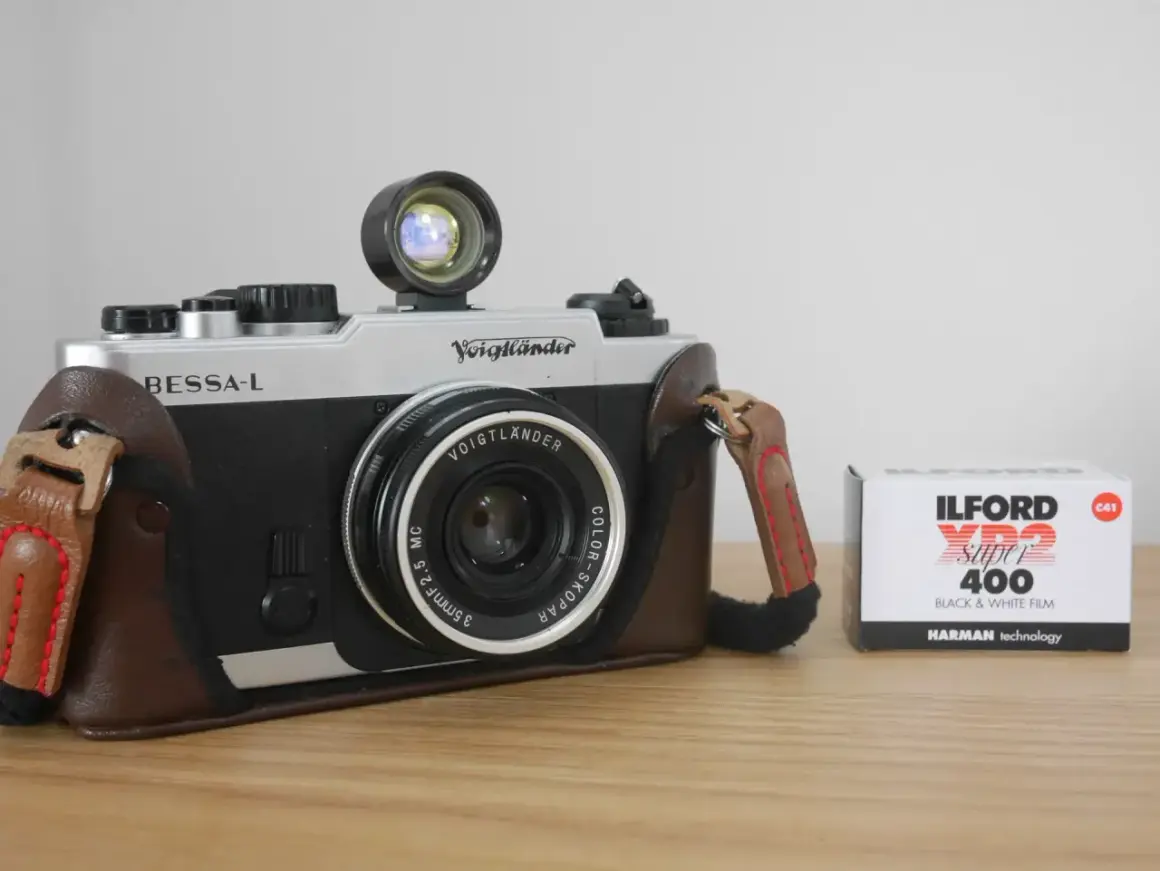
The Voigtlander Bessa line sits in a useful middle ground: it is practical enough for real film work, but specific enough that the wrong body can feel awkward fast. In this article, I break down what the line actually includes, which models fit different lenses and shooting styles, and what I would check before paying used-market prices in 2026.
The few things that matter most before you buy one
- The name covers more than one camera family, so the first job is to separate the older folding Bessas from the Cosina-made 35mm rangefinders.
- For 35mm shooters, the biggest decision is finder geometry: 0.7x, 1:1, or the ultra-wide 0.52x view on the R4 bodies.
- M means mechanical shutter and A means aperture-priority automation, not mount type.
- Mechanical bodies can still shoot without batteries; the battery usually powers only the meter.
- The Bessa line makes the most sense when you already know what focal lengths you actually use.
- In the U.S. used market, condition matters more than cosmetics, and service history matters more than a clean listing photo.
Why the name covers more than one camera
There are three different Bessa stories, and mixing them up is the fastest way to make a bad buying decision. The earliest Bessas were Voigtländer folding medium-format cameras from the late 1920s and 1930s; much later, Cosina revived the name for a separate family of 35mm film rangefinders, and that is what most photographers mean today. There was also the medium-format Bessa III, which is a different beast again: a folding 6x6/6x7 camera that is interesting, rare, and not the same shopping problem as the 35mm bodies.
That matters because the older folders, the Bessa III, and the Cosina 35mm bodies solve different problems. If you want a compact rangefinder for everyday 35mm film, you are almost certainly looking at the Cosina era cameras. If you want a collector piece or a medium-format folder, you are in another category entirely. I would keep that distinction in mind before comparing prices, because the used market can make two cameras with the same name look related when they are not.The practical takeaway is simple: decide first whether you want 35mm, medium format, or a folding rangefinder, and only then compare individual bodies. Once that is clear, the model differences become much easier to read.
Which body fits which kind of shooting
The easiest way to understand these cameras is to match the body to the lens and the way you work. I would not start with the badge or the reputation; I would start with the focal length I shoot most often.
| Model family | Mount | Finder setup | Power and shutter | Best fit |
|---|---|---|---|---|
| Bessa L | Leica screw mount (L39/M39) | No built-in rangefinder or conventional viewfinder | TTL meter; scale-focus workflow | Ultra-wide lenses, zone focus, the lightest possible setup |
| Bessa T | Leica M mount | Rangefinder only, no combined viewfinder | Manual operation with external framing | Deliberate shooting, people who already own M lenses and do not mind an external finder |
| Bessa R / R2 | L39 on the original R, M mount on the R2 | Combined rangefinder-viewfinder | Manual exposure; mechanical operation on the later style bodies | All-round 35mm rangefinder use |
| Bessa R2S / R2C | Nikon S or Contax RF | Combined finder | Manual exposure | Collectors and users with existing Nikon or Contax rangefinder lenses |
| Bessa R2A / R3A / R4A | Leica M mount | Combined finder, with finder geometry matched to the model | Aperture-priority; electronic shutter; battery required | People who want automation and do not mind relying on batteries |
| Bessa R2M / R3M / R4M | Leica M mount | Combined finder, with finder geometry matched to the model | Manual exposure; mechanical shutter; meter uses batteries only | Film shooters who want the safest long-term option |
Rule of thumb: R2 bodies are the balanced choice, R3 bodies are the 40mm and 50mm sweet spot, and R4 bodies are the wide-angle specialists. The letter after the number changes the shooting experience more than the badge on the top plate.
If I were buying my first one, I would choose the finder first and the mount second. That leads directly to the bigger question: why do people still keep returning to these cameras when newer gear exists?
Why photographers still keep coming back to them
There are three reasons the Bessa bodies still hold attention. First, they are genuinely useful cameras rather than decorative objects. Second, they give you a real rangefinder experience without forcing you into the highest-price tier of classic 35mm gear. Third, the system has enough variation that you can pick a body around your lens habit instead of making yourself adapt to a single compromise.
- Finder choice is the real advantage. The R2 family is comfortable for general use, the R3 family is almost made for 40mm work, and the R4 family is one of the few ways to get native 21mm and 25mm framelines in a film rangefinder.
- The lens ecosystem is unusually strong. L39 and M-mount versions can use a deep pool of legacy glass and modern Voigtländer lenses, so the body does not trap you in a narrow system.
- The mechanical bodies stay usable. On the M models, dead batteries usually mean no meter, not a dead camera. That is a meaningful difference if you actually shoot film in the field.
- The tradeoffs are real. These cameras feel lighter and less overbuilt than a classic Leica, and the shutter is not whisper-quiet. I would call that a handling compromise, not a fatal flaw.
The part many buyers underestimate is that the camera only feels “right” when the finder matches the lens you actually use. A 1:1 finder is wonderful if you live around 40mm or 50mm, but it is not automatically better than a lower-magnification body. The next section is where that becomes practical rather than theoretical.
What I would inspect before paying used-market prices
These are discontinued film cameras, so buying condition is more important than buying hype. In the U.S. used market, I would expect common bodies to range roughly from the high hundreds into the low thousands depending on model, condition, box, and lens kit; special editions and mint black-paint examples can climb above that. A clean listing is nice, but a functioning shutter, a bright rangefinder, and a sane asking price matter more.
- Check the rangefinder patch. It should be bright enough to focus quickly and line up accurately at infinity and at close distance.
- Test the shutter at multiple speeds. I listen for consistency, not just whether it fires once. If the slow speeds drag or the fastest settings sound wrong, I walk away unless the price is clearly discounted.
- Verify the meter. On A models, the camera depends on electronics much more heavily. If the meter behaves erratically or the body is battery-sensitive, I treat that as a real risk.
- Inspect the finder glass and framelines. Haze, grime, or dim framelines are not cosmetic problems if you plan to use the camera often.
- Advance and rewind the film path. The lever should feel smooth, and the take-up should not bind. Film cameras age in the transport system as much as in the shutter.
- Budget for service. If the seller cannot explain the last CLA, I would mentally add another $150 to $300 for maintenance on a mechanical body, and I would be even more cautious with electronic models.
For the niche bodies, the inspection gets more specific. On the Bessa L, I would make sure you understand that it is a scale-focus camera built for wide lenses, not a conventional combined finder. On the T, I would confirm that the external finder solution is included or easy to source. On the R2S and R2C, I would check that the mount really matches the lenses you own, because that is the whole reason to buy them. That leads into how I would actually use the camera once it is in hand.
How to get the best results from the body you choose
Most disappointment with these cameras comes from mismatched expectations. The Bessa line is not difficult to use, but it is unforgiving if you choose the wrong body for the job. If I were setting one up today, I would match the model to the lens family first.
- 21mm to 28mm belongs on an R4 body. That finder is the reason the R4 exists, and it is still the clearest argument for the entire line.
- 35mm to 40mm is where the R2 and R3 bodies become interesting. I like the R3 if you live around 40mm or 50mm, because the 1:1 finder feels natural and fast.
- 50mm works on several bodies, but I would pick the one whose framing style feels least fussy to you. A lot of people assume 50mm means “safe choice”; in practice, it means “choose the finder you can live with for hours.”
- 75mm and 90mm are more comfortable on the R2-style finders than on the ultra-wide R4. If you shoot portraits or tighter documentary frames, that matters more than brand loyalty.
I also think it helps to treat the meter as guidance, not gospel. The built-in meter is useful, but high-contrast scenes, backlight, and reflective surfaces still fool any in-camera meter. If you are using one of the mechanical bodies, keep the workflow simple: set aperture, confirm the meter, shoot, and adjust when the light changes. If you are using an A body, aperture-priority can be a real advantage for street or travel work, but only if you are comfortable replacing batteries and accepting the extra electronics dependency.
There is one more habit I recommend: do not ignore close focus and parallax. Rangefinders are wonderful, but they are not a blank check for near-distance framing. Once you get close to a subject, I slow down, re-check focus, and accept that the finished frame may sit a little differently than it looked in the finder. That small discipline saves more negatives than any lens upgrade.
What I would buy in 2026 and why
- If I wanted one safe all-rounder, I would start with an R2M or R2A.
- If I shot mostly 40mm or 50mm, I would lean toward an R3M or R3A.
- If my work lived in 21mm to 28mm, I would go straight to an R4M or R4A.
- If I already owned Nikon S or Contax RF lenses, I would look at the R2S or R2C before anything else.
- If I wanted the cheapest route into wide-angle rangefinder shooting, I would consider the Bessa L, but only if I was comfortable with scale focusing.
My practical advice is to buy the finder geometry you will actually enjoy using, then pay for condition rather than cosmetics. The Bessa bodies reward photographers who know their focal lengths, care about compact gear, and want a film camera that still feels fast in the hand. If that is your use case, this is still one of the smartest rangefinder families to shop for in 2026.