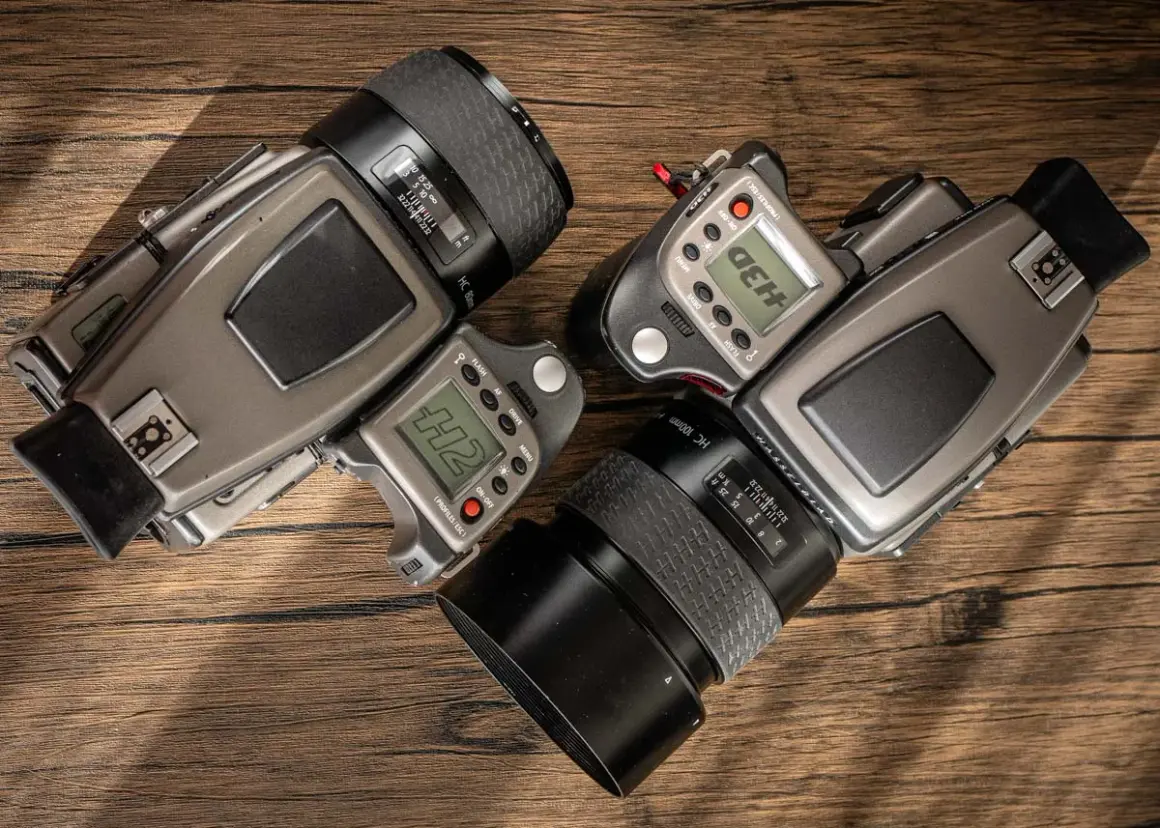
The Hasselblad H2 sits in a narrow but still interesting corner of medium-format photography: a modular 6x4.5 SLR that can work with film magazines or digital backs, depending on the kit. In this article I cover what the system actually is, how it feels in the hand, what kind of image quality it delivers, and what to check before buying one used. That matters because the H2 rewards the right photographer, but it can become an expensive mistake if you buy the wrong version or assume it behaves like a modern mirrorless body.
Key takeaways before you decide
- The H2 is a modular medium-format SLR built around HC lenses, a 90-degree finder, and a pro-oriented grip layout.
- Its biggest advantage is leaf-shutter flash sync at every shutter speed, which makes it unusually strong for portrait and studio work.
- A complete kit is heavy. With an 80mm lens, battery, and card, the system weighs about 2,175 g and measures 153 x 131 x 213 mm.
- Used pricing in 2026 varies sharply with condition and accessories, so the body alone is rarely the whole story.
- The safest buy is the most complete, recently serviced kit you can afford, not the cheapest body on the page.
What the H2 actually is
This is a working system, not a one-piece camera in the modern sense. You get an autofocus body, Hasselblad HC lenses with built-in leaf shutters, a 90-degree reflex finder, and a platform that can be configured for film or digital capture. The image area is 6 x 4.5 cm, with the system designed around a larger frame than 35mm so that framing, tonality, and subject separation all feel different.
| Core trait | Why it matters in practice |
|---|---|
| Interchangeable capture setup | The same body can be used with film magazines or the right digital back, which keeps the system flexible but adds compatibility checks. |
| HC lenses with leaf shutters | Flash sync at all speeds up to 1/800 s is a real advantage for studio portraits and daylight fill flash. |
| Autofocus with instant manual override | Faster and more practical than many older medium-format bodies, yet still slower than current mirrorless systems. |
| 100% viewfinder coverage | Framing is accurate, which helps when you are composing carefully on a tripod or in a controlled setup. |
| Modular design | You can build a kit around film, digital, or both, but the modularity also means more parts to inspect and maintain. |
That architecture is the reason the camera still has a following: it gives you a serious medium-format tool without locking you into a single capture path. The tradeoff is obvious, though. Flexibility comes with more weight, more contacts, and more things to verify before you spend money, which leads straight into how the camera actually behaves in the field.
How it handles in real shooting
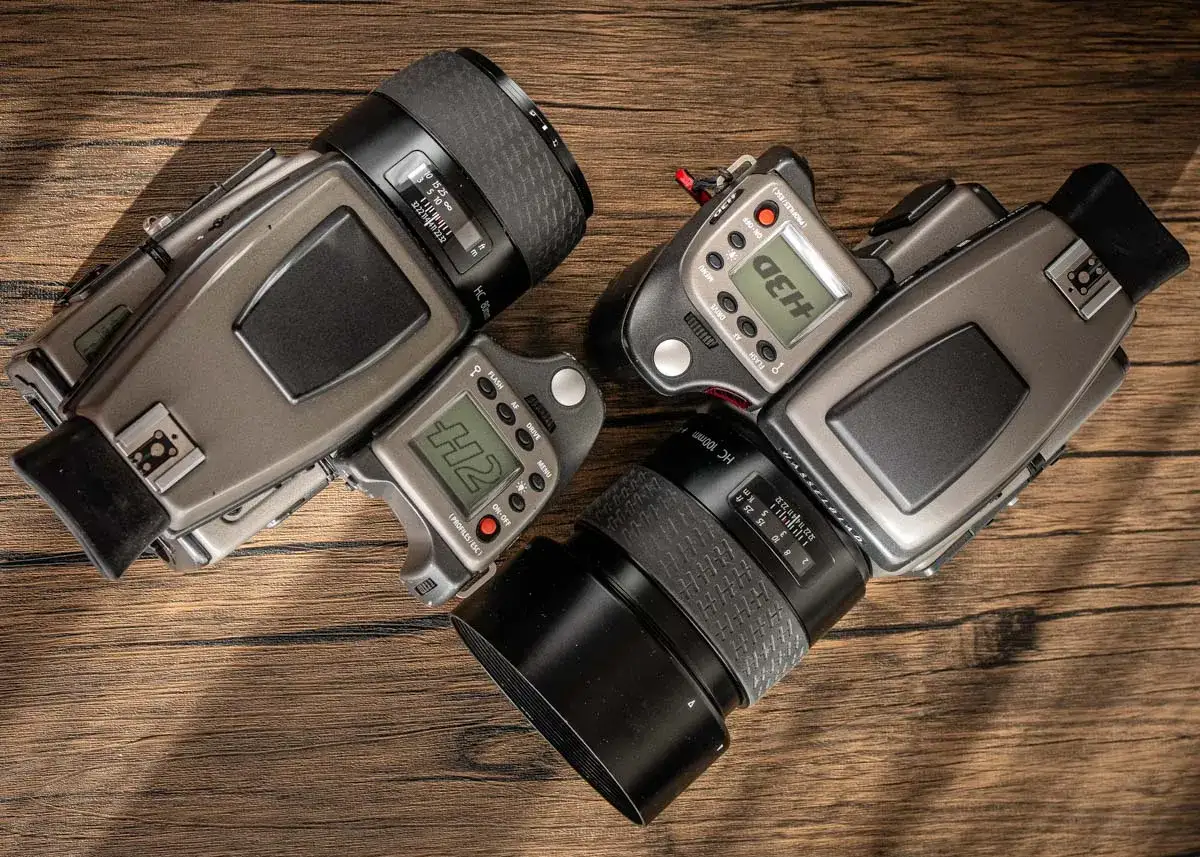
With an 80mm lens, battery, and CF card installed, the complete camera weighs about 2,175 g, or 4 lb 12 oz. That is not a carry-it-all-day body, and I would not pretend otherwise. What you get instead is a camera that feels planted and deliberate, with controls that make sense once you stop expecting a small digital body to do the same job.
- For portraits, the balance is good and the leaf shutter keeps flash work simple.
- For studio still life, the weight is an advantage because the camera settles quickly on a tripod.
- For travel, events, or fast handheld work, the system feels slower and more demanding than it looks on paper.
The handling story is really about pace. The H2 encourages you to focus, meter, and commit, which is great when the assignment rewards precision. It is less appealing when you need to move fast, change direction constantly, or forget the gear and just shoot. Once that tradeoff is clear, the next question is whether the camera’s output justifies the physical burden.
Where the image quality still stands out
The H2’s value is not nostalgia. It is the combination of a larger capture area, the rendering of HC lenses, and a shutter system that gives you unusually broad control over flash and ambient light. In practical terms, that means smoother transitions, more room in the frame, and a look that many photographers still prefer for portraits, fashion, landscapes, and controlled commercial work.
| Strength | What it gives you | Main limitation |
|---|---|---|
| Leaf-shutter flash sync | Cleaner daylight fill and more freedom with strobes in bright conditions | The lens ecosystem is expensive, and every lens should be checked carefully |
| Medium-format rendering | A different sense of scale, depth, and tonal separation than 35mm | Focus and support matter more, especially with shallow depth of field |
| Modular workflow | Film and digital flexibility in one platform | More points of failure than a sealed, fixed-body camera |
I would be careful not to oversell resolution as the whole story. Medium format only pays off when the lighting, focus, and lens choice are doing their part. The H2 is at its best when you use it as a precise tool, not as a magic shortcut. That is also why buying used requires more discipline than buying something newer and simpler.
What to check before buying one used
In the U.S. used market, recent listings I’ve seen put body-only examples roughly around $320 to $490, a body with a finder near $1,195, and complete kits much higher once a lens or digital back is included. I treat those numbers as a working range, not a fixed price, because condition and accessories change the value fast. On a camera like this, a cheap listing can turn expensive quickly if the shutter, power system, or back interface is tired.
| What to inspect | Why it matters | Red flags |
|---|---|---|
| HC lens shutter action | Every exposure depends on the leaf shutter behaving consistently | Sticky blades, uneven timing, or inconsistent firing |
| Autofocus and manual override | The body should lock focus and let you correct it without fighting the mechanism | Hunting, dead focus confirmation, or a gritty focus ring |
| Battery grip and contacts | Power and communication are central to the camera’s operation | Corrosion, loose terminals, or swollen batteries |
| Finder display and optics | The viewfinder is part of the control system, not just a window | Dim LCD, cracked optics, or unreadable information display |
| Magazine or digital back interface | The body can look fine while the back connection is unreliable | Error messages, intermittent recognition, or worn contacts |
| Service history | Older pro gear rewards documented maintenance | “Untested,” missing service records, or vague seller answers |
If the kit includes a digital back, I would verify the exact body-back combination before paying. Compatibility is the kind of detail that can ruin a bargain, especially when the seller is selling a mixed lot and assumes “H system” is enough detail. At this age, the best buy is usually the one with fewer surprises and better documentation, which is why the next question is really about fit, not just price.
Who should choose it and what to budget for first
I would recommend the H2 to photographers who work deliberately: portrait shooters, studio artists, still-life photographers, and film users who want a modular 645 body with real system depth. If you need fast autofocus, light weight, or a camera that disappears in travel work, this is the wrong tool. It is not a universal answer, and that is part of its appeal.
| Best fit | Why it works | Main tradeoff |
|---|---|---|
| Portrait sessions | Leaf-shutter flash sync and a larger-format look are excellent for controlled subject work | Weight becomes tiring during long handheld sessions |
| Studio still life | Tripod use, precise framing, and modular backs make the workflow efficient | Setup is slower than with a modern fixed-body camera |
| Landscape on a tripod | Deliberate pace and strong lens rendering suit careful compositions | Less convenient for hiking and changing conditions |
| Travel and events | Only if you specifically want the system experience | Bulk, battery dependence, and slower operation |
- Budget first for a working HC lens, because the shutter and optics matter more than cosmetic condition on the body.
- Make sure the battery solution is complete and healthy, because a weak power setup makes the whole system frustrating.
- Prefer a kit with the finder and one proven lens over a bare body that looks cheap on the listing page.
- Reserve money for service or replacement parts, because age and use are part of the real ownership cost.
The cleanest way to approach this camera is to treat it as a specialized tool with a clear job, not as a trophy buy. If your work benefits from medium-format rendering, controlled lighting, and a system that still feels serious in the hand, the H2 can remain a very satisfying choice. If you want convenience first, look elsewhere and save yourself the friction.