The smallest full-frame DSLR is a narrower question than it looks. Body dimensions, weight, and the lens you mount all change the answer, and that matters if you want a camera that feels genuinely portable instead of just smaller on a spec sheet. In 2026, this is mostly a used-market decision, so I’m separating the true size winner from the body that is easiest to live with.
Key takeaways before you buy
- By raw body dimensions, the Nikon Df is the smallest full-frame DSLR I would put at the top of the list.
- The Canon EOS 6D is the lighter, more commonly recommended compact full-frame Canon body.
- Newer full-frame DSLRs like the D780 and D850 are excellent, but they are not compact cameras.
- The lens matters almost as much as the body, and a big zoom can erase the size advantage fast.
- In 2026, buying one usually means shopping the used or refurbished market, so condition matters as much as spec sheet size.
What people usually mean by the smallest full-frame DSLR
When I compare compact full-frame DSLRs, I separate three things: raw shell size, carry weight, and kit size once a lens is attached. The first two are body questions; the third is the one that actually decides whether you will take the camera with you.
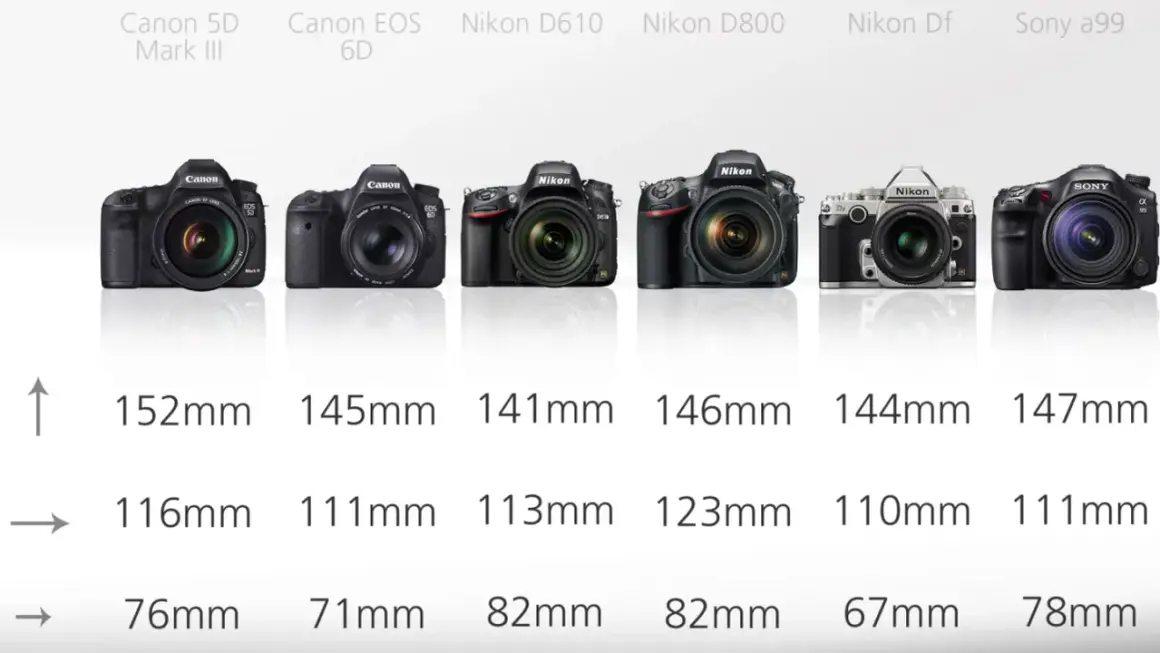
If you want one name, the Nikon Df is the body I would call the smallest by published dimensions. If you want the model most people still remember as the compact full-frame Canon, that is the EOS 6D. They are close enough that the difference only matters when you start caring about a few millimeters and a very real difference in how the camera sits in a bag.
The table below makes that easier to see, and it also shows why newer does not automatically mean smaller.
Once you see the numbers side by side, the pattern is clear: the Df wins on size, the original 6D stays close, and the 6D Mark II is already a little too deep to claim the compact crown. The D780 and D850 are excellent cameras, but they belong in a different conversation.
The bodies that belong in the comparison
| Camera | Published dimensions | What that means in practice |
|---|---|---|
| Nikon Df | 143.5 x 110 x 66.5 mm | Smallest shell in this comparison; the depth is where the size advantage really shows up. |
| Canon EOS 6D | 144.5 x 110.5 x 71.2 mm | Very close in height and width, but noticeably thicker. |
| Canon EOS 6D Mark II | 144.0 x 110.5 x 74.8 mm | Newer, but not a smaller body. |
| Nikon D780 | 143.5 x 115.5 x 76.0 mm | More modern feature set, but clearly not compact. |
| Nikon D850 | 146 x 124 x 78.5 mm | A pro body first, a small camera never. |
That is the part most buyers miss: the Df is not just compact in a vague marketing sense, it is actually smaller on paper than the Canon 6D. Canon’s body is still light enough to feel travel-friendly, though, which is why it keeps showing up in compact-camera discussions.
Why the Canon EOS 6D still matters
I still think the Canon EOS 6D earns its reputation because it trims weight without becoming awkward. Canon lists it at 680 g for the body only, and that lighter feel matters more than a spreadsheet suggests when you carry it all day.
It also sits in a sweet spot for people building an EF-lens kit. The camera is small enough to feel manageable, but it still gives you the familiar DSLR grip, viewfinder, and controls that many photographers prefer over the more recent mirrorless style. That makes it a strong choice if your real goal is a camera that disappears in a bag, not a camera that looks tiny on paper.
I would not call it the absolute size winner, but I would call it the easier compact full-frame DSLR to recommend to most buyers. The Nikon Df goes further on raw dimensions, which is where the comparison gets interesting.
One practical detail I like here is that the 6D’s handling stays conventional. It does not try to be clever, and that restraint is part of why so many photographers still like it for travel, family work, and casual content creation.
Why the Nikon Df is the stricter size winner
The Nikon Df is the body I would choose if absolute compactness is the priority. Nikon’s own positioning is telling here: it describes the Df as its thinnest and lightest FX-format body, and the published dimensions back that up at 143.5 x 110 x 66.5 mm.
What you give up is not size alone, but modern convenience. The Df is a deliberate, tactile camera with a retro control layout and an older 16.2 MP sensor. That is not a flaw if you value a classic shooting feel, but it is a real tradeoff if you want speed, video flexibility, or the newest autofocus behavior.
In other words, I see the Df as the answer for someone who wants the smallest body and enjoys the mechanical feel of the camera itself. If you want the same compactness with a more mainstream feature set, the 6D is the safer compromise.
The Df is also the body that reminds you how much of camera size is driven by design language. A deep grip, tall prism housing, and pronounced dials can make a camera feel substantial even when the numbers are modest, so the Df’s cleaner silhouette really does matter.
What usually ruins the compact-camera plan
The lens can erase the size advantage
This is where most compact-camera plans fall apart. Put a 24-70mm f/2.8 or a 70-200mm zoom on any full-frame DSLR and the body size stops mattering very much. A small body only stays small if the lens does too.
For a genuinely portable kit, I would look at compact primes first: Canon shooters often pair the 6D with the 40mm f/2.8 STM or 50mm f/1.8, while Nikon shooters can keep the Df feeling light with a 50mm f/1.8G or a small 35mm prime. That is where the real travel-friendly experience lives.
If you want to stay realistic, think in terms of the whole package: body, lens, strap, and bag. The camera body is what sells the idea, but the lens is what decides whether the idea survives day-to-day use.
Read Also: Olympus PEN-F Review - Still Worth It?
Used cameras need a slower checklist
Because these are older DSLR bodies, I would inspect them more carefully than I would a current mirrorless release. Check the shutter count, the rear screen, battery health, card-slot doors, rubber grips, and autofocus accuracy at both the center and edge points.
A compact body is only a good buy if it is still reliable. A worn Df or 6D can become expensive quickly if the battery system, buttons, or main dial are already failing.
I also pay attention to how the camera has been stored. Moisture, sticky rubber, and faded displays are common on older bodies, and those are the kinds of problems that turn a good deal into an annoyance.
Once you think in terms of the complete kit and the condition of the used body, the buying decision becomes much clearer.
What I would buy in 2026 if portability is the priority
If I were buying today and size was the main constraint, I would rank the Nikon Df first for pure shell compactness, the Canon EOS 6D second for a lighter and easier everyday feel, and the Nikon D780 only if I needed newer autofocus and was willing to accept a bigger body. That is the honest tradeoff in 2026.
- Choose the Df if you want the smallest shell and like a tactile, old-school control layout.
- Choose the 6D if you want the most approachable compact full-frame DSLR and a lighter carry.
- Skip the D850 or D6 if your top priority is portability, because they are excellent cameras but not compact ones.
My practical rule is simple: if your goal is the smallest full-frame kit rather than only the smallest body, buy the compact camera you can tolerate ergonomically and then keep the lens modest. That choice matters more than chasing another few millimeters on the spec sheet, and it is also the point where a DSLR can still make sense in 2026 instead of just looking like a nostalgia play.