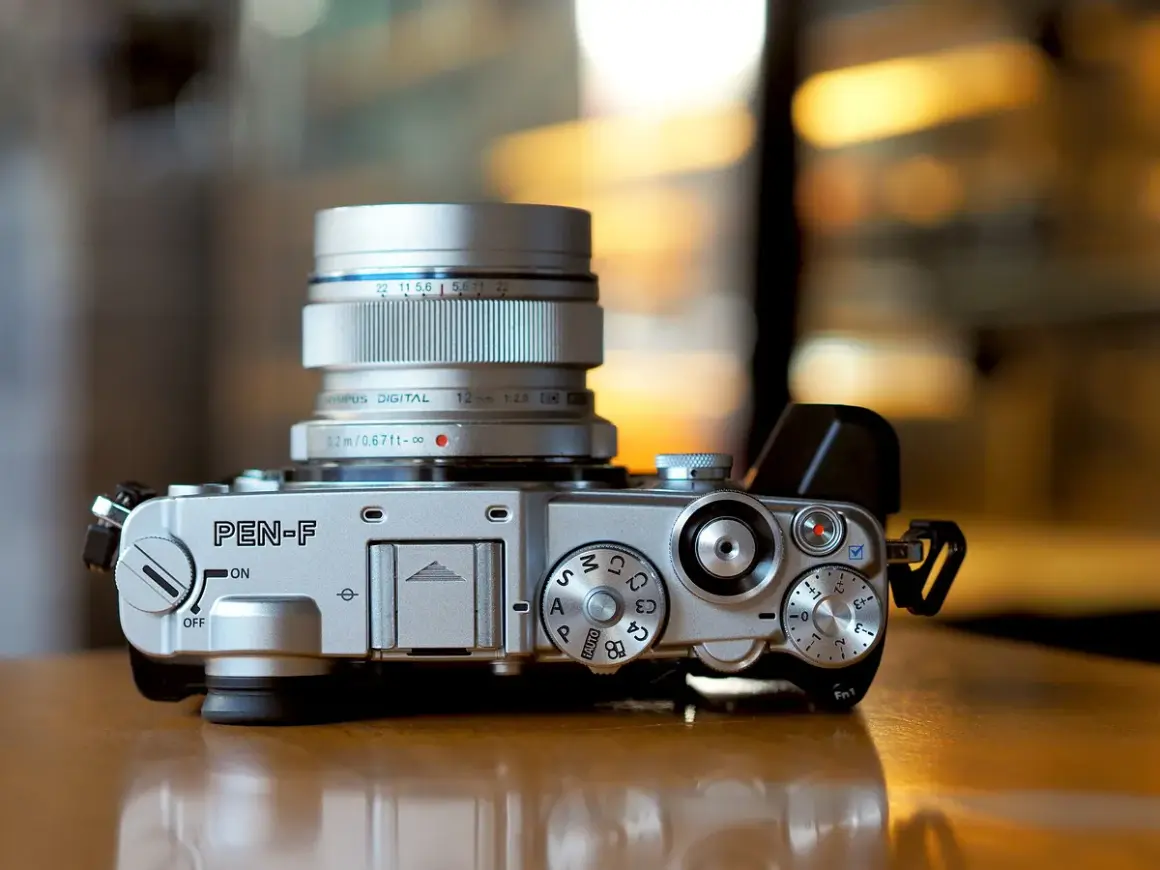
The PEN-F still rewards careful lens choices: its small body only feels right when the glass stays compact, balanced, and easy to use. When people talk about olympus pen f lenses, the real decision is not just sharpness; it is how the lens handles autofocus, how much it weighs, and whether you want native convenience or adapted character. In this guide I break down what fits the camera cleanly, which focal lengths make the most sense, and which filters actually earn a place in the bag.
What matters most when choosing PEN-F glass
- Native Micro Four Thirds lenses are the safest default because they keep full electronic communication and the cleanest handling.
- Four Thirds lenses work through an adapter, but autofocus is limited enough on PEN-F that I treat them as a special case rather than a first purchase.
- Legacy OM lenses mount through the MF-2 adapter and are fully manual, which is useful if you want character more than convenience.
- The most practical focal lengths are 17mm, 25mm, 45mm, and the 12-45mm zoom, because they cover the widest range of everyday shooting.
- For filters, a circular polarizer and a neutral density filter solve more real-world problems than a drawer full of clear filters.
What the PEN-F mounts without adapters
The compatibility table from OM SYSTEM makes the core rule simple: the PEN-F takes Micro Four Thirds lenses directly, and it also accepts Four Thirds and older OM glass through adapters. In practice, that means the safest purchase is still a native Micro Four Thirds lens, because autofocus, aperture control, and metadata all behave normally.| Mount or lens family | Adapter | What you gain | Main trade-off |
|---|---|---|---|
| Micro Four Thirds native | None | Full electronic communication, the cleanest autofocus behavior, and the most balanced handling | No meaningful downside if the focal length fits your use case |
| Four Thirds lenses | MMF-1, MMF-2, or MMF-3 | Access to older Olympus E-System glass, including some strong bargains on the used market | Autofocus is limited on PEN-F, and AF does not operate while shooting movies |
| OM manual lenses | MF-2 | Classic rendering, cheap used options, and a very deliberate shooting experience | Manual focus and manual aperture only |
| Body cap lenses | None | Extreme portability and a playful look in a body-cap form factor | More of a creative side note than a serious all-day lens choice |
If I were buying for the PEN-F with no existing lens stash, I would start with native glass every time. Once that baseline is clear, the more useful question becomes which focal lengths actually make the camera pleasant to carry and fast to shoot with.
The lenses I would prioritize first
I usually think about this camera in terms of balance rather than specs alone. A lens can be excellent on paper and still feel wrong if it makes the PEN-F front-heavy or too slow for casual use. Because Micro Four Thirds gives you roughly a 2x full-frame field of view equivalent, a 17mm behaves like a 34mm, a 25mm like a 50mm, and a 45mm like a 90mm. That is the frame of reference I use when choosing lenses for real work.
| Lens | Approx. 35mm equivalent | Best for | Filter diameter | Why it stands out |
|---|---|---|---|---|
| M.Zuiko 17mm F1.8 II | 34mm | Street, travel, environmental portraits | 46mm | Small, quick, and wide enough to tell a story without looking exaggerated |
| M.Zuiko 25mm F1.8 II | 50mm | Everyday shooting, documentary, food, product work | 46mm | This is the easiest “normal lens” choice for the PEN-F; it keeps the body feeling compact |
| M.Zuiko 45mm F1.8 | 90mm | Portraits and tighter subject isolation | 37mm | Light, affordable, and still one of the cleanest ways to get flattering separation on this system |
| M.Zuiko 12-45mm F4 PRO | 24-90mm | Travel, family use, daylight general-purpose shooting | 58mm | Probably the smartest zoom if you want one lens to do most things without making the camera bulky |
| M.Zuiko 12-40mm F2.8 PRO II | 24-80mm | Lower light, events, a more serious zoom feel | 62mm | It is the faster workhorse, but it is also the first lens here that starts to overpower the PEN-F visually |
| M.Zuiko 60mm F2.8 Macro | 120mm | Macro, close-up detail, product stills | 46mm | One of the best ways to turn the PEN-F into a detail camera without adding much weight |
| M.Zuiko 75-300mm F4.8-6.7 II | 150-600mm | Wildlife, sports, compressed landscapes | 58mm | Long reach in a relatively modest package, but it is clearly a specialized lens rather than a daily companion |
If product work matters, I would also keep the 30mm F3.5 Macro in view. It gives a 60mm-equivalent angle of view, a 1.25x maximum magnification, and a 46mm filter thread, which makes it an efficient close-up lens for tabletop shots, packaging details, and small objects.
The body cap options deserve a mention too. The BCL-0980 fisheye and BCL-1580 body cap lens are fun, tiny, and undeniably specific, but I would only buy them if I wanted the smallest possible kit or a deliberately playful look. For serious everyday use, they sit outside the main decision tree.
For most people, the shortest path to a satisfying PEN-F setup is simple: 25mm F1.8 II for one-lens work, 17mm F1.8 II for travel and street, and 45mm F1.8 for portraits. If you want a zoom instead of primes, the 12-45mm F4 PRO is the cleanest compromise.
When adapters are worth it and when they are not
Adapters are where PEN-F owners can either save money or create friction. The right adapter makes sense when you already own the lens or you want a very specific rendering; it is a poor shortcut when you are simply trying to avoid buying the right native glass.
| Adapter path | Best use case | What stays the same | What changes |
|---|---|---|---|
| Four Thirds lens + MMF-1/2/3 | Reusing older Olympus E-System lenses you already own | Focal length and aperture values do not change | Autofocus is limited on PEN-F, C-AF and C-AF+TR are not selectable, and AF is not available while shooting movies |
| OM manual lens + MF-2 | Vintage rendering, low-cost experimentation, deliberate manual shooting | Nothing electronic is required for the lens to work | Focus and aperture are manual, so speed depends on your patience and technique |
| Native Micro Four Thirds lens | Most photographers, most of the time | Full camera-lens communication and the least hassle | Almost nothing, which is exactly why it is the default I trust |
I would not buy a Four Thirds adapter just to avoid buying a native lens. If a specific lens is excellent and you already have it, the adapter can be worth it. If not, the autofocus compromises on PEN-F are enough to make the whole setup feel less modern than it should.
Legacy OM lenses are a different story. Those make sense when you want a manual-focus workflow and a distinct rendering style, not when you want a quick walk-around camera. The PEN-F can absolutely support that kind of shooting, but it rewards intention, not improvisation.
Once adapters are out of the way, filters become the part of the kit that either feels smart or starts to get messy.
How to choose filters that actually help
The PEN-F already has creative in-camera looks, but those are not the same thing as physical filters. I treat Art Filters as a stylistic layer and optical filters as tools for exposure control, reflection management, and light shaping. If a filter does not solve a real problem, I leave it out of the bag.
| Filter type | Best use | Practical note |
|---|---|---|
| Circular polarizer | Blue skies, water, glass, foliage, car paint, shop windows | Probably the single most useful filter for daylight work, especially with the 17mm, 25mm, and 12-45mm |
| ND 3-6 stop | Daylight portraits, slower shutter speeds, video control | This is the best general-purpose neutral density range if you only buy one dark filter |
| ND 8-10 stop | Long exposures, clouds, water blur, city scenes | More specialized, but worth it if you like dramatic motion rendering |
| Diffusion 1/8 or 1/4 | Portraits and highlight bloom | Subtle strengths are usually enough; strong diffusion gets gimmicky fast |
| Clear or protective filter | Dust, beach spray, drizzle, rough travel days | I still prefer a hood first, then a filter only when the shooting environment justifies it |
The filter sizes that come up most often on the lenses above are 37mm, 46mm, 58mm, and 62mm. That matters because a shared filter strategy can save real money. If you own several 46mm lenses, a 46mm CPL and 46mm ND pair make sense. If your main zoom is the 12-45mm or you expect to use the 75-300mm often, building around 58mm can be smarter. I would not make the whole kit depend on 62mm unless the 12-40mm F2.8 PRO II is truly your main lens.
I also avoid stacking thick filters on wide-angle glass unless I have no choice. That is where vignetting and edge softness show up first, and it is an easy way to make an otherwise excellent lens look sloppy. If you want to share filters across lenses, step-up rings are usually the cleaner move.
With the lens and filter basics sorted, the last decision is not technical anymore. It is about which kit stays small enough that you actually want to carry it.
The PEN-F kits I would build around real shooting needs
If I were buying for this body today, I would think in kits rather than loose lenses. The whole point of the PEN-F is that it encourages use, and a kit that stays compact will get used far more often than a perfect but oversized collection.
- Minimal everyday kit - 25mm F1.8 II plus a 46mm circular polarizer. This is the easiest way to get a true normal lens that still keeps the camera small.
- Street and travel kit - 17mm F1.8 II plus 45mm F1.8. That pairing gives you a practical wide view and a tight portrait view without overcomplicating the bag.
- Balanced travel zoom kit - 12-45mm F4 PRO plus a 58mm CPL and a 58mm 6-stop ND. This is the most efficient do-everything setup if you prefer one lens over changing primes.
- Portrait and detail kit - 45mm F1.8 plus 60mm F2.8 Macro, or the 30mm F3.5 Macro if you want a smaller close-up lens. This is the setup I would use for people, products, and tabletop work.
- Reach kit - 75-300mm F4.8-6.7 II for wildlife or compressed landscapes. Useful when you need distance, but not the first lens I would buy for the PEN-F.
If I had to start from zero, I would buy the 25mm F1.8 II first, then the 12-45mm F4 PRO, then add either the 45mm F1.8 or the 60mm Macro depending on what I shoot most. That order keeps the PEN-F true to itself: compact, quick, and expressive, without turning it into a bag full of compromises.