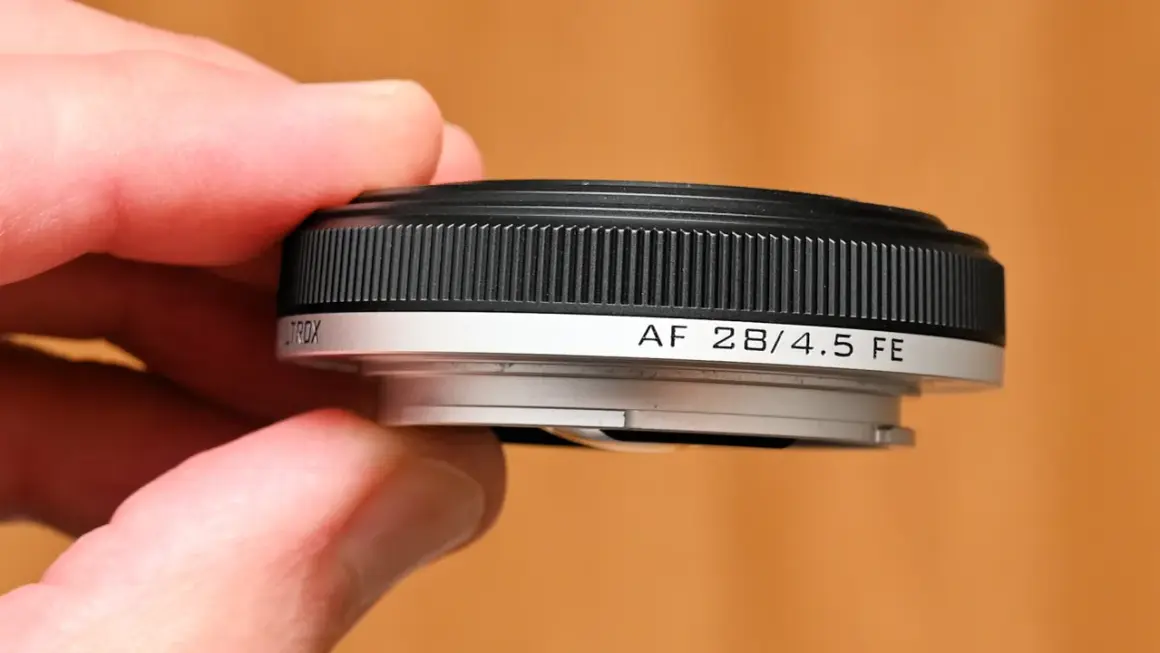
Camera size changes how often you carry it, how quickly you shoot, and how natural the setup feels in public. A pancake lens can change all three at once, which is why this format keeps showing up in travel, street, and everyday kits. In this article I break down what makes it different, where it is genuinely useful, what it gives up, and how filters and camera choice affect the final result.
The main takeaways before you choose one
- The biggest advantage is not just weight; it is a smaller, more portable camera that gets used more often.
- Most examples are fixed-focal-length primes, but a few compact zooms exist and behave a little differently.
- Expect a tradeoff: smaller size usually means a slower maximum aperture, less subject separation, or fewer extra features.
- Current examples sit roughly around 84g to 120g, with barrel lengths close to 23mm to 25mm on prime models.
- Small filter threads such as 37mm, 39mm, or 55mm can make filter use easier and cheaper, but slim rings matter on wide angles.
What a pancake lens actually changes on the camera
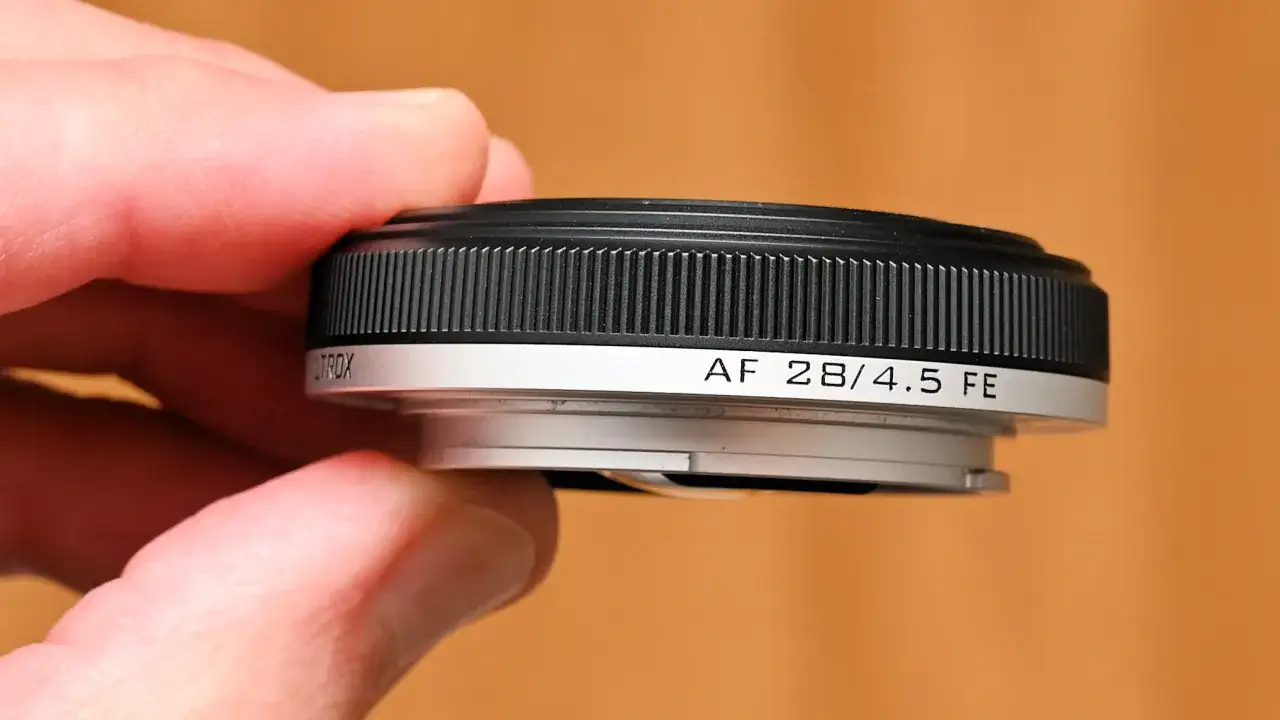
Physically, the design is simple: short barrel, thin profile, and a body that stays close to the camera mount. That compact shape matters because it changes balance as much as size. On a mirrorless body, I notice the camera feels less front-heavy, slips into a smaller bag, and looks less like a tool built to announce itself.
Most examples are primes, meaning they use one focal length rather than zooming. A few compact zooms fit the same spirit, but the mechanical trick is different and usually comes with a slower aperture. In practice, the format is less about a single optical formula and more about a design goal: keep the lens short enough that the camera becomes easier to carry, easier to hold, and easier to use casually.
That also explains why this category often sits around normal or slightly wide views on the sensor. A 27mm lens on APS-C behaves like a 41mm equivalent field of view, which is close to a natural perspective; a 28mm full-frame lens gives a wider but still usable everyday angle. Once you understand that relationship, the real question becomes where the format pays off in real shooting.
Where the slim format really earns its keep
I reach for this kind of lens when I want the camera to disappear into the day instead of dominating it. That is why it works so well for street photography, travel, backstage coverage, BTS content, and casual brand work where people relax faster when the camera looks small and approachable.- Street and documentary work because the camera is less intimidating and easier to keep ready.
- Travel because shaving even 100 g from the lens changes whether you bring the camera all day.
- Social and marketing content because a discreet setup is easier to use in offices, cafes, events, and product shoots.
- Everyday carry because a camera that stays assembled gets used more often than one that feels like a bag of parts.
The advantage is not only physical. A smaller lens changes behavior: you take the camera out sooner, you keep it on your shoulder longer, and you spend less time negotiating with your own gear. That matters more than people admit, especially when a project depends on fast, real-world coverage rather than carefully staged setups.
The tradeoffs that matter more than the spec sheet
The main trap is assuming that small automatically means better. I do not think of these lenses as budget miracles or miniaturized versions of bigger optics; I think of them as a different contract with the camera. You trade some speed and flexibility for portability, and the balance only works if you actually value that trade.
| Lens type | Representative example | What it gives you | What you give up |
|---|---|---|---|
| Ultralight prime | 27mm, 41mm-equivalent view, 84g, 23mm long, 39mm filter thread | Very small carry size, easy everyday use, natural perspective | Only f/2.8, limited reach, less blur than a faster prime |
| Full-frame compact prime | 28mm, 120g, 24.7mm long, 55mm filter thread, 23cm close focus | Simple walkaround lens with a classic wide view and quick handling | No optical stabilization, no weather resistance, modest background separation |
| Compact zoom | 14-42mm, 28-84mm-equivalent range, 93g, 22.5mm long, 37mm filter thread | Framing flexibility in one small package, useful for travel and video | Variable f/3.5-5.6 aperture, less low-light headroom, less subject isolation |
The biggest technical compromise is usually aperture. A lens that tops out at f/2.8 already gives up two stops of light to an f/1.4 prime, and a small zoom at f/5.6 gives up another two stops relative to f/2.8 at the long end. That affects shutter speed, ISO, and how much background blur you can create. I also check for stabilization and weather resistance, because small does not automatically mean protected or shake-free.
One practical note: if you want the subject to stand out, a compact lens can do it, but it will rarely do it as effortlessly as a fast 35mm or 50mm prime. A fast lens is one with a wider maximum aperture, which lets in more light and usually creates a shallower depth of field. That is not a flaw; it is the price of shaving bulk. The lens is strongest when speed of carry matters as much as speed of aperture.
How to choose one for your camera system
When I narrow the options, I look at four things before I look at sample images. First, sensor size changes the field of view, so I decide whether I want a normal perspective or a wider street-friendly look. Second, I check the aperture, because a compact lens that only opens to f/5.6 is a different tool from a compact f/2.8 prime. Third, I look at the filter thread, because 37mm, 39mm, and 55mm filters affect both cost and how much bulk I am adding. Fourth, I test the balance in my hand, since a tiny lens on a large body can feel less elegant than the spec sheet suggests.
- Choose 23mm to 28mm equivalent if you want one lens to do almost everything, especially for travel and everyday scenes.
- Choose a slightly wider option if you shoot interiors, behind-the-scenes video, or social content in tight spaces.
- Choose a faster aperture if you care about low light or cleaner subject separation more than absolute compactness.
- Choose a zoom only when flexibility beats simplicity, because many small zooms get slower as they extend.
I would not choose only by brand loyalty. I would choose the lens that makes the camera feel easy enough to grab on an ordinary Tuesday, because the best optic is useless if it stays in the bag.
How filters change the experience
Filters matter more on tiny lenses than people expect, mainly because the front element and barrel are so compact. On the examples I checked, filter threads sit at 37mm, 39mm, or 55mm, which is much smaller than the 67mm, 77mm, and 82mm rings common on larger zooms. That usually means lower filter cost, less weight, and a cleaner front-heavy feel.
For most shooters, I would think about filters in this order: polarizer, neutral density, then protection. A circular polarizer helps with reflections on glass and water, but it can be awkward on wider focal lengths if you push it too far. Neutral density is the one I care about most for video, because it lets you hold a workable shutter speed in daylight. A simple protection filter is optional in my view; if you already use a hood and carry the camera carefully, it can be more habit than necessity.
If you already own larger filters, a step-up ring can be a sensible move. It lets a smaller lens share one bigger filter set, but it also adds a little bulk and can partially defeat the whole point of going slim. In other words, the decision is not just optical; it is about whether you want a self-contained minimalist kit or a more modular one.
The lean kit I would build around it
If I were building a stripped-down but genuinely useful setup, I would pair the lens with a light body, a comfortable strap, one good memory card, and only the filters I actually use. That keeps the camera ready for short-form video, BTS clips, quiet street work, or quick client coverage without the overhead of a full production bag.
For stills, I would keep one faster prime in the bag if low light or portrait work matters. For video, I would prioritize a small ND and a compact hood before chasing more glass. The point is to keep the rig honest: compact enough that I do not hesitate, but capable enough that I do not feel under-equipped when the scene gets interesting.
The real advantage is simple: a small lens changes the probability that the camera comes with you, and that changes the quality of the images you end up making.