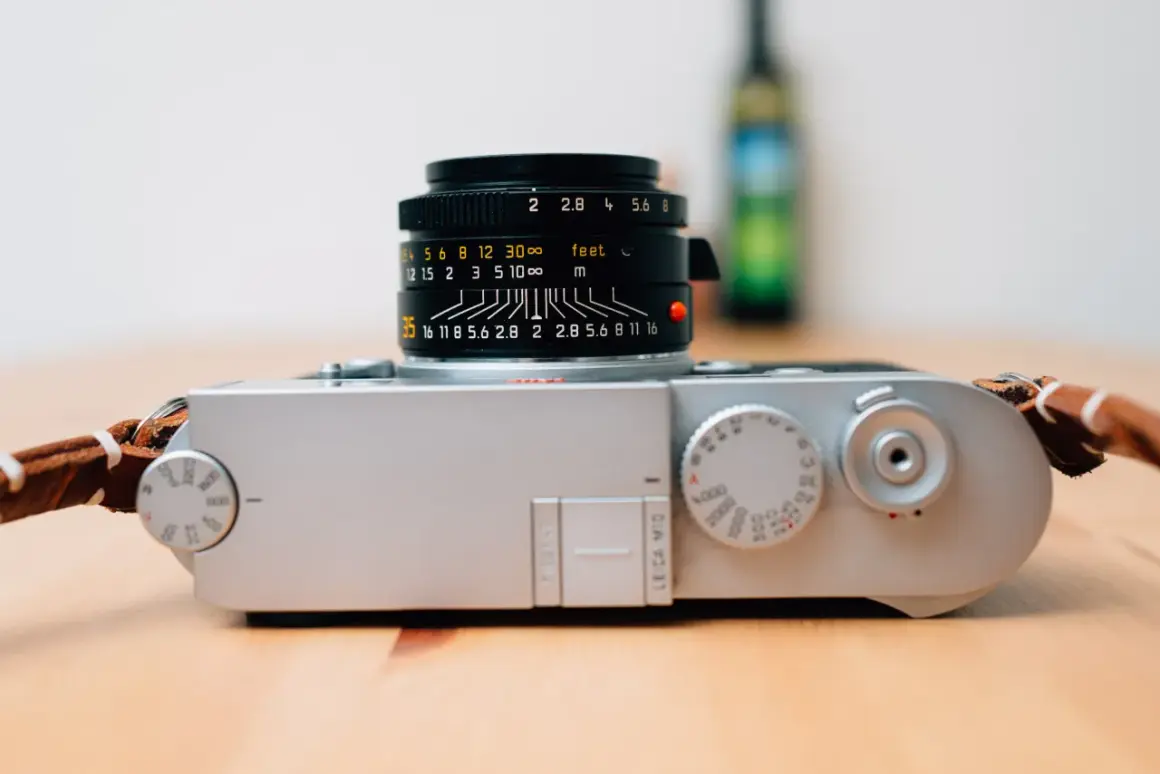
The essentials before you choose a lens
- Summicron means f/2.0, so the line favors portability and consistency over the size and cost of faster Leica glass.
- The most useful focal lengths are still 35 mm and 50 mm, with 28 mm when you need more context and 75 mm or 90 mm when you want tighter subject separation.
- Filter mounting is not standardized across the family: you will run into E39, E46-compatible accessories, E67, and older Series VII solutions.
- APO versions are the safer choice if you shoot high-resolution stills and want the lowest possible chromatic aberration.
- If video matters, an SL Summicron is usually easier to live with because autofocus and electronic aperture control are faster on set.
- On location, a good ND or polarizer often earns more value than a generic protective filter.
What the name actually tells you
I always start with the naming, because Leica’s lens families are not just marketing labels. Leica’s lens guide ties Summicron directly to f/2.0, and historically the term was used for the most popular M focal lengths: 28, 35, 50, 75, and 90 mm. That matters because the line was never meant to win the aperture race; it was meant to give photographers a lens that stays usable all day, behaves predictably, and still delivers a highly polished rendering wide open.
Compared with a Summilux, you trade a stop of speed for less weight, less bulk, and usually easier handling. Compared with a Noctilux, you trade dramatic background blur for focus reliability, portability, and a far more realistic workflow. In practice, that makes the Summicron idea appealing to anyone who values precision, size, and consistency more than the shallowest possible depth of field. That balance is the real story, because the next question is not how fast the lens is, but which version fits the way you work.
Where it sits in Leica’s lineup
I think of the Summicron world in three practical layers. First are the classic M lenses: manual focus, compact, and intentionally stripped down to the essentials. Then come the APO-M versions, which push correction harder and are better suited to high-resolution files and critical color work. Finally, the SL versions bring autofocus and electronic aperture control, which makes them more natural for hybrid stills and video work.
| Lens | System | What stands out | Filter setup | Best use |
|---|---|---|---|---|
| Summicron-M 28 f/2 ASPH. | M, manual focus | 9 elements in 6 groups, 40 cm close focus, integrated hood | E46-compatible accessory path | Street, documentary, interiors, location work |
| Summicron-M 35 f/2 ASPH. | M, manual focus | 7 elements in 5 groups, 252 g, 0.7 m focus | Series VII filter in the hood | Editorial, travel, everyday carry |
| Summicron-M 50 f/2 | M, manual focus | 6 elements in 4 groups, 240 g, integrated extendable hood | E39 | General-purpose shooting, portraits, product work |
| APO-Summicron-M 35 f/2 ASPH. | M, manual focus | 10 elements in 5 groups, 4 aspherical surfaces, 0.3 m focus | E39 | High-resolution stills, detailed scenes, low-CA work |
| APO-Summicron-M 50 f/2 ASPH. | M, manual focus | 8 elements in 5 groups, 0.7 m focus, built-in extendable hood | E39 | Portraits, reportage, premium all-rounder use |
| Summicron-SL 50 f/2 ASPH. | L-Mount, AF/manual | 9 elements in 8 groups, 0.45 m focus, electronic aperture | E67 | Hybrid stills and video, events, fast-moving production |
The current 28 mm M lens is especially interesting because Leica Camera US lists a 40 cm close-focus limit and an integrated hood, which makes it more modern in practice than older M-wide-angle norms. For anyone building a real working kit, that means the frame you choose is only half the story; the hood and filter system are the other half. That leads directly to the question most people get wrong first: which focal length actually matches the job.
How focal length changes the result
The most common mistake is to treat these lenses as if they were interchangeable “Leica quality” boxes. They are not. A 28 mm Summicron changes a scene very differently from a 50 mm, and a 75 mm or 90 mm changes it again. I choose the focal length first, then I worry about the version name.
- 28 mm works when the environment matters as much as the subject. I reach for it for street, architecture, behind-the-scenes coverage, and editorial work where I want context in the frame. It asks for discipline, because busy edges and leaning verticals show up fast.
- 35 mm is the most forgiving compromise. It keeps enough context for documentary and brand storytelling, but it is still natural enough for people. If I could keep only one M lens in a small kit, this would be my default more often than not.
- 50 mm is the clean standard. It feels straightforward for portraits, product details, and general assignments, and it usually gives the easiest balance between subject isolation and spatial realism.
- 75 mm and 90 mm are for compression and cleaner backgrounds. They are excellent for portrait work and detail shots, but they are less forgiving when you need to move quickly or work in tight spaces.
For marketing shoots, I often see 35 mm do the most work because it preserves the location without making the subject feel small. For a hero portrait or a product-on-table setup, 50 mm is usually the calmer choice. Once the focal length is right, the filter choice becomes the part that either preserves that look or quietly undermines it.
Filters that actually make sense on these lenses
On Leica glass, the filter decision is less about collecting accessories and more about protecting contrast. A cheap clear filter can erase more of the lens’s appeal than most people expect, especially on a lens that already has strong microcontrast and well-controlled flare.
- Protection filters are useful for dust, spray, travel, and crowded location work, but only if the glass is genuinely high quality and multicoated.
- Polarizers are the strongest creative filter outdoors. They help with reflections on water, windows, cars, and glossy surfaces, and they can deepen skies without making the file look artificial.
- ND filters are the most practical video accessory. If I want a cinematic shutter in daylight and still want to shoot near f/2, ND is what keeps the exposure under control.
- Color filters still matter for black-and-white work, but they are now a specialist choice rather than a default one.
The key is to match the filter strategy to the lens design. The 35 mm Summicron-M uses a Series VII filter in the hood, while the 50 mm M and the APO 35/50 M lenses use E39 screw-on filters. The SL 50 jumps to E67, which is a different accessory world again. Leica Camera US also lists an ND 16x E46 accessory for the current 28 mm M model, which is a useful clue that this lens is meant to do serious location work, not just live in a case.
My rule is simple: check the hood and filter geometry before you buy the filter. On wide lenses, stacking thick rings can cause vignetting or edge flare, and that is exactly the kind of problem that makes expensive glass look average. The next section is where those tradeoffs become impossible to ignore.
The tradeoffs that decide whether the lens feels brilliant or frustrating
Summicron lenses are excellent, but they are not magical. The tradeoffs are real, and they matter more once you start shooting demanding assignments instead of casual test frames. The biggest one is that f/2 is fast, but it is not extreme. If you are working in bright daylight and want shallow depth of field or a controlled video shutter, you will still reach for ND filters.
Another tradeoff is focus method. On M lenses, especially the manual-focus versions, close-up work is more deliberate. The APO-Summicron-M 35 f/2 ASPH. can focus down to 0.3 m, which is unusually close for an M lens, but that still does not turn it into a run-and-gun autofocus tool. The SL 50 is easier when speed matters because autofocus and electronic aperture control fit production work more naturally.
Sensor resolution also changes the conversation. With current high-resolution bodies, the difference between a very good Summicron and an APO version is easier to see, especially on backlit edges, chrome surfaces, fine hair detail, and hard black-white transitions. In other words, the APO badge is not just decoration. It is the kind of upgrade you notice when the file is inspected closely, which is exactly what happens in client delivery and premium editorial workflows.
The final trap is buying the wrong lens for the wrong task. A 28 mm lens does not replace a portrait lens just because it is sharp, and a 50 mm does not automatically give you enough context for documentary work. I see more buyers regret mismatched focal length than they do regret optical quality. That is why the smartest buying rule is not “pick the sharpest lens,” but “pick the lens that fits the assignment and the accessories you actually plan to carry.”
The smartest way to build a kit in 2026
If I were building a Summicron kit from scratch today, I would keep it brutally simple. For a single-lens stills setup, I would start with a 50 mm M lens because it is the most flexible compromise between people, product, and everyday use. If the work leans editorial, street, or brand documentary, I would choose 35 mm instead. If the work is hybrid and often ends up on video sets, the SL 50 is the more practical tool because it behaves better under production pressure.
- Choose 28 mm if you need environment, interiors, and close subject-background relationships.
- Choose 35 mm if you want one lens that can cover most assignments without feeling overly wide.
- Choose 50 mm if you want the cleanest standard perspective and the easiest all-around framing.
- Choose APO versions if your delivery is high-resolution, color-sensitive, or heavily inspected.
- Choose SL versions if autofocus, electronic aperture, and video-friendly handling matter more than compactness.
For filters, I would build around one excellent polarizer, one practical ND set, and only then decide whether I need a protective clear filter at all. That order saves money and avoids the common mistake of buying accessories before the hood and filter diameter are settled. If there is one thing I trust in this family, it is that the right lens disappears in use and leaves you with files that feel calm, precise, and easy to deliver.