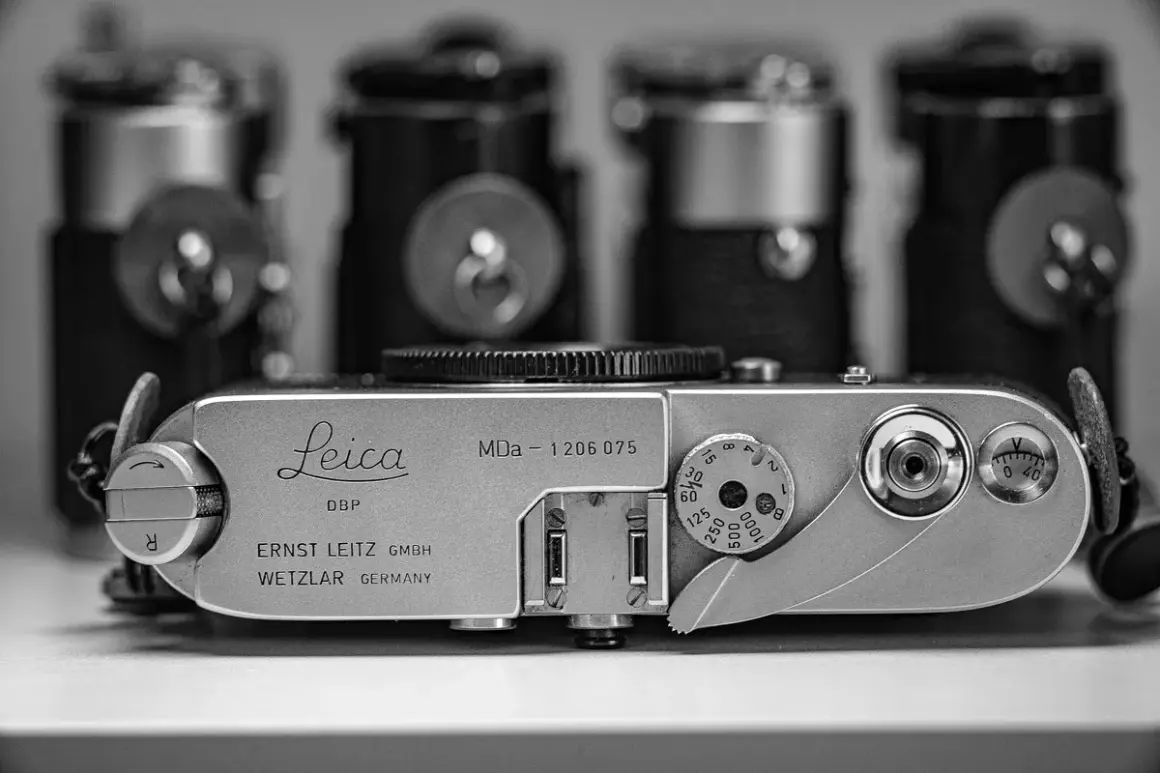
The Leica MDa is one of those cameras that makes sense only when you stop expecting a rangefinder to do everything. It is a stripped-down M body built for external finders, zone focus, and technical shooting, which is why it often comes up in the same conversation as the M4-2. In this article I break down what it is, how it differs from the M4-2, and when the bare-bones approach is an advantage rather than a compromise.
The MDa is a specialist body, not a mainstream rangefinder
- It removes the built-in viewfinder and rangefinder, so framing and focus happen externally.
- The M4-2 keeps the rangefinder experience, which makes it the easier camera to live with day to day.
- Both are mechanical film bodies, so condition and service history matter more than cosmetic perfection.
- The MDa works best with wide or normal lenses, an external finder, and a disciplined distance workflow.
- For most photographers, the real decision is between a specialist tool and a general-purpose film M.
What the MDa actually is
I read the MDa as a deliberate utility camera rather than a compromised one. Leica took the M platform and removed the built-in finder system, leaving a body intended for copy work, technical work, and any situation where you already know your framing before you press the shutter. That is why the camera feels so spare: its job is to move film and fire accurately, not to help you focus through the body.
What remains is very familiar if you know M cameras at all. You still get the compact brass-and-metal feel, the M-mount lens interface, and the mechanical discipline that makes film Leicas attractive in the first place. But once you understand that the camera does not try to solve focus for you, the MDa starts to look purposeful instead of incomplete. That distinction matters most when you put it beside the M4-2.
How it differs from the M4-2
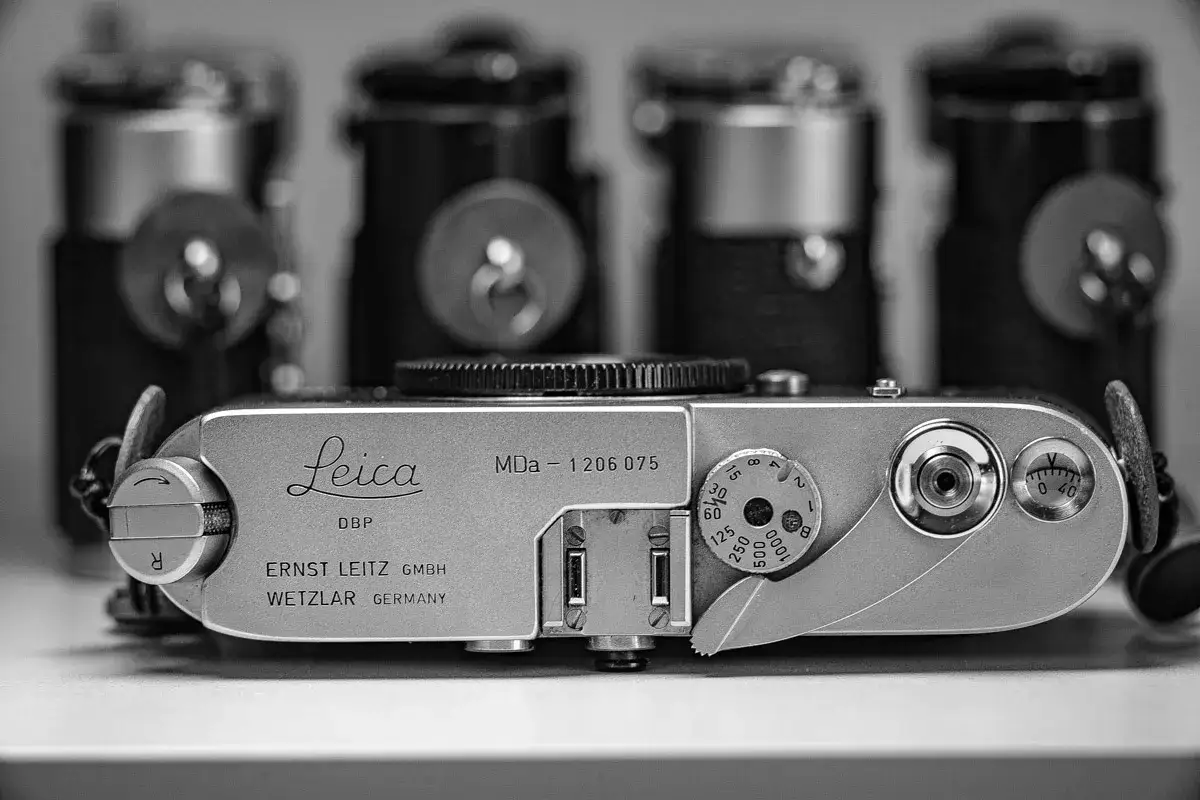
The cleanest way to think about the MDa and the M4-2 is this: one is a specialist platform, the other is a usable everyday rangefinder. The M4-2 keeps the essential M shooting experience intact, while the MDa removes the viewfinder-side convenience and pushes you into a more deliberate workflow.
| Feature | MDa | M4-2 |
|---|---|---|
| Finder | No built-in viewfinder or rangefinder | Built-in bright-line rangefinder finder |
| Focus method | External finder, zone focus, or hyperfocal setup | Through-the-finder rangefinder focusing |
| Best use case | Copy work, tripod work, wide-angle work, deliberate setups | Street, documentary, travel, and general film shooting |
| Workflow | More specialized, but very clean once configured | More flexible and faster to use in the field |
| Accessory logic | External finder matters a lot | Leica's current Leicavit M materials still list the M4-2 as compatible |
The practical difference is bigger than the badge suggests. The M4-2 still behaves like a normal Leica M body, while the MDa expects you to bring more of the system with you. That makes the M4-2 the safer recommendation for most buyers, and the MDa the more interesting one for photographers who want a very specific workflow.
Why the stripped-down design still makes sense in 2026
I still see a place for a finderless M body because modern shooting habits often hide sloppy technique. A camera like this forces you back to basics: subject distance, depth of field, framing, and consistency. If you are scanning film for editorial delivery, shooting a product on a copy stand, or working with one lens in a controlled environment, that discipline is useful rather than restrictive.
There is also a mechanical argument. Fewer optical parts mean less to drift, haze, or misalign over time, and that matters on a vintage camera. The tradeoff is obvious, though: the body only feels simple if your process already includes an external finder and a meter. Without those, you are just giving yourself extra steps. That is why shooting technique becomes the real story.
How to shoot it without fighting the body
The easiest way to make this camera work is to stop treating it like a normal rangefinder. I would pick one focal length and build the whole workflow around it. For most people, 28 mm or 35 mm is the cleanest starting point because wide lenses are easier to frame externally and give you more depth of field to work with.
Zone focus means setting a distance range in advance instead of focusing shot by shot. Hyperfocal focusing means setting the lens so that everything from a chosen near distance to infinity stays acceptably sharp. Those two methods are where the MDa becomes genuinely useful, especially when you stop down.
- Use an external finder that matches the lens you actually carry.
- Start around f/8 or f/11 when you want margin for error.
- Keep a handheld meter or phone meter in your workflow, because the body gives you no exposure help.
- Use 28 mm or 35 mm first if you want the most forgiving setup.
- Choose 50 mm only if you are comfortable working more slowly and placing focus by distance with care.
In practice, this camera rewards rhythm. Once you have one lens, one finder, and one exposure routine, it becomes fast in a very low-key way. That only works, though, if the body itself is mechanically healthy, which is where buying advice matters.
What to inspect before buying one
With any vintage Leica, I care more about function than perfection. A clean engraving is nice; a smooth shutter and reliable film transport are non-negotiable. Leica Classic still lists serviced examples of the MDa, and that is a useful reminder that condition is a real part of the value equation, not a cosmetic footnote.- Check that the shutter fires evenly through the full speed range and on B.
- Inspect the film advance and rewind action for roughness or binding.
- Look closely at the shutter curtains for damage, uneven travel, or pinholes.
- Confirm that the baseplate, rear door, and body shell fit correctly and do not feel sprung or bent.
- Verify any external finder you plan to use, because the camera itself will not correct your framing.
- Prefer a documented CLA, which means a clean-lubricate-adjust service, over a cheaper body with unknown history.
I would also be suspicious of a camera that looks beautiful but feels inconsistent in the hand. On older mechanical bodies, smooth transport is usually worth more than original paint, and that is especially true here because the whole point is dependable simplicity. Once you know what to inspect, the final question is which body actually fits the way you work.
When I would choose the MDa over the M4-2
If I wanted the cleanest possible external-finder platform, I would choose the Leica MDa. If I wanted a body I could hand to most film photographers without a long explanation, I would choose the M4-2. That is the real split: one camera is optimized for a narrow, deliberate job, and the other is optimized for everyday usability.
- Choose the MDa if you shoot mostly wide lenses, work from a tripod, or prefer one repeatable setup.
- Choose the M4-2 if you want the classic M rangefinder experience with fewer compromises.
- Skip both if you expect metering, automation, or autofocus-like convenience from an older film body.
That is the decision I would actually make. The MDa is the more specialized tool, but the M4-2 is the better all-rounder, and that is usually the smarter buy unless your workflow is already built around external framing and zone focus.