Key points at a glance
- The X-Pro3 is built around a viewfinder-first workflow, with a hidden rear LCD that intentionally reduces screen dependence.
- Its 26.1MP APS-C X-Trans sensor, hybrid autofocus, and Fujifilm color pipeline still produce strong stills in 2026.
- It is best suited to street, documentary, travel, and deliberate prime-lens shooting, not screen-heavy or video-first work.
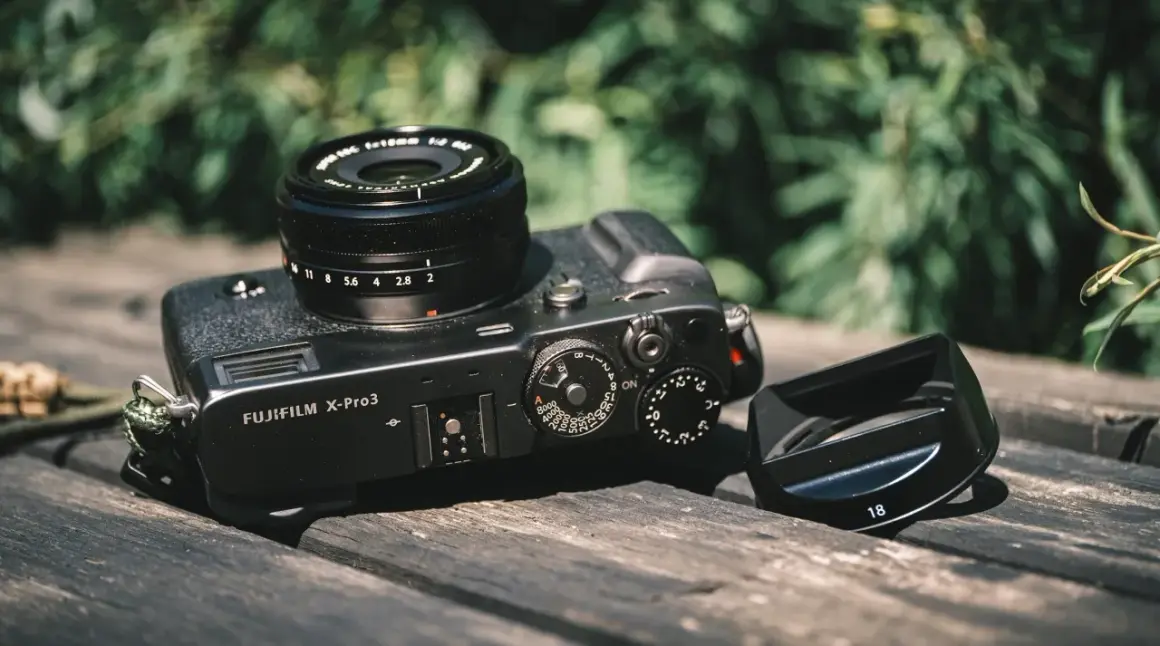
- The camera feels premium because it is: Fujifilm uses a magnesium frame with titanium top and base plates, plus weather resistance.
- Used prices remain relatively high, so condition and completeness matter a lot more than with ordinary older mirrorless bodies.
The design is the whole argument
The first thing I think about with the X-Pro3 is not the sensor. It is the philosophy. Fujifilm made a camera that tries to pull your attention away from the rear display and back into the scene, and the hidden LCD is the clearest expression of that idea. You get a small sub monitor for shooting info, then the main screen flips down when you actually want to review images or dig into menus.
That sounds gimmicky until you hold the camera for a while. The body feels deliberate, with a magnesium frame and titanium top and base plates, and Fujifilm positions it as a weather-resistant tool for photographers who carry a camera all day rather than treat it like a device that lives on a desk. At 447 g body-only, it is not featherlight, but it is compact enough to disappear in a bag and still substantial enough to feel like a serious instrument.
The hybrid viewfinder is the other part of the design story. You can shoot through an optical viewfinder or switch to the electronic viewfinder, which changes the camera from a rangefinder-like experience into something more conventional. That flexibility is useful, but the larger point is simpler: this is a camera that wants you to compose first and inspect later. That only works if the files justify the discipline, which is where image quality comes in.
The files still look good enough to justify the body
The X-Pro3 is not chasing resolution for its own sake. Fujifilm gives it a 26.1MP APS-C X-Trans CMOS sensor, and that is still a very workable sweet spot for editorial, travel, portrait, and street work. It is enough detail for prints and cropping without turning the camera into a giant file machine.
| Feature | Why it matters in practice |
|---|---|
| 26.1MP APS-C X-Trans CMOS sensor | Enough detail for most real-world jobs without bloated files or slow workflow. |
| ISO 160-12800, with extended values down to 80 and up to 51200 | Useful flexibility, especially for black-and-white or low-light stills, but the extended settings are situational. |
| Classic Neg., Clarity, and Color Chrome Effect Blue | More character straight out of camera, which is a real advantage if you shoot JPEGs or want less editing. |
What I like most is that Fujifilm’s color tools are not just decorative menu items. Classic Neg. gives the camera a stronger, more film-like snap than the older simulations, while Clarity and Color Chrome Effect Blue let you tune contrast and color depth without living in post-processing. Fujifilm still leans hard into color science, and in this body that matters because so many owners buy it to enjoy the process as much as the final file.
There is also practical depth beyond the obvious look. The camera supports HDR and up to nine-frame multi-exposure work, and the body includes two UHS-II SD card slots. That is useful if you want redundancy on paid shoots or simply prefer to keep your workflow disciplined. It is a stills camera first, but it is not a bare-bones tool. That balance becomes clearer when you look at how it handles focus and framing.
The viewfinder and autofocus decide whether you will love it
I think the X-Pro3 makes sense only when you actively enjoy looking through a finder. Fujifilm gives you a reverse Galilean optical viewfinder with about 0.52x magnification and roughly 95% frame coverage, plus a 0.5-inch 3690k-dot OLED EVF with 0.66x magnification. In plain terms, the camera lets you choose between an old-school framing experience and a more exact digital preview, and that choice is the core of its identity.
Autofocus is strong enough to support that way of working. Fujifilm lists its intelligent hybrid AF system, and it can focus down to -6EV, which is a meaningful number if you actually shoot in dim interiors, twilight streets, or poorly lit rooms. I would not call this a sports camera, but it is more capable than the aesthetic suggests.
In burst shooting, the X-Pro3 can go up to 30 fps with the electronic shutter, though that comes with a 1.25x crop. That detail matters because it reminds you what the camera is and is not. Yes, the headline speed looks impressive. No, that does not turn it into an action specialist. For fast-moving subjects I would still prefer a body designed around that job. The X-Pro3 is best when you are working deliberately, not firing long bursts at unpredictable motion.
The good news is that the handling supports slower, more considered shooting. The controls are tactile, the sub monitor gives you the essentials without forcing a screen-centric workflow, and the camera stays out of your way once you learn the layout. That experience is the real reward, but it comes with trade-offs that are impossible to ignore once you spend time away from the finder.
The hidden screen is clever, and also the main reason some people bounce off it
The hidden LCD is either the camera’s best idea or its biggest obstacle, depending on how you work. If you like to shoot through the finder and review images in batches, it can feel refreshing. It removes the habit of checking every frame and makes the body feel more focused. If you prefer to glance down, confirm exposure, tap focus, or move quickly through settings, it slows you down.
This is also where the X-Pro3 becomes a less obvious choice for hybrid creators. The rear LCD is a 3.0-inch, 1620k-dot touchscreen that tilts, but it is not built for the same kind of casual, always-visible interaction you get on most modern mirrorless bodies. Video support exists, with 4:2:0 8-bit internal recording and frame rates up to 59.94p, plus Full HD high-speed modes at 120p or 100p, but I would not buy this camera for video-first work. It is functional, not central.
The battery story is similarly practical rather than generous. Fujifilm’s own figures put stills endurance roughly between 260 and 440 shots depending on display mode and power settings, and video capture lands around 40 to 75 minutes depending on the mode. In real terms, I would treat the X-Pro3 as a one-battery daytime camera with a spare in the bag, not a body that will comfortably carry you through a long mixed-use day without thinking about power.
That is the pattern with this camera. Every appealing trait has a built-in limitation. The next step is figuring out who should accept those limitations and who should not.
Who I would recommend it to in 2026
As of 2026, the X-Pro3 mostly lives in the used market. MPB currently shows used bodies at roughly $1,499 to $1,759, which is a serious price for a discontinued-style experience, even if the camera still feels special. That pricing matters because it changes the buying logic: you are not hunting for a cheap nostalgia piece, you are paying for a very specific shooting style.
| Best fit | Why it works |
|---|---|
| Street and documentary photographers | The finder-first layout, compact body, and restrained rear display encourage a more intuitive pace. |
| Travel shooters who like primes | It is compact, weather resistant, and strong enough to carry all day without feeling fragile. |
| JPEG shooters and Fujifilm color fans | Classic Neg. and the other simulations make the camera rewarding straight out of camera. |
| Photographers who enjoy a slower, more intentional workflow | The hidden LCD is a feature, not a punishment, when you want to shoot less mechanically. |
| Video-heavy creators and screen-dependent shooters | The camera is simply too opinionated and too inconvenient for that kind of work. |
If you want a camera that disappears while you work, this is a very good one. If you want a body that is forgiving, modern in the usual sense, and easy to share between stills and video, I would look elsewhere in the Fujifilm line. The X-Pro3 is for someone who already knows they want the experience it offers, not for someone who is hoping to be convinced by specs alone.
Before buying one used, I would inspect the screen hinge, the sub monitor, the finder, and the condition of the titanium body carefully. That is the last step where a smart purchase gets separated from an expensive regret.
The used-body checklist I would not skip
I would not buy an X-Pro3 sight unseen unless the seller can provide clear photos and a complete description. The body is premium enough that cosmetic wear matters less than function, but the hidden-screen mechanism means you need to be a bit stricter than you would be with a normal mirrorless camera.
- Check that the hidden LCD opens smoothly and sits flush when closed.
- Confirm that the sub monitor is readable and not partially dead or heavily scratched.
- Inspect the OVF and EVF for dust, haze, alignment issues, or display artifacts.
- Ask whether the original battery and charger are included, because missing accessories add up quickly.
- Look at the card slots, USB-C port, strap lugs, and hot shoe for signs of abuse.
- Verify the shutter count if the seller can provide it, but do not treat that number as the only thing that matters.
- Check the firmware version and basic AF operation before committing, especially if the camera has changed hands several times.
My verdict is simple: the X-Pro3 is still a compelling camera if you want a body that changes how you shoot, not just what you shoot with. If you love viewfinder-led photography, Fujifilm color, and a more deliberate pace, it can still feel inspiring in 2026. If you want convenience first, I would pass and buy a more conventional X-series body instead.