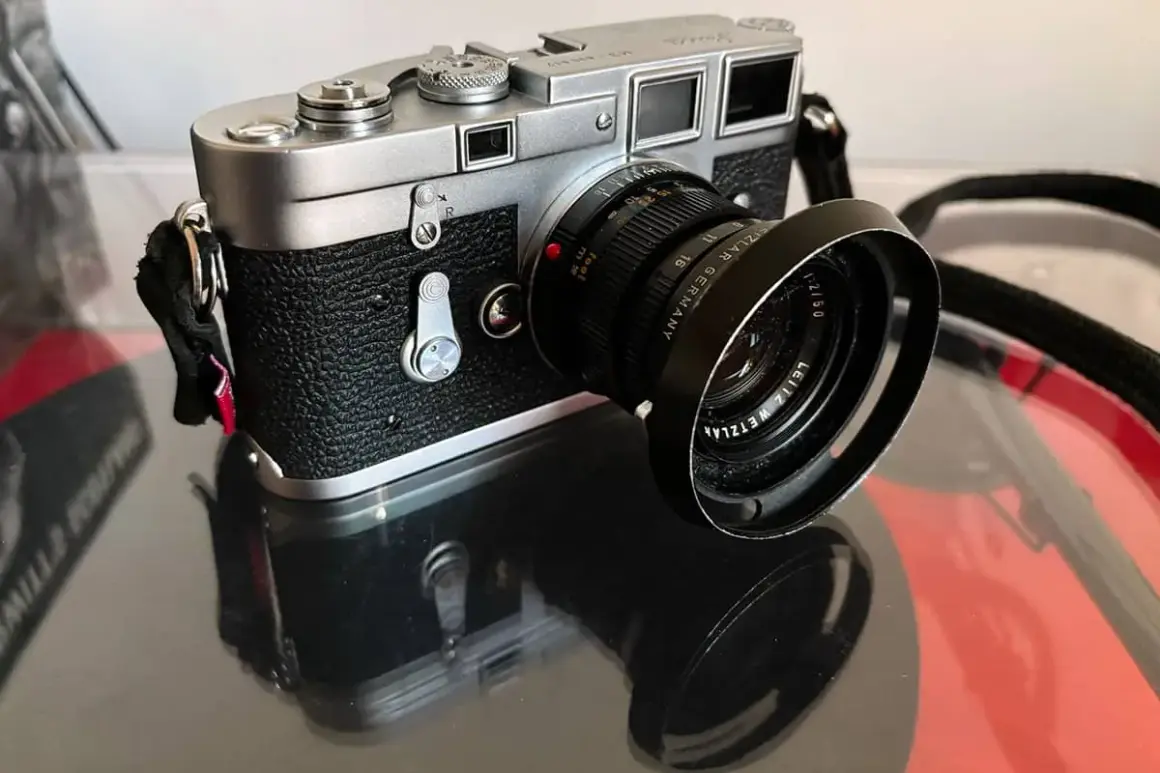
The Leica M3 camera is one of those rare film bodies whose reputation still matches the experience of using it. It defined Leica’s modern M system, and it remains relevant because its finder, rangefinder, and mechanical controls still make 35mm shooting feel deliberate without becoming cumbersome. In this article, I break down what the M3 actually does well, where its limitations are real, and what I would check before buying one today.
The essentials behind the M3
- The M3 launched Leica’s M system and established the rangefinder layout that later M bodies refined.
- Its 0.91x viewfinder and long rangefinder base make it especially strong with 50mm and longer lenses.
- It is fully mechanical and meterless, so exposure control is entirely on you.
- The native framelines are 50mm, 90mm, and 135mm, which is why 35mm shooters often prefer another M body.
- Used prices are still high enough that condition and service history matter more than cosmetics.
Why the M3 still matters
When Leica introduced the M3 in 1954, it did more than launch a new model. It reset expectations for what a 35mm rangefinder could be: bright, fast to use, and mechanically elegant without feeling fragile. Around 220,000 units were built, which is one reason the camera still feels less like a museum piece and more like the foundation of a long-running system.
What matters to me is that the M3 turned rangefinder shooting into a clean, repeatable process. The combined viewfinder and rangefinder, the M bayonet mount, and the rapid film advance all pushed the camera toward actual field use, not just collector appeal. Later M bodies added conveniences, but the M3 established the core grammar, and that is still easy to feel the moment you bring one to your eye. That leads straight into the part that defines the camera most clearly, the finder and the controls around it.
The finder and controls that define the body
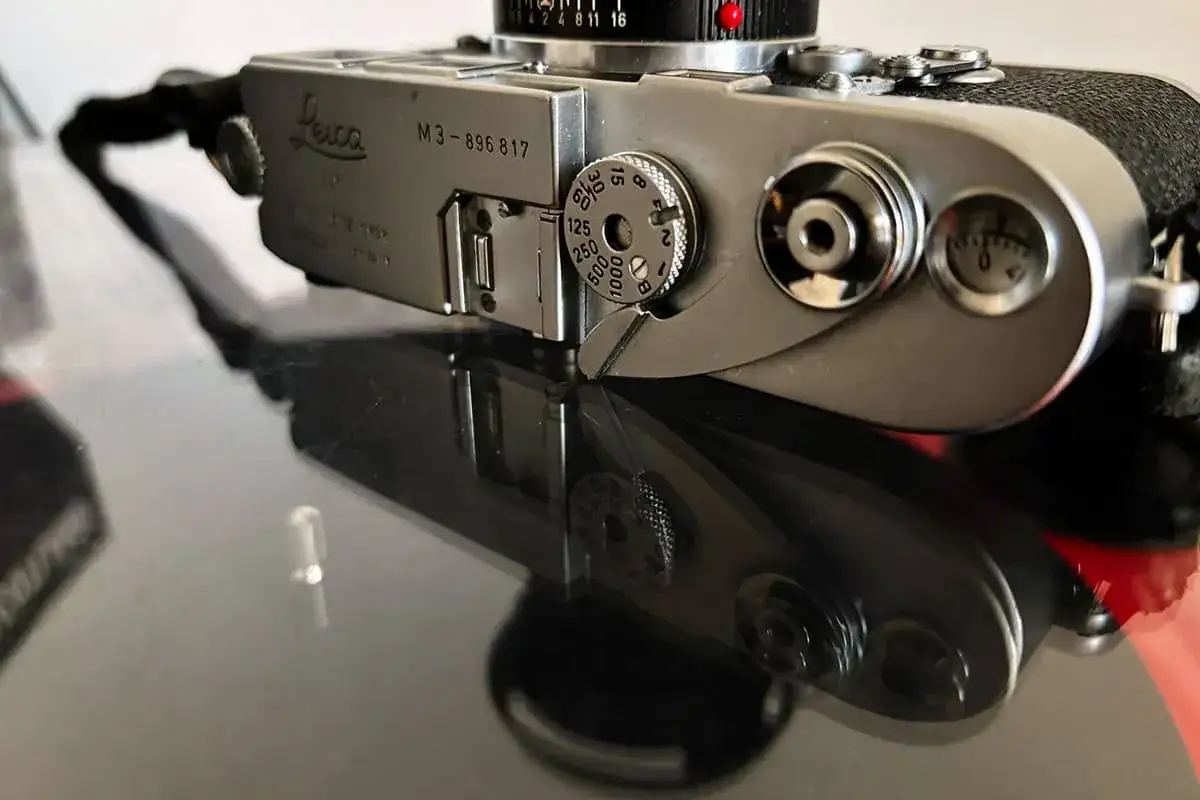
The M3 looks simple from the outside, but in use it is very deliberate. I care most about the finder because that is where the camera earns its reputation: the view is bright, the rangefinder patch is easy to read, and the 0.91x magnification makes focusing feel unusually confident.
| Specification | What the M3 offers | Why it matters |
|---|---|---|
| Format | 35mm rangefinder | Compact, quiet, and built for manual shooting |
| Lens mount | Leica M bayonet | Fast lens changes and a large M-lens ecosystem |
| Viewfinder | Bright 0.91x coupled range/viewfinder | Excellent focusing precision and a large, clear image |
| Framelines | 50mm, 90mm, 135mm, projected and parallax-compensated | Natural fit for normal and telephoto lenses |
| Shutter | 1 s to 1/1000 s plus B | Enough control for most film use without automation |
| Flash sync | 1/50 s | Important if you plan to work with flash |
| Meter | None built in | Requires a handheld meter, app, or clip-on meter |
| Advance | Manual lever, early double-stroke and later single-stroke versions | Daily handling changes, but the imaging core stays the same |
| Weight | About 19.2 oz body only | Light enough to carry, but dense enough to feel substantial |
There are also version differences that matter in real life. Early bodies use a double-stroke advance, which is wonderfully tactile but adds an extra motion to every frame, while later single-stroke bodies are simpler and quicker in the hand. Neither version changes the images, but it does change the rhythm of shooting, and that rhythm is part of the M3 experience.
The design choice that matters most, though, is the frame-line set. The M3 was built around 50mm, 90mm, and 135mm lenses, and that tells you almost everything about how Leica expected it to be used. If you want a body that naturally speaks in 35mm first, this is not that camera. The practical impact of that becomes obvious once you actually start shooting with it.
What it feels like to actually shoot with it
The M3 rewards photographers who already like to think in terms of aperture, distance, and framing before they press the shutter. For readers who have never used a rangefinder, the focus patch is the small overlapping image in the finder, and you turn the lens until the two images snap into one. Once that clicks, the camera becomes remarkably fast, but the learning curve is real if you are used to autofocus or an SLR.
For me, the M3 is at its best when I use it as it was intended:
- It excels with 50mm lenses because composition and focusing line up naturally with the finder.
- It is excellent for portraits and documentary work where timing matters more than automation.
- It can feel limiting with 35mm glass unless you add an auxiliary finder or special goggles.
- It is not built for exposure automation, so you need to control light with a meter, an app, or experience.
My practical starting point is simple: a 50mm lens, 400-speed film, and a handheld meter or phone app. That setup lets the camera show its strengths without forcing you into guesswork. Once the exposure habit settles in, the M3 feels less like a collectible and more like a very disciplined tool.
The biggest limitation is not power, it is fit. If your work depends on fast action, ultrawide compositions, or exposure changes that must happen instantly, the M3 will slow you down more than you want. If you like focus, timing, and a clean optical finder, that slowdown is exactly why it still feels satisfying in 2026. Once you know how it handles, the real buying question becomes condition, originality, and service history.
What I would inspect before buying one in 2026
I treat an M3 as a mechanical instrument first and a collectible second. Current used listings on MPB cluster around €829 to €1,339 for double-stroke bodies and €1,039 to €1,339 for single-stroke bodies, depending on condition. That is a useful reality check, because the body price is only part of the bill and a proper service can move the total higher quickly.
| What to inspect | What I look for | Why it matters |
|---|---|---|
| Rangefinder patch | Bright image, clean contrast, accurate alignment at infinity and close focus | Misalignment ruins the camera’s main advantage |
| Shutter | Even curtains, repeatable speeds, no dragging or sticking | Timing problems affect every frame, even if the body looks perfect |
| Finder clarity | No heavy haze, fungus, separation, or distracting debris | The finder is the whole experience on this camera |
| Advance and counter | Smooth winding, clean reset, no gritty spots or skipped movement | Mechanical wear usually shows up here first |
| Lens mount | Secure bayonet lock and no obvious wobble | A loose mount undermines focusing accuracy and confidence |
| Service record | Recent CLA, documented repair, or a trustworthy seller statement | Mechanical cameras age better when someone has already addressed wear |
If I were buying one for use rather than display, I would prioritize shutter health, finder alignment, and a recent CLA over cosmetics. Brassing is fine. Sticky wind, a dim rangefinder, or a sluggish shutter is not. Collectors may pay more for rare finishes or early features, but a photographer usually gets more value from a well-sorted user-grade body than from a prettier problem child. That is especially true once you start choosing lenses for it.
Which lenses and subjects make the most of it
The M3 is happiest when you lean into its native framing. I would call the 50mm lens the sweet spot, 90mm the practical second choice, and 135mm the option that still works well if you know why you want it. Once you move to 35mm and wider, you are fighting the finder design more than using the camera as intended.
| Focal length | Fit on the M3 | My take |
|---|---|---|
| 50mm | Native sweet spot | Best balance of speed, accuracy, and composition |
| 90mm | Very strong | Great for portraits and compressed documentary scenes |
| 135mm | Usable, but less common | Works if you want tighter framing and slower pacing |
| 35mm | Possible with goggles or an external finder | Fine if you really want it, but not the camera’s natural language |
| 28mm and wider | Not native | Better on another M body with wider framelines |
This is why the M3 still comes up so often in street and documentary conversations. It encourages a frame-first mindset rather than a menu-first one, and that kind of discipline can improve your photography faster than a pile of features ever will. If you are building a working kit around an M body, the lens choice matters more here than it does on a more forgiving camera.
When the M3 is the right Leica and when it is not
I would recommend the M3 to someone who wants the purest classic Leica experience with a 50mm lens and does not need metering or native 35mm framelines. I would point a different buyer toward an M2 if 35mm is central, or toward an M4 if quicker loading and a little more everyday convenience matter more than first-generation charm. The M3 is not the easiest Leica to live with, but it is one of the easiest to understand once you accept its rules.
- Buy it if you want precision, manual control, and a finder built around 50mm shooting.
- Skip it if you want a meter, native 35mm framelines, or the fastest possible daily workflow.
- Budget for service, not just the body.
- Judge examples by mechanics first and cosmetics second.
That is the short version of why the M3 still matters in 2026: it is less a trophy than a very specific answer to a very specific way of shooting. In the right hands, a clean body and a good 50mm lens still feel unusually honest, and that is something newer gear does not automatically replace.