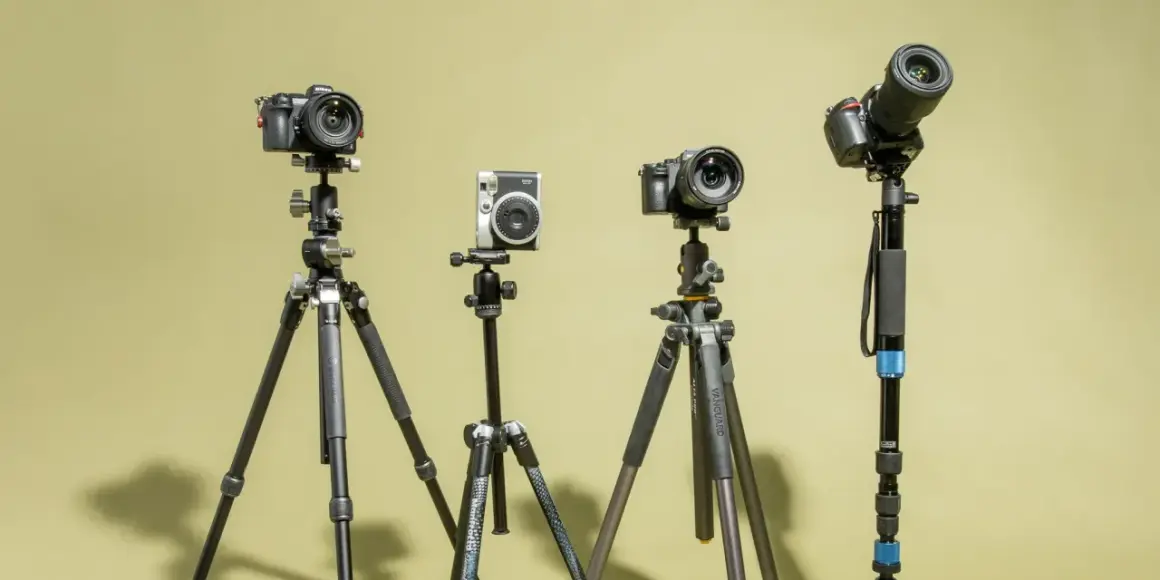
A tripod is one of those pieces of gear that looks simple until you have to live with it on location. The right one changes how sharp your frames are, how stable your video feels, and how quickly you can move between setups.
If you're trying to figure out how to choose a tripod, I start with the way you shoot, not the spec sheet. In this guide, I break down the decisions that actually matter: size, weight, load rating, head type, materials, and the compromises behind each choice.
The fastest way to narrow tripod choices is to start with your camera, your lens, and how far you carry it
- Match the support to your heaviest real setup, not the lightest camera body you own.
- Prioritize working height and folded size before chasing a headline load rating.
- Ball heads are fast for stills, fluid heads are better for video, and gimbal heads belong with long telephoto lenses.
- Carbon fiber is usually lighter and pricier; aluminum is usually heavier and easier on the budget.
- In the U.S. market, good travel tripods often sit around $100-$300, while carbon-fiber and video kits can move well above $500.
- Cheap tripods fail in predictable places: flex, sloppy heads, and too little stability when the wind or lens length increases.
Start with the way you shoot, not the tripod category
When I narrow tripods down, I first ask what the camera actually has to do. A tripod for a studio interview, a tripod for hiking with a mirrorless body, and a tripod for wildlife work are solving different problems, even if they all look similar at a glance.
The fastest way to avoid an expensive mistake is to connect the tripod to the job, not the brand. I think in terms of mobility, precision, and how often the tripod will leave the bag.
| Use case | What I prioritize | What usually makes less sense | Typical U.S. budget |
|---|---|---|---|
| Travel and city shooting | Low weight, compact folded length, quick setup | Heavy studio legs that stay home because they are annoying to carry | $100-$350 |
| Stills with a mirrorless or DSLR body | Stable legs, a reliable ball head, enough height without the center column raised | Ultra-light travel models that wobble under a longer lens | $150-$500 |
| Video interviews and branded content | Fluid head, smooth drag, counterbalance, steady panning | Stills-focused heads that feel jumpy when you pan or tilt | $250-$900 |
| Wildlife and sports | Rigid legs, strong head, good balance for a long telephoto lens | Small travel tripods that flex when the lens gets long | $400-$1,500+ |
| Tabletop and smartphone work | Low minimum height, easy framing, compact footprint | A full-size tripod that adds weight without adding much value | $20-$120 |
If you know the job, the rest of the choice gets much easier. Once that is clear, I move to size and weight, because those are the specs you will feel every day.
Get the size and weight balance right
The most common mistake I see is buying a tripod that sounds capable on paper but is awkward in real life. A tripod that is too tall, too short, or too heavy will be left behind, and a tripod left behind does not help your footage or your stills.For many adults, a working height around eye level without the center column fully extended is the sweet spot. In practical terms, that often means something in the 55-65 inch range, or about 140-165 cm, depending on your height and whether you shoot from a standing or seated position.
Folded length matters almost as much. If the tripod needs to live in a backpack or carry-on, I like to see a folded length around 15-20 inches (38-50 cm). Once you get closer to 20-25 inches (50-64 cm), it can still be practical, but it starts to feel more like a car tripod than a daily carry item.
Weight is the other half of the deal. A tripod under 3 lb (1.4 kg) feels friendly for hikes and day trips. Between 3 and 4.5 lb (1.4-2 kg) is a common all-around range. Past 5 lb (2.3 kg), I assume the tripod is being bought for stability first and portability second.
- 3-section legs usually feel stiffer and faster to deploy.
- 4-section legs are the common compromise between size and portability.
- 5-section legs fold smaller, but they usually give up some rigidity.
A tall tripod is not automatically a good tripod if it only reaches full height with the center column fully raised. That leads naturally into the next question: can the system stay steady once your camera is on it?
Treat load capacity as a stability margin
I never read load capacity as a simple yes-or-no number. A tripod rated for a certain payload can still feel different depending on how the weight is distributed, how long the lens is, and whether you're shooting in a calm room or in a windy parking lot.
My practical rule is simple: I want a comfortable margin between the rated capacity and the weight of my actual setup. For a stills kit, that often means aiming for a tripod and head that are rated at about 1.5x to 2x the weight of the camera package I use most often. That is not a universal law, but it is a useful buffer.
The package weight should include more than the camera body. I think in terms of the complete rig:
- Camera body
- Heaviest lens I regularly use
- Battery grip, cage, mic, monitor, or matte box if those stay attached
- Any adapter, teleconverter, or accessory plate that adds leverage
Leverage matters as much as mass. A modestly heavy camera with a long lens can stress a tripod more than a heavier body with a short lens because the lens extends the weight farther away from the center of the system.
Stability also depends on details that do not always get enough attention. A useful hook under the center column can help when conditions are windy, but it does not rescue a flimsy set of legs. Rubber feet are better for floors; spikes help outdoors. The center column is convenient, but it is usually the first thing I lower when I want the platform to feel solid.
Once the legs are honest about the weight, the head becomes the part that determines whether the tripod feels fast, precise, or annoying to use.
Choose the head that matches how you move the camera
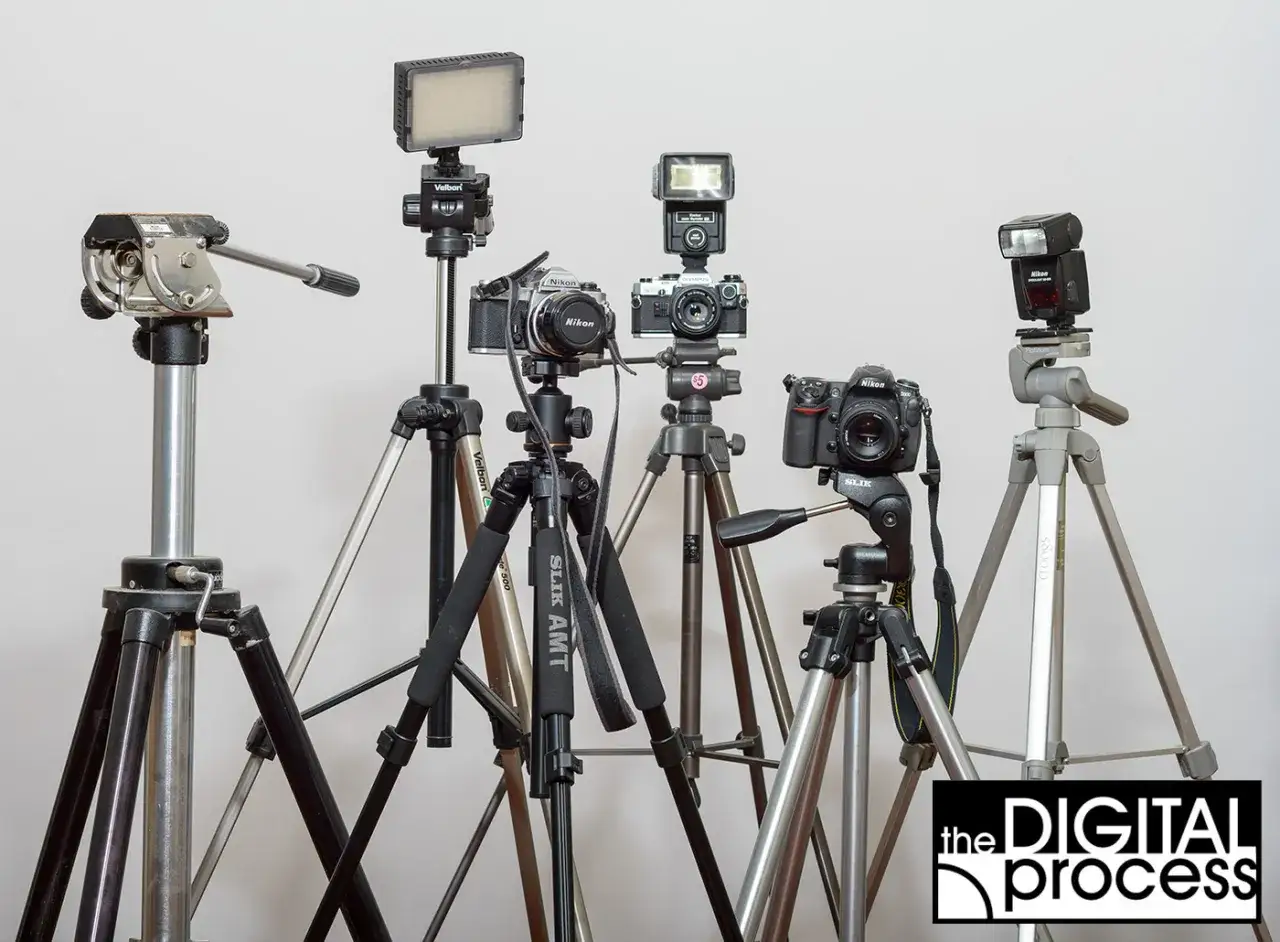
The head is where a tripod becomes personal. Two tripods with similar legs can feel completely different once you start framing, panning, and locking off shots.
| Head type | Best for | Tradeoff |
|---|---|---|
| Ball head | Fast composition, general stills, travel use | Quick and flexible, but less precise for repeatable tilts and leveling |
| Pan-tilt head | Architecture, product shots, controlled stills | Slower to adjust, but easy to move one axis at a time |
| Fluid head | Video interviews, motion work, smooth pans and tilts | Better for movement, but usually bulkier and more expensive |
| Geared head | Studio work, precise framing, tabletop and copy work | Very accurate, but slower and often heavier |
| Gimbal head | Wildlife, sports, long telephoto lenses | Specialized and overkill for most stills kits |
For still photography, I usually default to a ball head unless I know I need very fine, repeatable adjustment. For video, I prefer a proper fluid head with usable drag and counterbalance. Counterbalance is the feature that helps the camera stay put instead of tipping forward or backward when you release the handle, and it makes a bigger difference than many buyers expect.
Quick-release matters too. I like Arca-type plates because the standard is widely supported and the camera can move between compatible heads without much friction. A plate is just the small mounting piece that stays on the camera, but when it is good, it saves time every single day.
If your tripod feels awkward even though the head is technically rated for the job, the problem is often not the legs. It is usually the interface between the camera and the support. That is where materials and leg design start to show their value.
Materials and leg design change the feel more than the spec sheet suggests
I think of materials as a daily-use decision, not a prestige decision. Carbon fiber is lighter, and that matters if the tripod is going into a backpack or traveling by air. Aluminum is usually cheaper and still very capable, especially if the tripod lives in a studio, car, or bag that does not need to stay ultralight.
| Material | What it gives you | What you trade away |
|---|---|---|
| Carbon fiber | Lower carry weight, strong feel, good vibration damping | Higher price, sometimes a bigger upfront investment than the rest of the kit |
| Aluminum | Better value, durable, easy to replace if the budget is tighter | Heavier to carry, especially on long days |
Leg locks are another place where personal preference matters. Twist locks tend to stay slim and clean in a bag, and I like them when I want a compact profile. Lever locks are faster to read at a glance, which can be useful when I am moving quickly on set or working in low light. Neither is automatically better; the better choice is the one you will operate without thinking.
The number of leg sections is a real compromise. Fewer sections usually mean more stiffness. More sections usually mean a smaller folded size. If you shoot outdoors or with longer lenses, I lean toward fewer sections and stronger legs. If the tripod has to disappear into luggage, extra sections can be worth the small loss in rigidity.
There are a few small details I keep an eye on as well:
- Removable or reversible center column for low-angle and tabletop work
- Interchangeable feet for moving between indoor floors and outdoor terrain
- Leg angle selectors that let the tripod sit low when the shot demands it
- Simple, serviceable locks and knobs that do not feel fragile after months of use
Those features do not sound glamorous, but they decide whether a tripod feels like a tool or a chore. The next step is to translate all of that into the kind of camera kit you actually use.
Match the tripod to the camera kit you actually use
When I compare tripods for real buyers, I stop thinking in abstract terms and start with the setup on the camera. A lightweight smartphone rig does not need the same support as a full-frame body with a 70-200mm lens or a cinema-style interview rig.
| Typical setup | What to look for | What I would avoid | Typical U.S. price range |
|---|---|---|---|
| Smartphone or compact creator kit | Mini or tabletop tripod, easy angle changes, compact clamp system | A heavy full-size tripod that adds bulk without improving the result much | $20-$120 |
| Mirrorless body with a standard zoom | Travel tripod or lightweight full-size model, ball head, good folded size | Very cheap legs that flex the first time you extend them fully | $100-$300 |
| Full-frame stills kit with a fast zoom | Stiffer legs, stronger ball head, better working height | Overly compact travel models that sacrifice too much rigidity | $150-$500 |
| Video interviews and branded content | Fluid head, counterbalance, smooth pan and tilt behavior | A stills head that jerks when you try to move the frame | $250-$900 |
| Wildlife or sports with a telephoto lens | Stable legs, gimbal head, easy balance adjustments | A general-purpose head that sags when the lens gets long | $400-$1,500+ |
| Product or tabletop work | Low minimum height, precise framing, reversible column or center-column options | A tall travel model that cannot get low enough for the shot | $80-$600 |
If I had to simplify the whole buying decision, I would say this: pay for stability where you need it, and pay for portability only where you will actually carry it. That balance is what keeps the tripod useful after the first week of ownership.
The checklist I use before I pay for one
Before I buy a tripod, I run the same short checklist. It keeps me from getting distracted by marketing terms and forces the decision back to function.
- Can it reach the framing height I need without relying on the center column for every shot?
- Does the rated support margin comfortably exceed my heaviest camera package?
- Is the head actually suited to the way I move the camera?
- Will I carry it often enough to justify its weight and folded size?
- Can I get replacement plates or compatible accessories easily?
- Does it still feel like a tool I will enjoy using after a long day?
If the answer to the last question is no, I usually step down one size or one feature tier and buy the tripod I will use instead of the one that looks best on paper. That is the real test: not whether the support is impressive, but whether it becomes part of your workflow without friction.
That is the standard I trust most for camera gear in general. A good tripod should feel steady, predictable, and easy to live with, because the support you use consistently is far more valuable than the one that only looks right in the spec sheet.