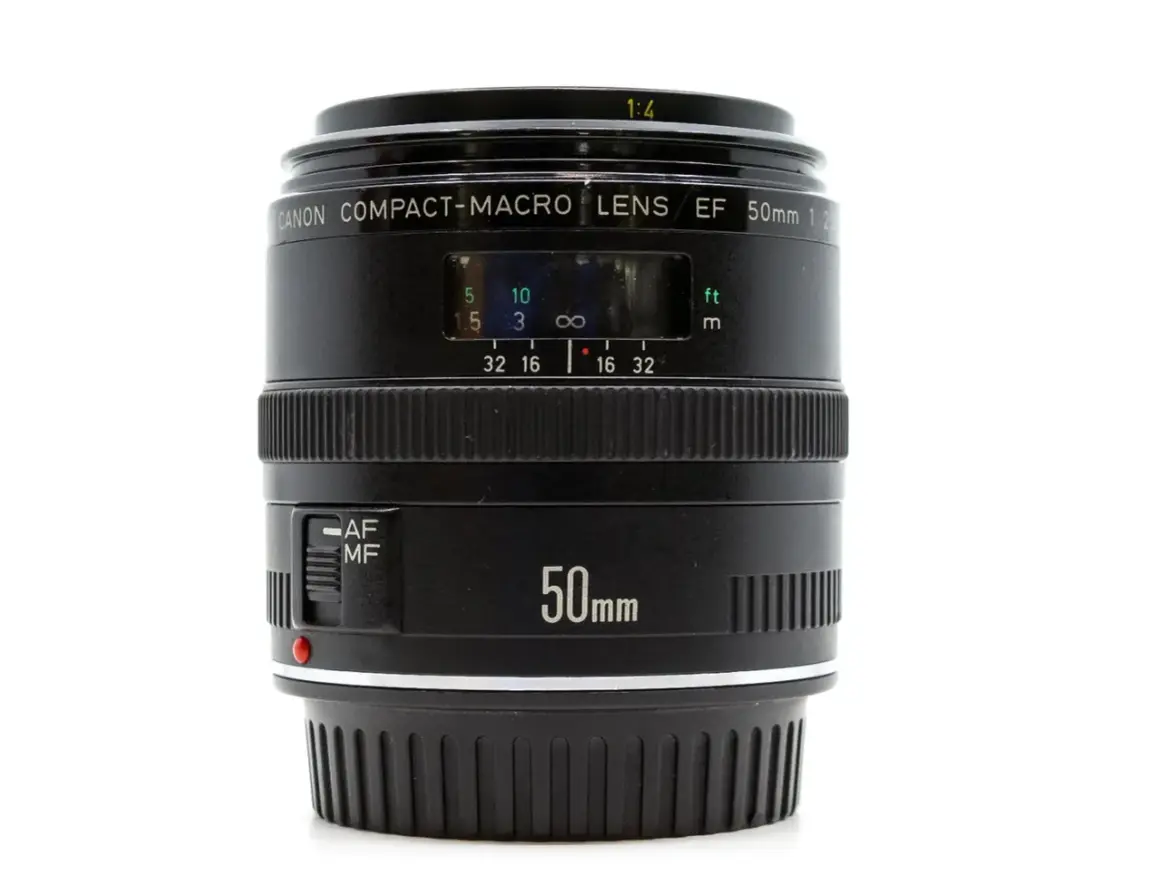
The Canon EF 50mm f/2.5 Compact Macro sits in a useful middle ground: it is small enough to travel light, close-focusing enough for detail work, and still natural enough to use as an everyday 50mm prime. In practical terms, that makes it interesting for product photography, tabletop work, portraits, and any shoot where you want one lens to handle both standard framing and close-ups without changing gear every few minutes. I’m breaking down the real specs, the limitations that matter, and the filters and accessories that actually make sense with it.
What matters most about this lens in everyday use
- It is a 1:2 macro lens, not a true 1:1 macro lens by itself.
- Its 0.23 m minimum focus distance is useful, but the working distance is still short for live subjects.
- The 52 mm filter thread keeps filter costs reasonable.
- The floating optical design helps the lens stay useful beyond close-up work.
- Used prices in the US are usually far more sensible than buying around the original launch-era retail level.
What this lens really is and why the compact design matters
I think the easiest way to understand this lens is to stop treating it like a normal 50mm prime and start treating it like a hybrid tool. Canon designed it as a compact macro lens that can focus close enough for half life-size reproduction, which means it can capture product textures, labels, flowers, and small objects with much more flexibility than a standard 50mm lens.
The important part is the floating optical construction. That is what keeps image quality from falling apart when you move from normal shooting distances into close-up territory. In plain English, the lens is not optimized for just one distance; it is built to stay reasonably well corrected as you focus near and far. That is why it still makes sense for editorial product work, not only for obvious macro scenes.
Canon also describes it as a multi-purpose lens, and I agree with that framing. If your workflow mixes close details with more general shooting, this lens has a practical identity. It is not trying to be a specialist monster that lives at 1:1 all day. It is trying to be a compact, honest compromise that still delivers useful close-up capability.
That brings us to the specs that actually change how it feels on a camera, because on a lens like this the numbers matter more than the marketing line.
The specs that matter in real shooting
Here are the numbers I would pay attention to first. They explain both the strengths and the tradeoffs better than any slogan.
| Specification | What it means | Why it matters |
|---|---|---|
| 50mm focal length | A normal field of view on full frame | Useful for product, detail, and portrait-style framing without distortion getting in the way |
| f/2.5 maximum aperture | Fairly bright for a compact macro prime | Gives you decent subject separation and some low-light flexibility |
| 0.23 m minimum focus distance | Very close focusing for a 50mm lens | Good for detail work, but the camera-to-subject space gets tight fast |
| 0.5x magnification | Half life-size reproduction | Enough for many product and texture shots, but not true 1:1 macro |
| 52 mm filter diameter | Common and affordable filter size | Makes filter choices easy and keeps the cost of extras down |
| 280 g weight | Light enough to stay in the bag | One of the lens’s biggest practical advantages over larger macro optics |
| 6 diaphragm blades | A modest blade count by modern standards | Blur is pleasant, but not especially creamy compared with newer premium primes |
One other detail matters in practice: as you stop down for macro work, you eventually run into diffraction, which is the softening that happens when the aperture gets very small. That is why macro shooters often live somewhere around f/5.6 to f/11 instead of chasing the smallest possible opening. The next question is where this lens actually earns its keep.

Where it earns its keep in real projects
I would not build a macro workflow around this lens for insects or anything that moves quickly. The working distance is simply too short for that to be comfortable, and the older AF design does not help. Where it shines is in controlled environments where you can position the subject, shape the light, and work methodically.The strongest use cases are usually:
- Product photography for small goods, packaging, cosmetics, labels, and accessories.
- Tabletop work where you need both a standard perspective and the ability to move in close.
- Portraits with detail emphasis, especially when you want a normal perspective with extra subject isolation.
- Texture and surface studies such as fabric, paper grain, print detail, or craft work.
- Flowers and static natural subjects where the lens can be used carefully at close distance.
What I like most here is the workflow flexibility. If I am shooting a product campaign and I need one lens that can cover a clean hero shot, a tighter crop, and a close detail frame without changing lenses, this one makes sense. It is not the best macro lens in the abstract. It is the best kind of practical lens: the one that helps you finish the job with fewer compromises in the field.
That also leads directly into the accessories question, because with a compact macro lens the real value often comes from how you light it and what you put in front of it.
Filters, extension tubes, and lighting choices
The good news is that the filter side is straightforward. The lens uses a 52 mm filter thread, which means you can buy protective filters, polarizers, and ND filters without spending much. If you already keep a 52 mm set in your kit, this lens drops neatly into that system. If not, the thread size is still common enough that replacements are easy to find. For macro work, I am usually conservative with filters. A high-quality clear filter is fine when I want basic front-element protection, but I would avoid stacking cheap glass on a lens like this unless I actually need the filter effect. Close-up shooting is where flare, contrast loss, and reflections start to show up quickly, and unnecessary extra glass only makes the job harder. If you are working with reflective products, a circular polarizer can help, but it is a tool, not a default.The more interesting accessory story is magnification. Canon lists the lens as compatible with extension tubes, and that matters if you want more close-up reach without switching to a bigger macro lens. Extension tubes are simple spacers that move the lens farther from the sensor, allowing closer focus and higher reproduction ratios. In practice, that can push this lens from “close-up capable” into genuinely more aggressive macro territory.
For lighting, I would plan around one of three approaches:
- Diffused daylight for flowers, paper, and still objects.
- A small LED panel when you need constant light for product work or video.
- A speedlight with diffusion when you want more control and cleaner highlights.
The lack of a bundled hood means you should be a little more careful with stray light than you might be on a newer lens. For product shooters, that is rarely a dealbreaker, but it does mean I would think about flags, white cards, and careful subject placement instead of assuming the lens will handle bad light on its own. Once you compare it against newer options, that tradeoff becomes easier to judge.
How it stacks up against newer 50mm and macro options
If you are choosing between this lens and a more modern alternative, I would simplify the decision into three paths. You either want a cheap normal prime, a compact hybrid macro, or a true dedicated macro lens. The Canon sits between the first and third category, and that middle position is both its strength and its limitation.
| Lens type | Best for | Main drawback | Typical US used price |
|---|---|---|---|
| Canon EF 50mm f/2.5 Compact Macro | Hybrid everyday and close-up shooting | Only 1:2 magnification by itself | About $175 to $250 |
| Canon EF 50mm f/1.8 STM | General-purpose everyday use on a budget | No macro capability | About $78 to $119 |
| Canon EF 100mm f/2.8L Macro IS USM | True macro, more working distance, serious close-ups | Bigger, pricier, less compact | About $534 to $634 |
The comparison tells the story pretty clearly. If your priority is simple general photography, the cheaper 50mm f/1.8 class of lens makes more sense. If your priority is serious macro with comfortable working distance, a 100mm macro is the better tool. The compact macro earns its place when you want a single lens that is more flexible than a normal prime but far smaller and cheaper than a full macro setup.
Used pricing is also part of the equation. In the US, I would budget roughly $175 to $250 for a clean copy, depending on condition and seller. At that level, the lens starts to feel like a smart specialist buy rather than a nostalgic curiosity. That said, you still want to inspect a few things carefully before handing over the money.
What I would check before buying one in 2026
Because this is a discontinued EF lens, I would treat any purchase as a used purchase and inspect it like one. The body is compact, but age matters more than size here. I would check the following before I commit:
- Focus smoothness so the ring does not bind or feel gritty.
- Aperture blade movement so the iris opens and closes cleanly.
- Front and rear glass for haze, fungus, deep cleaning marks, or separation.
- Autofocus behavior to make sure the older drive system still functions consistently.
- Accessory bundle because the original cap, rear cap, and any converter or tube can change the real value.
If you shoot on Canon RF, I would also factor in the adapter cost if you do not already own one. That does not make the lens less useful, but it does change the total budget. For a photographer who wants a light close-up lens for products, textures, tabletop work, or occasional portraits, the math can still work out well.
My practical read is simple: this lens makes sense when you value compact size, close focus, and versatility more than absolute macro reach. If that balance matches your work, the Canon EF 50mm f/2.5 Compact Macro is still a sensible tool in a modern kit.