Mamiya RZ67 lenses are one of the camera system’s real strengths: they are sharp, modular, and built around leaf shutters that keep flash work simple. In practice, the lineup splits into a small set of core focal lengths, a few specialty optics, and a filter story that is straightforward once you know the exceptions. This guide breaks down what is available, which lenses are easiest to live with, and how I would choose filters without creating vignetting or wasting money.
The system is broad, but a few focal lengths and filter sizes cover most real-world work
- The native lineup runs from a 37mm fisheye to a 500mm APO, but most photographers will live happily between 65mm and 210mm.
- 77mm is the default front filter size for most RZ lenses, which makes building a filter kit much easier than people expect.
- The big exceptions are the 37mm fisheye, which uses rear filters, and the 75mm shift and 500mm lenses, which need larger or more specialized filter handling.
- If I were buying my first lens today, I would start with the 110mm f/2.8, then add a wide lens or a short telephoto based on the way I actually shoot.
- On the used market, condition matters more than cosmetics; a smooth shutter and clean aperture blades beat a prettier barrel every time.
How to read Mamiya's lens names
The RZ67 uses a large 61mm lens mount and every lens carries its own leaf shutter, so the system is more self-contained than a lot of medium-format cameras. That design is the reason the lineup can include APO telephotos, shift optics, and zooms without feeling like an afterthought. When I look at a listing, I do not just read the focal length; I also read the suffixes, because they tell me whether I am looking at a standard barrel, a close-focus design, or a specialty optic.
| Label | What it tells you | Why I care |
|---|---|---|
| W | A later barrel/version label on many lenses, not a promise of wide angle | Do not assume a 110mm W is a wide lens; it is still the classic normal lens |
| APO | Apochromatic correction | Better control of color fringing, especially useful on longer lenses |
| ULD | Ultra-low dispersion glass | Helps hold contrast and suppress chromatic aberration in difficult conditions |
| L-A | Floating element design | Usually a clue that the lens holds up better at close distances |
| N | Updated barrel design | Usually a refinement, not a different focal length to worry about |
| SB | Short barrel | Built with the shift/tilt adapter in mind, though it can also be used on the body with the right spacer |
| Shift / Zoom / Soft | Functional label rather than a standard prime designation | These lenses solve specific problems, so I judge them by use case instead of by general popularity |
| M | Later modular lens family in the broader RZ/RB ecosystem | Worth checking carefully for compatibility and intended use before buying |
Once the names make sense, the focal lengths are easier to judge, and that is where the real buying decisions start.
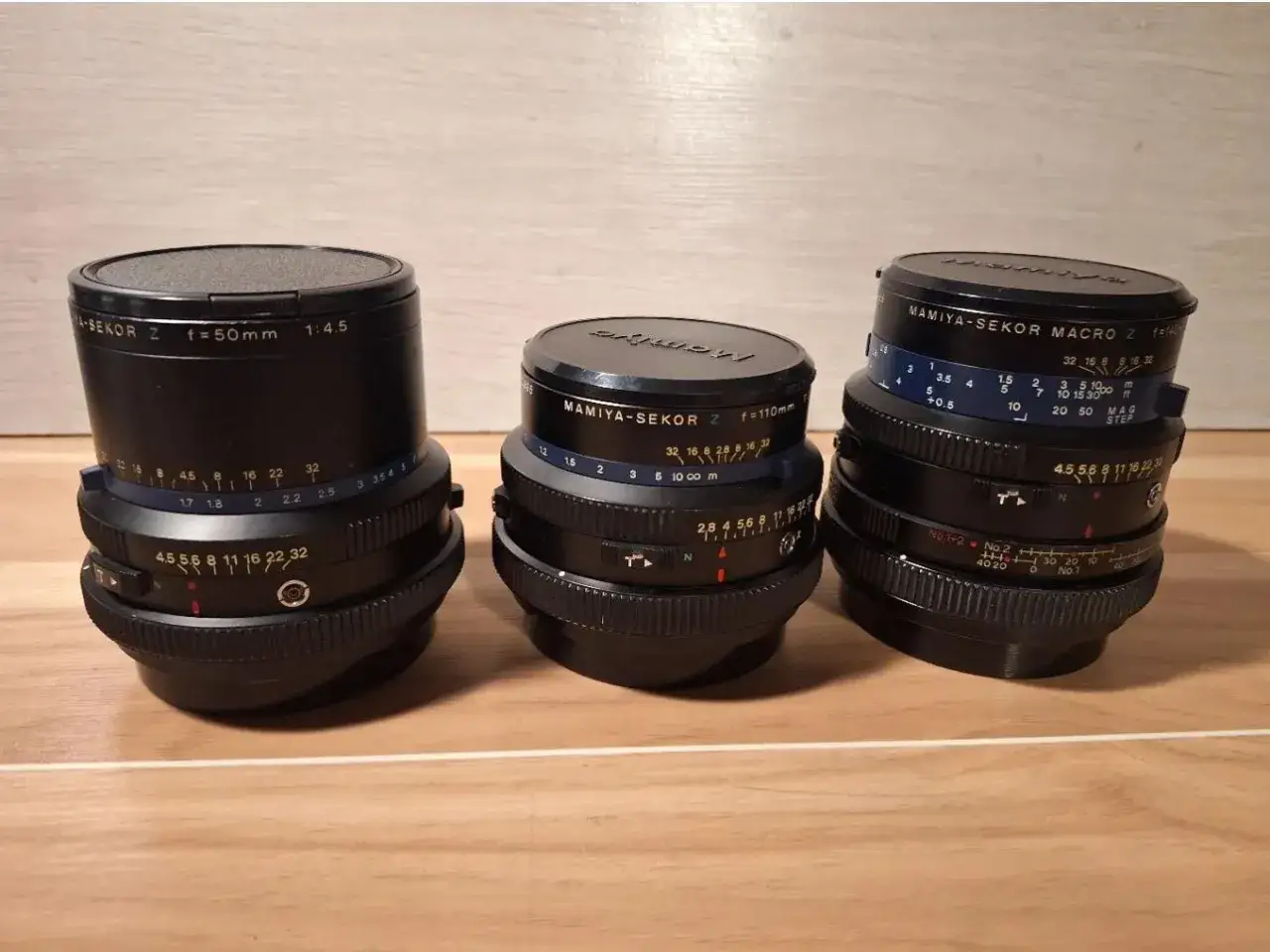
The focal lengths I would actually reach for
The full catalog is broad, but the practical question is simple: which lenses make the RZ67 feel versatile rather than just impressive on paper? For me, the answer starts with the lenses that cover everyday framing first, then moves outward to the more dramatic or specialized pieces. The sweet spot on 6x7 sits in a much tighter range than the whole brochure suggests.
| Focal length | Practical role | My read |
|---|---|---|
| 37mm f/4.5 fisheye | Extreme perspective and effect work | Fun, but highly specialized; I would not make it my first RZ lens |
| 50mm f/4.5 W / ULD | Ultrawide | Great for interiors and architecture when you need a very wide field of view |
| 65mm f/4 W / L-A | Wide but still practical | The wide lens I would call the most usable for mixed work |
| 75mm f/4.5 shift | Perspective control | The right tool when you need to keep verticals honest or move the frame with precision |
| 90mm f/3.5 W | Wide-normal | One of the best all-around focal lengths in the system |
| 110mm f/2.8 W | Classic normal | The safest first buy; bright, easy to compose with, and useful almost everywhere |
| 127mm f/3.5 W or earlier 3.8 version | Slightly tighter normal | A quiet in-between lens that works well for portraits and documentary frames |
| 140mm f/4.5 macro | Close-up and product work | Very practical if you shoot still life, details, or catalog-style images |
| 150mm f/3.5 W | Portrait lens | A comfortable step into compression without making working distance awkward |
| 180mm f/4.5 W or 180mm f/4 soft | Short telephoto | The regular version is a strong portrait choice; the soft-focus version is for a specific look, not general use |
| 210mm f/4.5 APO | Clean long telephoto | A serious lens when you want subject separation and better correction |
| 250mm to 500mm telephoto options | Compression and long reach | These are specialist tools; the 500mm especially is for photographers who know they need it |
| 100-200mm zoom | Convenience lens | Useful if flexibility matters more than size, but I would buy it after the core primes |
For most people, the real working range sits between 65mm and 180mm. The lenses outside that window are interesting, but they are usually deliberate choices rather than everyday defaults, which is why the specialty glass deserves its own section.
Specialty lenses that are worth the trouble
What makes the RZ67 line feel unusually complete is not just the number of lenses, but the fact that the odd ones are genuinely useful when you have a real problem to solve. I like that about the system. It does not force me to choose between boring practicality and creative flexibility; it gives me both, as long as I know what I am buying.
- The 75mm shift lens is the one I would buy if perspective control matters. It is the lens for architecture, tabletop, and any setup where you want to move the frame without tilting the camera into distortion.
- The 180mm soft-focus lens is not a gimmick if you know what you want from it. It gives a controlled softness that can suit portrait work, but I would never pick it as a general-purpose 180mm replacement.
- The APO telephotos matter when contrast and color fringing are the enemy. They are the lenses I would reach for if I were shooting high-detail product work, distant subjects, or anything with bright edges against dark backgrounds.
- The 100-200mm zoom is the convenience option. I can see the appeal for travel or scouting, but it is a lens I would buy only after deciding that flexibility matters more than a smaller bag.
- SB lenses are the ones people often misunderstand. They are designed for the shift/tilt adapter, and that adapter is really a close-up tool, not a general architecture fix. With the right spacer, those lenses can still be used on the body, but I would treat them as a specialized setup, not a casual add-on.
If I were buying for architecture, product work, or a very controlled studio setup, I would pay attention to the shift and macro pieces first. That naturally leads to the part most people underestimate: how the filters fit, and where they can go wrong.
Filters that actually work on the RZ67
The good news is that the filter story is simpler than it looks. Most of the system standardizes around 77mm screw-in filters, which means a single, well-chosen circular filter kit can cover a lot of lenses. The exceptions are what matter, and the exceptions are the lenses people tend to remember longest anyway.
| Lens group | Filter approach | Practical note |
|---|---|---|
| Most primes from 50mm through 350mm, plus the zoom | 77mm front filters | The easiest group to standardize; I would build my ND, CPL, and diffusion kit around this size |
| 50mm and 65mm wides | 77mm filters, but keep the hardware slim | Bulky holders and stacked rings can cause mechanical vignetting before the optics do |
| 37mm fisheye | Rear filters, commonly 40.5mm | Buy the rear-filter set with the lens if you can, because this is not a lens where improvisation feels elegant |
| 75mm shift | 105mm filters | Check clearances carefully if you use step rings or a rectangular holder |
| 500mm family | Special handling, often not a normal screw-in workflow | Do not assume that a 105mm front diameter means you can treat it like any other threaded lens |
- Standardize on 77mm first. That covers the majority of the catalog and keeps your kit sane.
- Buy 105mm accessories only if you own the shift lens or have a very specific reason to do so.
- Use slim rings on the wide lenses if you want to avoid corner shading.
- Think twice before stacking filters on the 50mm and 65mm, because mechanical vignetting shows up there quickly.
- For the fisheye, accept that the rear-filter solution is part of the lens, not an inconvenience to work around.
The rule I use is simple: buy one disciplined 77mm filter kit, add 105mm only if you own the shift lens, and treat the fisheye and 500mm as special cases rather than general-purpose filter platforms. Once that is sorted, the real risk moves from accessories to the condition of the used lens itself.
Buying used in 2026 without getting burned
In 2026, almost every copy of these lenses is a used copy, so I treat condition and service history as part of the spec. That matters even more here because the shutter lives in the lens, which means a sticky slow speed is not just a nuisance; it is a repair issue. A proper CLA, meaning clean, lubricate, adjust, is normal maintenance on gear this old, not a sign that the lens is doomed.
- Check the shutter at several speeds, especially the slow end and the top speed, and listen for consistency.
- Inspect the aperture blades for oil, hesitation, or uneven movement.
- Feel the focusing action from close to far. It should be smooth, not gritty, loose, or jumpy.
- Look for haze, fungus, scratches, and separation, especially on older wides and telephotos.
- Confirm that the listing names the exact lens family correctly. A lot of sellers blur RZ and RB terminology, and that matters.
- If you are buying an RB lens for use on an RZ body with RBL compatibility, remember the 7mm flange-distance difference, the body scale no longer applies, and the lens shutter speed ring becomes the control point.
The RB compatibility note is worth taking seriously. The RZ mount is 61mm, the RB system sits on a different geometry, and the 7mm spacing difference is exactly why the adapter or spacer exists. If the seller cannot explain that part clearly, I would move on. A clean, smooth, well-cared-for copy is worth more than a rare label with sticky blades or haze, because that is the part you will actually depend on. From there, the smartest move is to build a small kit that matches the way you really shoot.
The first kit I would build for real work
If I were starting from zero, I would keep the first RZ67 kit boring on purpose. That usually means one normal lens, one wider option, one portrait lens, and a filter set that does not fight me every time I mount it. The camera rewards discipline more than excess.
- One-lens start: 110mm f/2.8 plus a simple 77mm filter kit. This is the most flexible single-lens entry point.
- Two-lens start: 65mm and 110mm if I shoot in tighter spaces, or 110mm and 180mm if I care more about portraits and separation.
- Three-lens working kit: 65mm, 110mm, and 180mm. That covers wide, normal, and portrait without overcomplicating the bag.
- Studio or product kit: 110mm, 140mm macro, and 180mm, with 77mm filters first and 105mm only if a shift lens is part of the plan.
For a single-lens start, I would still choose the 110mm f/2.8, then add a 77mm filter kit and decide whether the next move should be a 65mm wide lens or a 180mm portrait lens based on how much space I usually have to work with.