COB lighting has become one of the most practical ways to get strong, controllable light out of a relatively small fixture. The practical answer to what is cob light used for is simple: it is used whenever you want a compact source that can deliver solid output, clean color, and easy shaping without the bulk of a traditional fresnel or the flatter feel of some panel lights. For creators, that usually means interviews, product shots, livestreams, and small studio setups; in larger lighting systems, it also shows up in street lighting, spot lighting, and high-bay applications.
The short version for creators and buyers
- COB stands for chip on board, a design that packs many LED chips into one bright emitter.
- Its main job is to provide a powerful, controllable light source that can be softened or shaped with modifiers.
- It is especially useful for photo, video, livestream, interview, and product lighting.
- It also appears in commercial lighting where high output from a compact source matters.
- The best COB light is not just bright; it is stable, color-accurate, quiet enough for the set, and compatible with the modifiers you plan to use.
How COB lighting works
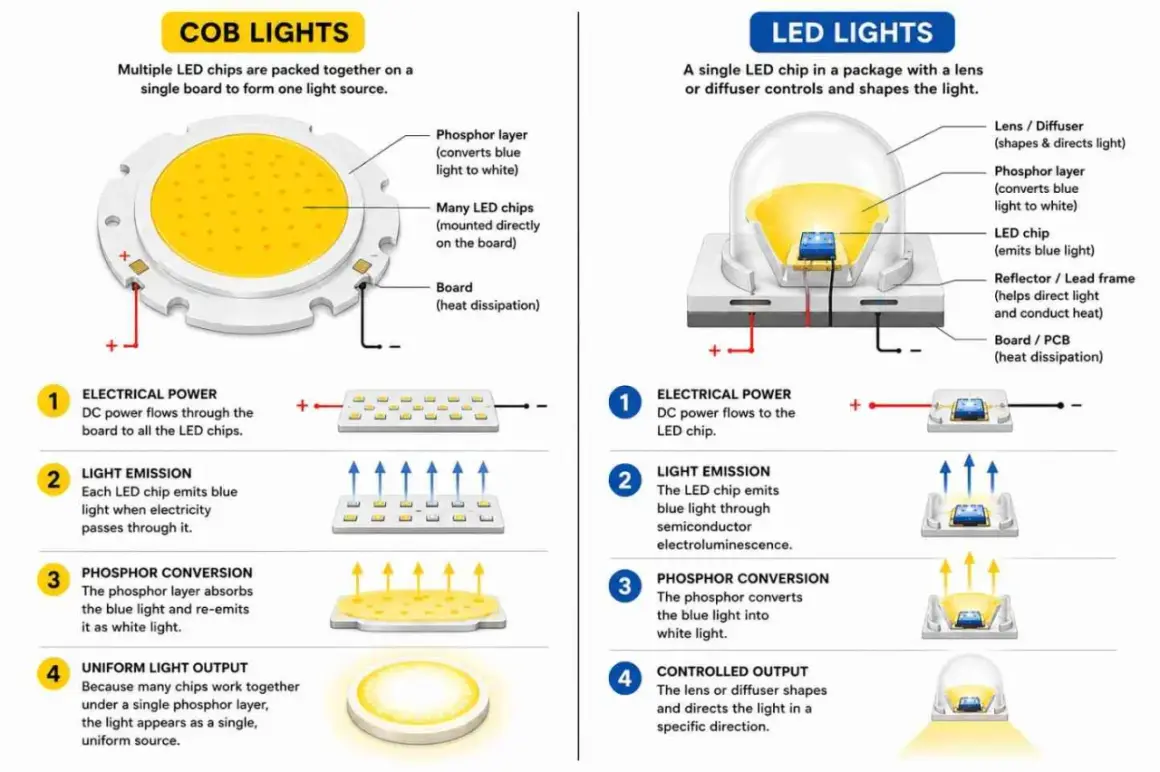
COB means chip on board. Instead of separating LED chips across a strip or board, the diodes are mounted closely together on a single substrate and covered with a phosphor layer that helps create a more uniform beam. The result is a bright source that feels like one emitter rather than a cluster of tiny points.
That matters because a compact emitter is easier to control. I can bounce it, diffuse it, flag it, or push it through a softbox and still keep the light coherent. The U.S. Department of Energy notes that COB packages are commonly used in street lighting, spot lighting, and high-bay fixtures, which tells you a lot about the technology’s core strength: it is built for high luminous output from a small source.
In plain terms, COB lighting is not magic. It is a practical packaging approach that makes LEDs more useful when you need power, efficiency, and directionality in the same fixture. That is why it has become so common in both production lighting and general illumination.
Where COB lights are used most often
Most readers are really asking where this technology actually earns its place. The answer depends on whether you care about production work, commercial lighting, or both. Here is the clearest breakdown I use when evaluating a COB fixture.
| Use case | Why COB fits | What to watch for |
|---|---|---|
| Talking-head video and interviews | It gives you a strong key light that can be softened for flattering skin tones. | Fan noise, harsh shadows if you skip diffusion, and spill in tight rooms. |
| Product photography | It provides punch for highlights, reflections, and controlled shaping through modifiers. | Specular highlights can get ugly fast if you do not manage angle and diffusion. |
| Livestreaming and webinars | Continuous output keeps the look stable on camera and makes white balance easier. | Cheap units may dim poorly or shift color at lower power levels. |
| Studio portraits and fashion | The source is easy to shape into hard light, soft light, or something in between. | You still need modifiers, flags, and background separation to keep the setup polished. |
| Retail and display lighting | It can highlight products without needing a huge fixture footprint. | Watch for hot spots and glare on glossy surfaces. |
| Street, spot, and high-bay lighting | High output from a compact source suits larger spaces and directional coverage. | Thermal design and driver quality matter much more at higher power levels. |
That mix of uses is why COB lighting is so adaptable. It is not limited to one niche. It is a source technology that can work in a creator’s bedroom studio one day and in a large commercial fixture the next.
Why creators keep reaching for COB fixtures
When I choose a light for photo or video work, I usually want four things: output, shapeability, color quality, and reliability. COB lights cover that combination better than many beginners expect.
First, they have real punch. A compact emitter can throw a lot of light, which helps when you are pushing through a softbox, bouncing off a wall, or trying to compete with window light. That extra power gives you more room to dial things in instead of running the fixture at its limit.
Second, they are easy to control. A bare COB can act like a hard source, but once you add a softbox, lantern, fresnel, or grid, it becomes very versatile. I like that flexibility because the same light can handle a clean interview one day and a more dramatic product setup the next.
Third, color quality matters. For camera work, brightness alone is not enough. Most creators should look for strong CRI and TLCI performance, and I would treat 95+ as a sensible benchmark when color accuracy matters. That is the difference between a subject that looks natural and one that needs extra correction in post.
Fourth, the ecosystem is mature. Many COB fixtures now support common modifier mounts, battery options, app control, and bi-color or RGB modes. That makes them easier to slot into a real production workflow instead of treating them like a one-off gadget.
Where COB lights are the wrong tool
COB lights are useful, but they are not the best answer in every setup. The most common mistake I see is assuming that a bright COB automatically gives a flattering image. It does not. It gives you a strong source, and what you do with that source determines the result.
They can also be the wrong fit when you need a very broad, wraparound wash with minimal shaping. In that situation, a panel light or tube light may feel easier because the source itself is already softer. A COB can absolutely get there, but only after you add the right modifier.
| Fixture type | Best for | Where it beats COB |
|---|---|---|
| COB light | Key light, product shots, controlled hard or soft light | More punch and easier modifier compatibility |
| Panel light | Soft fill, quick interview setups, broad coverage | Less setup and a gentler native output |
| Tube light | Accent lighting, practical effects, tight spaces | More flexible placement and a more decorative look |
There are also practical limits. High-output COB fixtures can generate heat, and some units rely on fans that are not ideal for quiet interviews. Cheaper models may also show color inconsistency when dimmed. If a light looks good only at full power and falls apart the moment you reduce it, that is not a strong production tool.
How to choose the right COB light for your setup
If you are buying one for content creation, start with the room, the modifier, and the distance to the subject. Those three factors matter more than the number printed on the box. A 100W light close to a subject can outperform a much stronger unit that is too far away or pushed through the wrong modifier.
As a rough starting point, I think about power like this:
- 60W to 100W for close desk interviews, webcam setups, and small product work.
- 100W to 200W for a small studio key light with a softbox or bounce setup.
- 200W to 300W for full-body portraits, larger modifiers, or rooms with more ambient light.
- 300W and up for bigger sets, heavier diffusion, or situations where the light has to fight daylight.
Modifier compatibility is another deal-breaker. If the light does not support the softbox, reflector, lantern, or fresnel you want, you will waste time solving problems that should have been solved before the purchase. I also pay attention to fan noise, app control, battery support, and build quality, because those are the details that decide whether a fixture is genuinely usable or just impressive on a spec sheet.
The practical rule I use before recommending a COB fixture
I recommend a COB light when the job calls for one controlled source that can be made hard or soft without losing too much power. That is the core use case, and it explains why the format is so common in production, retail, and general lighting. It is not just about brightness. It is about having a source that can be shaped into the look you need.
If you want the simplest possible answer, think of COB as the best choice when you need power, control, and modifier flexibility in one fixture. If you need ultra-soft coverage with almost no setup, another fixture type may be easier. If you need a workhorse key light that can carry interviews, product demos, and small studio work, COB is usually the first place I would look.
That is why the format has stayed relevant: it solves a real lighting problem instead of chasing a trend. For most creators, one good COB light does more useful work than several cheaper lights that cannot be shaped or trusted consistently.