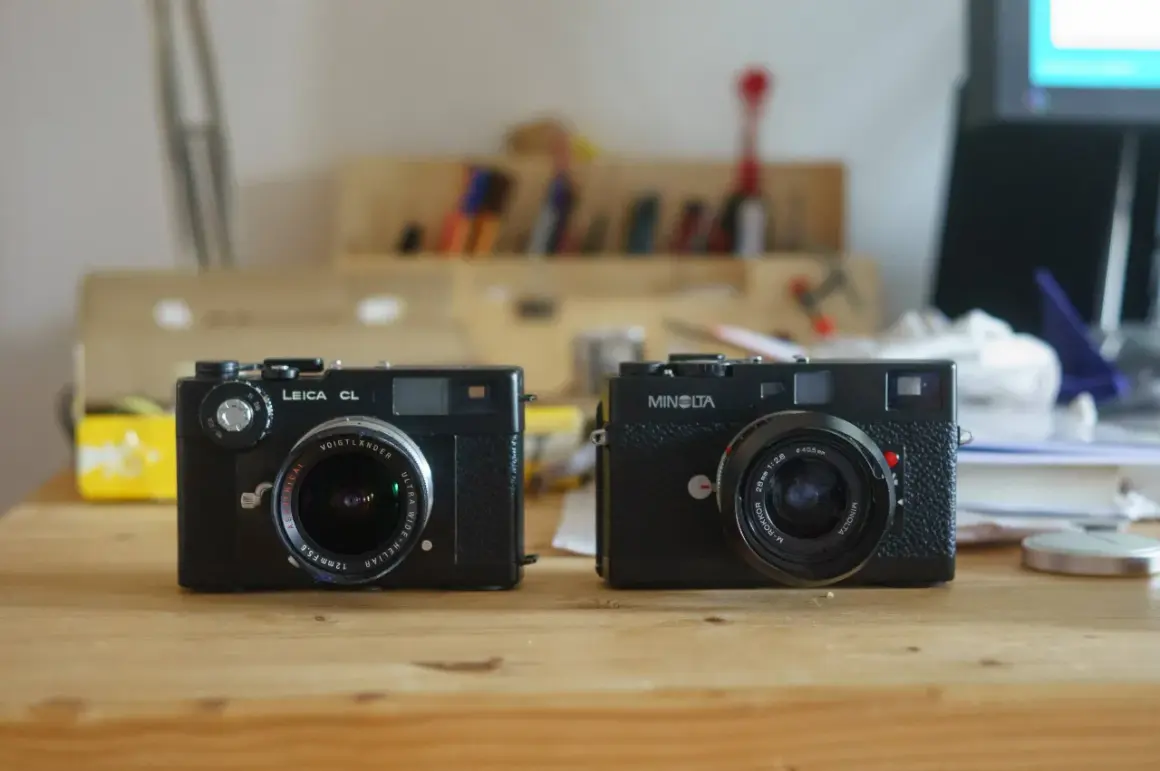
The Leitz Minolta CL is one of those cameras that makes sense only when you want a compact 35mm rangefinder without giving up interchangeable M-mount lenses. In this guide I focus on what it is, how the finder and meter behave, where it shines in real film work, and what I would check before paying used-market money for one.
What matters most before you buy or shoot one
- It is tiny for a real rangefinder, at about 365 g and roughly 121 x 76 x 32 mm, so it carries more like a compact than a classic M body.
- The native frame lines are 40, 50, and 90 mm, and the camera feels most natural with the 40 mm lens it was built around.
- The shutter is mechanical, from 1/2 to 1/1000 sec plus Bulb, so the camera still works even if the meter battery dies.
- The TTL meter reads a central area, which is practical but less forgiving than full-frame averaging in backlit scenes.
- Condition matters more than cosmetics, because a bright rangefinder patch and smooth transport are worth more than a shiny shell.
What the camera actually is and why the name is messy
This is a Minolta-built compact rangefinder that was developed in collaboration with Leica, and that collaboration is the reason the naming can feel confusing in the first place. Depending on market and badge, you will see it referred to as the Leica CL, the Leitz Minolta CL, or simply the CL, but the useful part is not the label, it is the camera body itself: a small 35mm rangefinder with an M-mount bayonet and a very specific set of framelines.
I think it helps to stop seeing it as a “mini M” and start seeing it as a purpose-built tool. It was designed to give you rangefinder shooting, M-lens compatibility, and a lighter bag without dragging around a larger body. That design choice explains almost everything about the camera, including its strengths and its compromises. Once you accept that, the specs make a lot more sense.
Core specs that matter in daily use
| Spec | What it means in practice |
|---|---|
| Film format | 35mm film, so it uses standard 135 cartridges and shoots full-frame 24 x 36 mm negatives. |
| Lens mount | Leica M bayonet, which opens the door to a large lens ecosystem, even if the finder is framed around 40/50/90 mm work. |
| Finder | Bright-line rangefinder with automatic parallax correction and a 0.6x feel that is clear, but not huge. |
| Exposure meter | Selective TTL metering that reads a central area through the taking lens, not the whole frame. |
| Shutter | Mechanical speeds from 1/2 to 1/1000 sec plus Bulb. |
| Film speed range | ASA 25 to 1600, which covers most practical black-and-white and color negative film choices. |
| Flash sync | Electronic flash at 1/60 sec and Bulb; simple enough for occasional fill flash. |
| Battery | Original meter cell was a PX625 mercury battery, so modern replacements or adapters are the real-world solution now. |
| Weight | About 365 g, which is a major reason people still reach for it. |
Those numbers only matter if the finder makes them usable, and that is really where this camera earns its reputation. The next question is not just what it can do on paper, but how it feels when you look through it and start composing.
Why the finder and 40 mm lens matter
The CL’s finder is built around the idea that you will mostly shoot a 40 mm lens, and that design choice shows up immediately. The 40 mm frame is always visible, the 50 mm frame can stay in view as well, and the 90 mm frame gives you a useful long option without turning the finder into a cluttered mess. I like that restraint. It keeps the camera readable instead of trying to impress you with too much information at once.
The metering patch and the rangefinder patch sit in the middle of the frame, so you can focus and judge exposure without constantly shifting your eye. The meter reads a central portion, roughly a selective patch rather than the whole scene, which is good when you want to meter a face, a doorway, or a midtone object. It is less forgiving when the important subject is not centered, so backlit scenes need more attention.
- 40 mm feels like the camera’s native language. It is the safest choice if you want the CL to feel coherent.
- 50 mm is comfortable if you prefer a classic normal lens and do not mind a slightly tighter workflow.
- 90 mm is fine for portraits and details, but focusing precision matters more because the rangefinder is not especially generous.
- 35 mm can work on an M-mount lens, but I would treat it as a compromise rather than the camera’s sweet spot.
What I find most practical is that the CL pushes you toward a simple lens choice instead of a gear-cycling habit. That limitation is not a flaw so much as a design decision, and once you shoot with it for a while, the next thing you notice is how the camera behaves in motion.
How it behaves when you actually shoot it
On the street or during travel, this is where the CL makes its case. It is small enough to disappear in a bag, quiet enough to avoid announcing itself, and simple enough that you can move through a scene without thinking about modes or menus. I like that the speed dial sits on the front instead of cluttering the top plate, because it keeps the camera feeling tidy and makes exposure changes feel deliberate.
The working rhythm is straightforward: load film, set the film speed, cock the shutter, meter the scene, focus, and fire. Because the shutter is mechanical, the camera does not turn into a paperweight if the meter battery dies. That matters more than people admit, especially when you are traveling and do not want one missing coin cell to end the day.
- Set the film speed before you start, so the meter is actually useful.
- Pull the advance lever off rest to wake the meter and check the needle.
- Use the center patch to focus precisely, then confirm your framing.
- Meter the tone that matters, not just whatever is sitting in the middle of the frame.
- Advance cleanly and keep shooting, especially if you are on a walk and the light is changing fast.
I would not pick it as my first choice for fast action or close-focus work at wide apertures, because the finder is good rather than luxurious. But for documentary walking, city detail, portraits at normal distances, and travel scenes where you want to stay light, it works with a kind of calm efficiency. That brings up the part most buyers should think about before they get romantic about the badge, which is the condition of the actual camera in front of them.
What to check before you buy a used copy
If I were inspecting one in person, I would care much more about the rangefinder and transport than about cosmetic wear. A scuffed top plate is ordinary for a camera this age. A dim finder, sticky advance, or erratic meter is where the real cost starts. In the U.S. used market, a healthy copy can still sit anywhere from the low hundreds into the higher hundreds depending on condition, and a pricing guide like CollectiBlend shows the same broad spread: good bodies stay relatively accessible, while mint or kit examples climb quickly.
- Rangefinder patch should be bright, clear, and easy to align. If it is dim or badly misaligned, focus will frustrate you every time.
- Shutter should sound even across speeds. A lazy curtain or sticky slow speeds usually means service is due.
- Advance and rewind should feel smooth, with no grinding, skipping, or partial cocking.
- Meter needle should respond consistently when the battery is fresh and the lever is slightly advanced.
- Lens aperture blades should close cleanly and open without oiliness or hesitation.
- Light seals and foam should not be gooey or missing, because light leaks can ruin otherwise good film.
I would also budget for service, not just for purchase. A clean, working, recently checked body is a better deal than a cheaper copy with a mystery meter or a vague description of “needs attention.” Once that is clear, the next decision is whether the CL is actually the best compact rangefinder for your style, or just the one with the most interesting story.
How it stacks up against the alternatives
| Camera | What it does best | What you give up | Best for |
|---|---|---|---|
| CL | Compact M-mount rangefinder, simple manual operation, very good 40 mm pairing | No 28 mm frameline, no auto exposure, shorter finder feel than a full M body | Photographers who want a small manual rangefinder and already like 40 mm or 50 mm lenses |
| CLE | Brighter finder, 28/40/90 framelines, aperture priority automation | More electronics and a different shooting character | People who want the most flexible compact M-mount user experience |
| Canonet QL17 GIII | Simple fixed-lens rangefinder, often cheaper to enter | No interchangeable lenses, less system growth | Anyone who wants a dependable compact rangefinder without building a lens kit |
| Leica M body | Better finder confidence, classic build, stronger all-around system | Much larger and usually much more expensive | Users who care more about the full M experience than about size or cost |
My blunt take is this: the CL makes sense when you want the M-mount path in the smallest practical manual body, and you are happy living mostly in the 40 mm and 50 mm world. If you want a more forgiving finder or a wider frameline set, the CLE usually wins. If you want the purest compact manual rangefinder experience without caring about interchangeable lenses, a fixed-lens body can be the smarter buy. That decision gets easier once you know how to keep a good copy working for the long term.
How to keep a good copy enjoyable in 2026
In 2026, I would treat this camera as a condition-first purchase and a maintenance-light shooter only after it has proven itself. The original mercury battery is obsolete, so plan on a modern 1.35V replacement or adapter solution for the meter. I would also test the camera with actual film before trusting it for a trip, because rangefinders can look beautiful in a listing and still feel gritty in the hand.
- Start with the 40 mm lens, because it gives you the cleanest read on what the camera wants to be.
- Use the meter as guidance, not gospel, especially in backlight or snow.
- Budget for a CLA if the transport feels uncertain, because old mechanics rarely improve on their own.
- Pay for a bright finder and clean mechanics before you pay for box, papers, or collector appeal.
When it is healthy, this is still one of the most satisfying compact rangefinders to carry: small, direct, and honest about what it does well. That is the real reason the CL continues to matter for film photographers who want a lightweight M-mount body without losing the feel of a true manual camera.