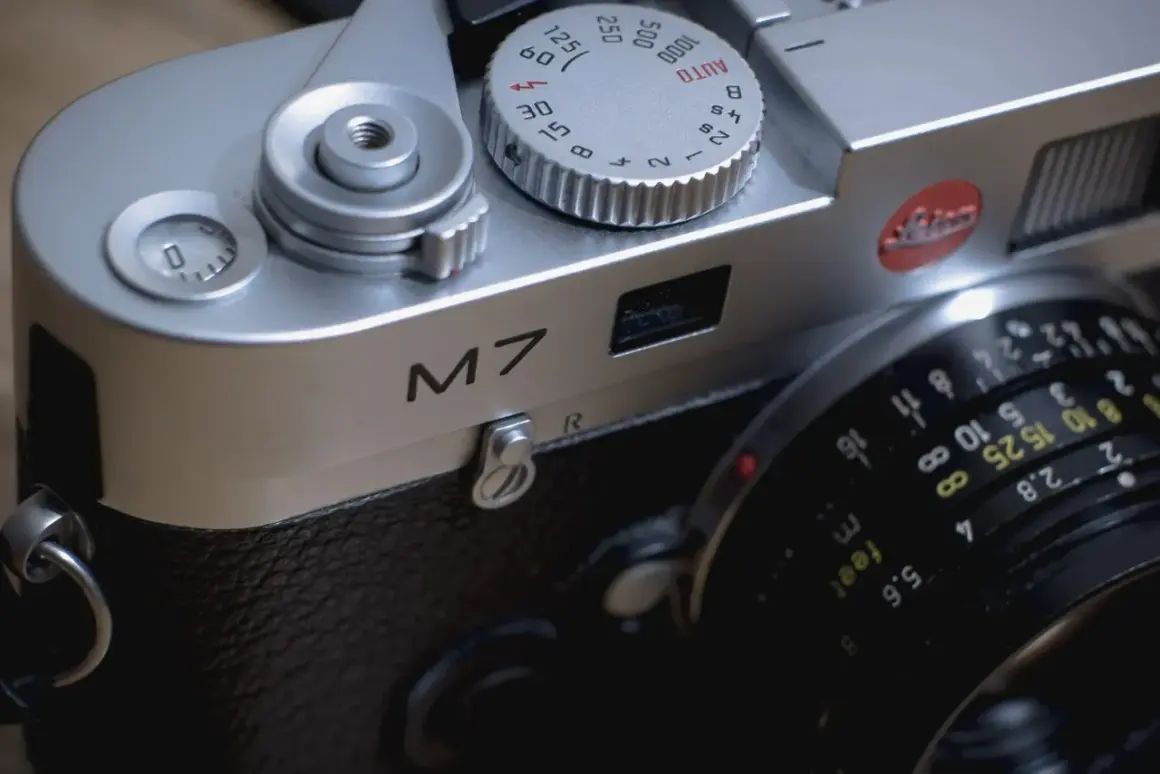
The Leica M7 sits in a narrow but interesting lane: it keeps the tactile, manual-focus character of the M system while adding aperture-priority automation, TTL flash, and an electronic shutter that can help when light changes faster than your hands do. This Leica M7 review focuses on how that hybrid design works in practice, what kind of photographer benefits most from it, and where the camera still asks you to slow down and think like a film shooter. I’ll also cover what matters when buying one in 2026, because with this body, condition and service history are part of the product.
Key things to know before buying or shooting an M7
- It is a true M camera, not a stripped-down experiment. The M7 keeps the rangefinder workflow but adds aperture priority and an electronically controlled shutter.
- The standard finder is 0.72x. That makes it comfortable for 35mm and 50mm lenses, with bright-line pairs for 28/90, 35/135, and 50/75.
- Automation is useful, but not unlimited. Auto mode runs from 32 seconds to 1/1000 second, while manual mode runs from 4 seconds to 1/1000 second.
- Battery failure does not completely kill the camera. You still have 1/60 and 1/125, but the body is not fully mechanical.
- Used prices are still high. Clean certified examples currently sit in the high-€3,000 range, with special editions far above that.
- Best fit: photographers who want rangefinder handling with just enough automation to keep the camera moving in mixed light.
What the M7 is really designed to do
The M7 was built for a simple problem: plenty of photographers loved the M system, but did not always want to meter and set shutter speed manually for every frame. Leica solved that by making the M7 the first M with aperture-priority exposure and an electronically controlled shutter, while leaving the rest of the experience recognizably Leica. In other words, the camera does not try to become a compact SLR or a pseudo-digital body; it tries to remove friction without changing the feel.
That design choice matters because the M7 still uses the M bayonet, still focuses through a rangefinder, and still expects you to know your lens choice. The standard body ships with a 0.72x finder, and the bright-line frames cover common focal lengths such as 28, 35, 50, 75, 90, and 135 mm. Wider lenses can be used, but if you are serious about 21 mm or 24 mm framing, you are back in accessory-viewfinder territory. That is very Leica: refined, compact, and a little uncompromising in ways that make sense once you start shooting. The important question is how that translates at eye level.
How it feels in hand and in the viewfinder
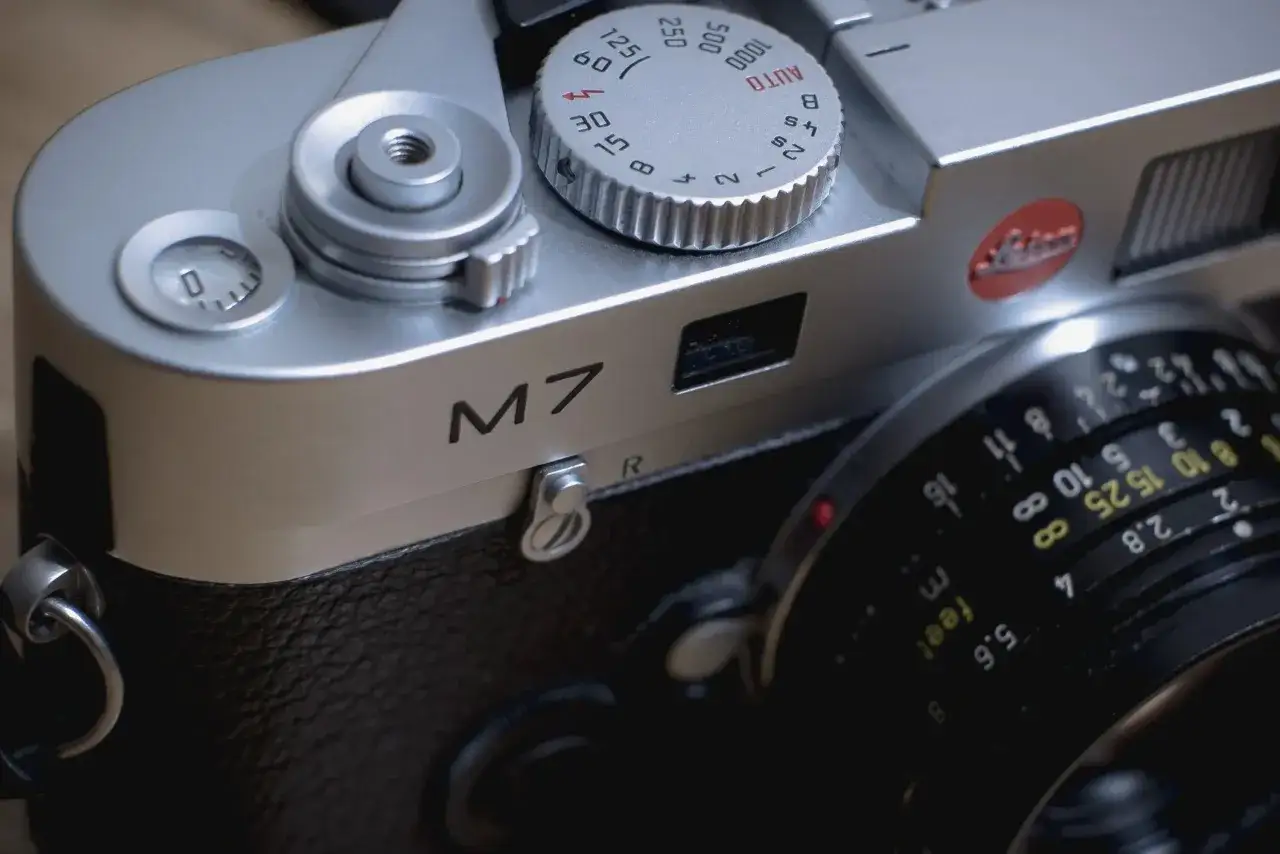
What I like most about the M7 is that its ergonomics do not get in the way of the picture. The body is compact at roughly 138 x 79.5 x 38 mm and weighs about 610 g without batteries, so it has enough density to feel serious without becoming a burden on a long day. The shutter is cloth-based and extremely quiet, which makes the camera genuinely useful for street work, documentary situations, and any environment where you do not want the camera announcing itself.
The viewfinder is where the camera earns its keep. Leica built in exposure information without cluttering the frame, so you can see shutter speed, film speed, exposure mode, and flash readiness along the bottom while still concentrating on composition. That sounds minor until you shoot a full roll under changing light and realize how often it saves a half-second of mental arithmetic. For me, the real advantage is not speed for its own sake; it is reduced hesitation. The camera still demands manual focus, but it removes just enough decision-making to help you stay responsive when the subject does not pause for you. Once you understand that balance, the exposure system starts to make even more sense.
Exposure control and flash are the real reason to choose it
The M7 is not just an M body with an extra letter. Its exposure system is the feature that defines the camera, and it is worth understanding the limits clearly before you buy one.
| Feature | What it gives you | Why it matters |
|---|---|---|
| Auto exposure | Aperture priority from 32 seconds to 1/1000 second | Ideal for changing light, quick street shooting, and travel |
| Manual mode | 4 seconds to 1/1000 second, plus Bulb | Lets you stay fully in control when you want a deliberate look |
| Fallback speeds | 1/60 and 1/125 are mechanically controlled | The camera is not dead if the battery fails, but it is limited |
| Metering | TTL, center-weighted, with a 12 mm metering spot | Good for intentional metering, less forgiving than a modern multi-zone system |
| Flash | TTL flash with 1/50 sync; higher speeds with compatible flash setups | Useful for fill flash and controlled daylight portrait work |
The practical takeaway is straightforward: the M7 rewards photographers who know what aperture they want but do not want to micromanage shutter speed on every frame. I also appreciate the ISO handling, because it reflects the same philosophy. With DX-coded film, the camera can auto-set roughly ISO 25 to 5000, while manual settings stretch from ISO 6 to 6400. Exposure compensation reaches +/- 2 EV, which is enough for real-world correction without turning the camera into a software problem. The 12 mm metering spot covers roughly 13% of the frame, so it feels more like a deliberate center-weighted/spot hybrid than a modern evaluative meter. If you shoot negative film, that flexibility feels natural. If you shoot slide film, or if you routinely work in harsh backlight, you will still need discipline, because the meter is helpful but not magic. That leads directly to the camera’s strengths and the compromises you have to accept.
Where the camera earns praise and where it can annoy you
The strongest case for the M7 is that it combines Leica M handling with a feature that genuinely improves response time. In mixed light, I would rather have aperture priority on a rangefinder than wish I had it after missing the moment. The body also benefits from classic Leica build cues: all-metal construction, brass top and base plates, and the kind of precise mechanical feel that makes even simple actions feel considered.
But I would not romanticize it too much. The M7 is not the body for someone who wants a camera that can sit in a drawer for years and come back to life with zero concern. Battery dependence is the obvious trade-off, and age adds another layer: electronics, viewfinder LEDs, meters, and the DX reader all deserve inspection before you trust the body. It is also not cheap. Current certified listings from Leica’s own pre-owned channel sit around the high-€3,000 range for standard bodies, while special editions can go far beyond that. That pricing makes the M7 as much a purchase decision as a creative one, which is why comparison shopping matters.
- Best strengths: quiet shutter, aperture priority, great M-lens compatibility, unobtrusive exposure display.
- Main weaknesses: battery dependence, old electronics, premium used pricing, and no shortcut around rangefinder focus.
- Most common mistake: buying the body for the Leica name while ignoring service history and meter behavior.
Once you are honest about those trade-offs, the next decision is not whether the M7 is good, but whether it is the right M body for the way you actually shoot.
Leica M7 versus MP and M-A in plain English
If you are deciding between Leica film Ms, I would keep the comparison simple. The M7 is the one that gives you the most convenience without abandoning the rangefinder experience. The MP keeps the meter but goes fully mechanical. The M-A drops the meter entirely and gives you the most stripped-back version of the system. That is the whole decision tree in practical terms.
| Body | Metering | Shutter behavior | Best for |
|---|---|---|---|
| M7 | TTL meter with aperture priority | Electronically controlled, with 1/60 and 1/125 fallback | Mixed light, faster pacing, and photographers who value convenience |
| MP | TTL meter | Fully mechanical | People who want a meter but want battery-free shooting continuity |
| M-A | No built-in meter | Fully mechanical | Manual shooters who want absolute simplicity and nothing extra |
If I were choosing with my own money, I would pick the M7 when I know I will shoot in changing light and want a body that helps me stay in rhythm. I would pick the MP if I wanted the same rangefinder feel with less electronic dependence. I would pick the M-A only if I truly enjoy working without a meter and do not want the camera to negotiate with me at all. That also means the best purchase is not always the cleanest-looking one; it is the one with the healthiest mechanics and the best service history.
How to buy a good used body in 2026
Buying an M7 used is mostly about avoiding false economy. A cosmetically attractive body with weak electronics, sticky controls, or a failing meter can become expensive very quickly. I would rather buy a less pretty camera with verified service than gamble on a mint shell with no history. In 2026, that is especially important because the body is no longer a bargain-tier curiosity; it is a premium used camera with collector pressure attached.
When I evaluate one, I check the same handful of things every time:
- Meter response: the LEDs should behave consistently in both auto and manual exposure modes.
- Shutter behavior: test the full range, not just a few quick speeds.
- Viewfinder clarity: look for haze, separation, dirt, or patch dimming that makes focusing less precise.
- Battery compartment: inspect for corrosion or looseness, because power issues can masquerade as bigger faults.
- DX reader and ISO dial: important if you rely on automatic film-speed recognition.
- Rangefinder alignment: a soft or misaligned patch defeats the whole point of the camera.
- Service history: this matters more than a near-mint exterior.
For a U.S. buyer, I would also factor in return policy, shipping, and the realistic cost of a cleanup or CLA if the camera has not been checked recently. A body that looks cheap on the listing page can easily become the most expensive option after repairs. Once you know what to verify, the final question is not whether the M7 is capable, but whether its particular balance of speed and dependence actually fits your style.
When the M7 is the smarter Leica to carry
The M7 makes the most sense when you want a film camera that still keeps pace with real life. I would choose it for street work, travel, casual documentary shooting, and any situation where aperture priority means fewer missed frames. It is also a strong choice if you already know the M system and want a body that feels familiar but less demanding under pressure. That combination is the camera’s real trick: it protects the Leica experience without insisting that every exposure be a small manual ritual.
It is less compelling if you want maximum mechanical security or if your ideal camera disappears into the background and asks almost nothing from you. In that case, the MP or M-A is the cleaner answer. My own rule is simple: if the idea of aperture priority on a rangefinder sounds like a convenience you will actually use, the M7 is worth serious attention; if it sounds like a feature you may admire but never rely on, buy the more mechanical body and stop paying for electronics you do not want. For the right photographer, though, the M7 remains one of the best examples of Leica improving the workflow without flattening the character.