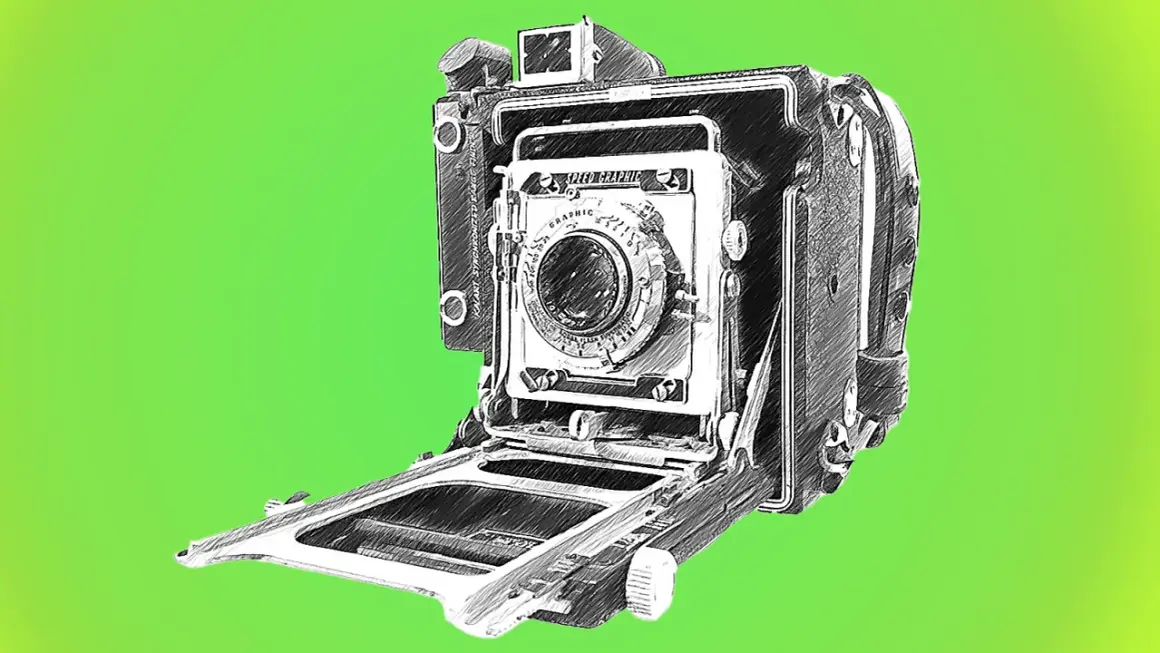
The Graflex Speed Graphic is one of those cameras that rewards patience with a very specific kind of image-making: large negatives, mechanical control, and a handheld press-camera feel that still makes sense for certain film shooters. I think that matters because it gives you a real alternative to both casual 35mm shooting and slower studio-only large-format work. Here I cover how the camera works, which film and lenses make sense, what to inspect before buying, and where it still fits in a 2026 film workflow.
The essentials that decide whether it fits your workflow
- It is a folding 4x5 press camera built for speed, not a stripped-down field camera.
- The rear focal-plane shutter is the defining feature on genuine Speed models and changes which lenses you can use.
- For most photographers, a 135mm lens is the safest first choice; 127mm and 150mm are also common.
- Graflok backs are the most useful version for film handling because they support sheet holders, Grafmatic backs, and roll-film adapters.
- In the U.S. used market, a working setup usually costs a few hundred dollars, while clean or rare kits cost more.
- It still makes sense if you want a mechanical, deliberate, contact-print-friendly camera that can also be used handheld.
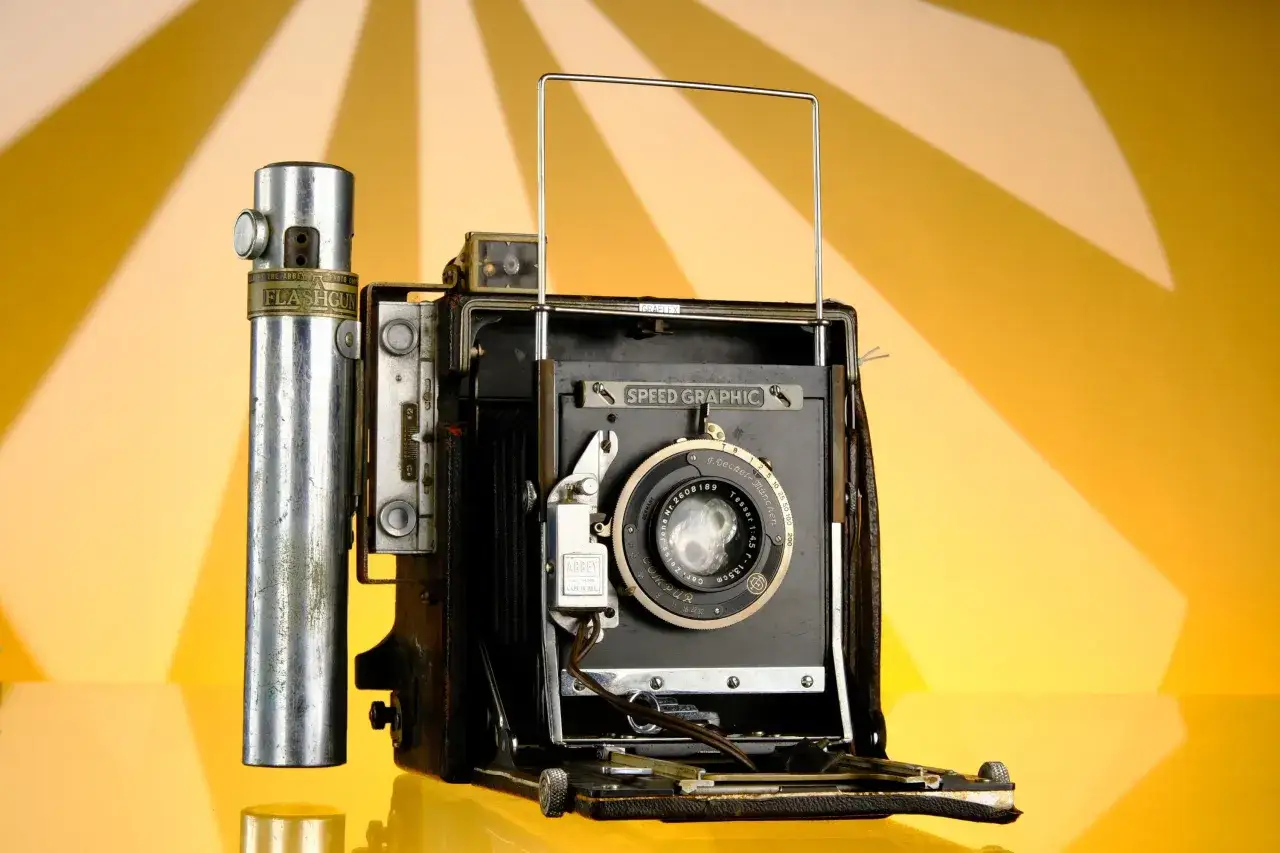
What made this 4x5 press camera a classic
The Speed Graphic became famous because it solved a real problem for working photographers: how to carry a large-format camera that could still be used quickly on location. It folds into a manageable package, opens into a rigid bed-and-bellows camera, and gives you enough controls to handle press, portrait, documentary, and general commercial work without feeling like a miniature view-camera lab. That combination made it the default choice for decades, and it is still easy to understand why.
What stands out to me now is not nostalgia but balance. You get the detail and tonal separation of 4x5 film, yet the camera still supports a rangefinder, flash work, and handheld shooting if the setup is right. It is heavy enough to feel serious, but not so abstract that every shot becomes an engineering project. That is also why collectors and active film shooters still talk about it in the same breath, even though their reasons for owning one are not identical.
The practical takeaway is simple: this is a camera that was built to be used, not just displayed. Once you understand that, the rest of the ownership questions become much easier to answer. Next I’ll get into the mechanics that make it feel so different from most other large-format cameras.
How the shutter, rangefinder and back work together
The most important thing to understand is that the Speed has two shutter systems. The rear focal-plane shutter gives you fast speeds, up to 1/1000 second on many versions, and it also lets you use barrel lenses that have no shutter of their own. The lens shutter, usually a leaf shutter built into the lens, is the cleaner choice for flash and often the simpler choice overall. You do not use both at once, so the first habit to build is knowing which shutter is actually making the exposure.
That dual-shutter design is useful, but it also creates the biggest beginner mistake: forgetting which shutter is active and exposing nothing, or fogging a sheet by leaving the curtain in the wrong state. I would treat the camera as two systems living in one body. The focal-plane shutter is for speed and lens flexibility. The lens shutter is for straightforward exposures and flash-friendly work. Once that distinction is automatic, the camera becomes much less intimidating.
- Focal-plane shutter: useful for barrel lenses and the classic press-camera workflow.
- Lens shutter: usually the easier choice for flash and general shooting.
- Rangefinder: handy for handheld work, but only accurate if it is matched to the lens and properly calibrated.
- Ground glass: the reliable way to check focus, movements, and composition.
- Graflok back: the most flexible rear standard for sheet holders and accessories.
The back matters more than many buyers expect. A Graflok back is the version I would want because it accepts standard sheet-film holders and makes it easier to use accessories such as Grafmatic magazines or roll-film backs. A spring back can still work, but it is less flexible and more limiting if you want to experiment. The real lesson here is that the camera is only as practical as the back, shutter, and rangefinder setup you end up with. From there, lens and film choices start to matter in a very real way.
Film and lens choices that make sense today
As of 2026, 4x5 sheet film is still a live format in the U.S. market. Black-and-white sheets are often roughly in the $3 to $6 per sheet range, while color is usually higher, sometimes around $6 to $10 or more per sheet depending on the emulsion and pack size. That means the camera is still usable, but every frame has enough cost attached to push you toward deliberate shooting. I actually think that is part of the appeal.
If you want the most straightforward starting point, I would pair the camera with a 135mm lens in a shutter. A 127mm lens is a classic press-camera choice and gives a slightly wider feel, while 150mm is a comfortable normal-to-short-portrait option. Wider than that, the camera gets more complicated because the rear curtain limits how wide you can comfortably go on a genuine Speed body. If you need very wide glass, especially in the 47mm to 65mm range, a Crown Graphic or different 4x5 camera is usually the better fit.
| Lens or format choice | Why it works | What I would use it for | Main tradeoff |
|---|---|---|---|
| 4x5 sheet film | Full-size negatives with the classic large-format look | Portraits, landscapes, archival work, contact printing | Slowest and most expensive per frame |
| Grafmatic holder | Six sheets in one compact holder | Handheld shooting and faster field work | More moving parts and more to inspect |
| 120 roll-film back | Lower per-frame cost and easier testing | Learning the camera or shooting more frames quickly | Less of the 4x5 negative size and feel |
| 135mm lens | Best all-around focal length for most users | General photography, portraits, travel, practice | Not especially wide or dramatic |
| 127mm or 150mm lens | Classic press-camera balance | Documentary work, portraits, everyday shooting | Requires a little more judgment in framing |
If I had to reduce the buying advice to one sentence, it would be this: choose the lens and film path first, then buy the body that actually supports it. That is the difference between owning a camera you use and owning one that only looks right on a shelf. The next issue is condition, because vintage cameras can be charming and still not be ready to shoot.
What to check before you buy one
If I were buying a Graflex Speed Graphic in 2026, I would spend almost all my attention on the parts that directly affect light-tightness and shutter function. The cosmetic stuff matters less than the bellows, the curtain, the lens shutter, and the state of the back. A clean case does not make an unusable camera usable.
| What to inspect | Healthy sign | Red flag | Why it matters |
|---|---|---|---|
| Bellows | No obvious cracks or pinholes | Light leaks, patches everywhere, stiff folds | Any leak ruins sheet film immediately |
| Focal-plane shutter | Curtain moves cleanly and speeds sound distinct | Tears, holes, frozen tension, uneven travel | Essential on genuine Speed models |
| Lens shutter | Blades open and close without sticking | Oil, hesitation, dead slow speeds | Determines whether the lens is actually usable |
| Rangefinder | Looks complete and can be matched to a lens | Missing cam, sloppy alignment, broken optics | Handheld accuracy depends on it |
| Back and ground glass | Locks securely and sits flat | Warped frame, loose clips, missing hardware | Film flatness and focusing both suffer |
| Lens board and infinity stops | Board is present and hardware is solid | Missing board, stripped screws, no stops | Setup becomes slower and less predictable |
My practical budget range in the U.S. is usually this: $75 to $200 for a rough body, $250 to $500 for a usable camera with a decent lens or two and some holders, and $500 to $800-plus for a cleaner, more complete kit. Rare variants, recently serviced examples, and especially tidy Super Speed versions can go higher. I would rather pay a premium for a camera with a known-good bellows and a believable shutter than save money on something that needs a full resurrection. That tradeoff becomes clearer once you start thinking about how you will actually shoot it.
How I would shoot a first roll of 4x5
The first session should be simple. I would start with one standard lens, two holders, a light meter, and enough time to make mistakes without rushing. Large-format cameras punish hurry more than they punish lack of talent, which is why a boring first outing is often a successful one.
- Check the bellows and shutter before loading any film.
- Load two holders in a changing bag and keep exposed and unexposed sides clearly separated.
- Open the camera, extend the bed, and focus on the ground glass first.
- Use the rangefinder only after you confirm it agrees with the ground glass.
- Choose one shutter system for the exposure and set the camera for that system only.
- Stop down to the working aperture, insert the dark slide, and make the exposure.
- Recheck the curtain, holder orientation, and dark slide before closing the camera.
There are a few mistakes I see over and over. People trust the rangefinder before they trust the lens calibration. They try to shoot too wide open before they know how the camera focuses. They load expensive film and then discover the curtain was left in the wrong position. None of these problems are mysterious, and none of them are a reason to avoid the camera. They are just reminders that this is a deliberate tool.
If you want one more practical habit, use the first roll or box of sheets to build a contact sheet and evaluate the negatives before you chase creative novelty. That feedback loop is where this camera starts paying off. Once the workflow feels natural, the bigger question becomes whether the Speed is the right large-format machine for the job compared with other options.
When this camera beats other large-format options
For me, the Speed wins when I want a handheld-capable 4x5 camera with a real mechanical personality. It is especially strong if I want to use a barrel lens, if I care about the historic press-camera feel, or if I want a system that still works well with sheet holders and a rangefinder. It also has a kind of honesty that I appreciate: it tells you immediately whether you are prepared or not.
| Camera | Best advantage | Main compromise | Best fit |
|---|---|---|---|
| Speed Graphic | Focal-plane shutter, barrel-lens flexibility, classic handheld press handling | Heavier, thicker, and less friendly to very wide lenses | Handheld 4x5, portraits, documentary-style work, mechanical charm |
| Crown Graphic | Lighter body and easier wide-angle lens use | No rear focal-plane shutter | Travel, wider lenses, simpler ownership |
| Modern field camera | More movements and more precision | Usually costs more and feels less like a press camera | Landscape, architecture, controlled tripod work |
If your shooting style is mostly tripod-based and your priority is lens movements, a modern field camera often makes more sense. If your priority is light weight and wide-angle freedom, the Crown is usually the cleaner buy. The Speed sits in the middle: less refined than newer cameras, but more flexible in its own odd, durable way. That middle ground is why it still earns shelf space for the right photographer.
Why this old press camera still earns its keep
I would still recommend this camera to photographers who want a large-format system with character, who are comfortable with a slower rhythm, and who like the idea of building each frame carefully. It is not the easiest way into 4x5, but it is one of the most satisfying ways to learn how much discipline large format can teach you. The combination of a rangefinder, a folding press body, and real sheet-film negatives still has a useful edge in the right hands.
- Buy it if you want a mechanically interesting 4x5 that can still be used on the move.
- Buy it if you want to explore classic press-camera shooting without jumping straight to a monorail.
- Skip it if your work depends on very wide lenses or maximum movements.
- Skip it if you want the lowest-friction path to large format.
My short version is this: choose a healthy body, a sound lens, and a lens or film path that matches the way you actually shoot. If those three things line up, the camera is still a practical, rewarding tool in 2026. If they do not, the romance of the shape will wear off quickly, and I would rather be honest about that than pretend otherwise.