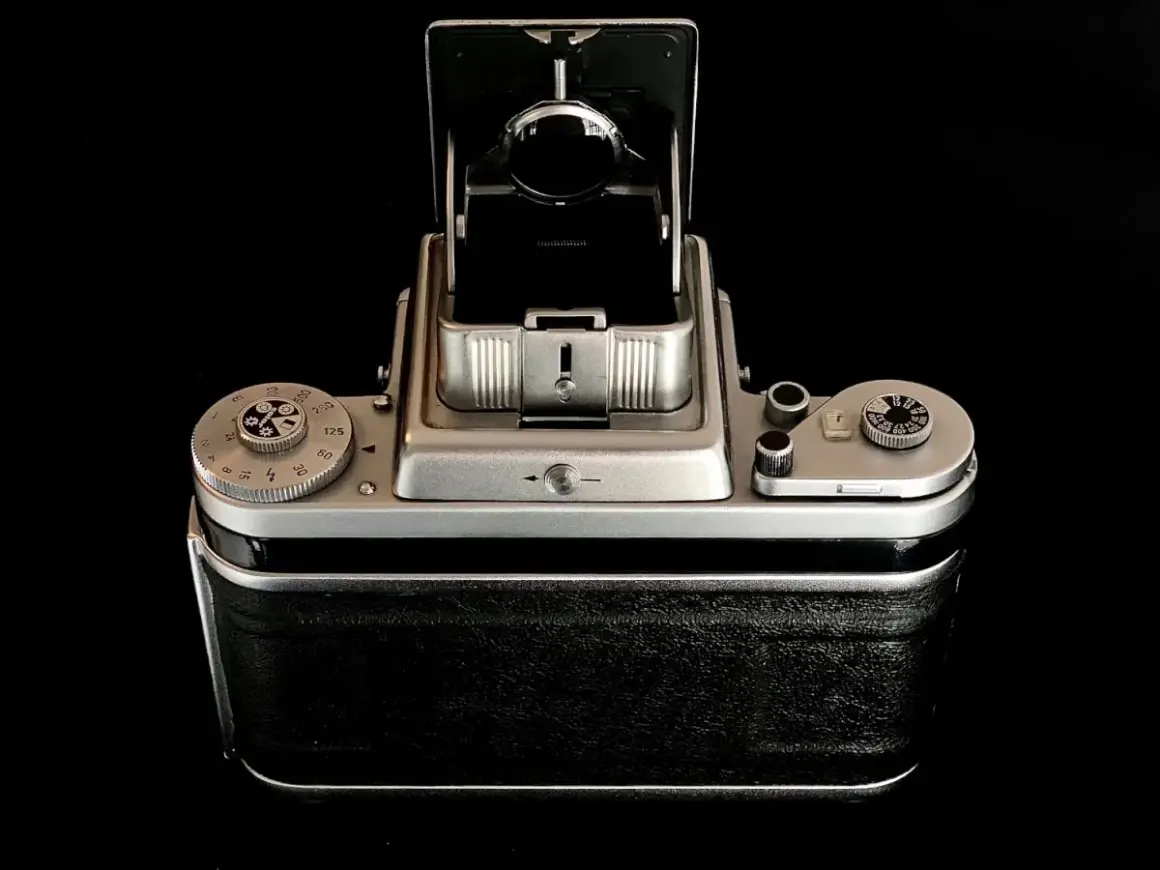
The Pentacon Six is a square-frame medium-format SLR that rewards a slower, more deliberate way of working. I’m focusing on what the camera actually gives you on film, where the real compromises are, which lenses matter most, and how I would buy one in 2026 without turning a bargain into a repair project. I’ll call it the P6 from here, because the camera makes more sense when you think in systems rather than model names.
What matters most before you buy into the system
- 12 frames per roll means every exposure counts more than it does on 35mm.
- The body is simple in theory, but transport quality varies a lot from copy to copy.
- The 80mm Biometar is the safest first lens, with the 50mm and 180mm as the next most useful.
- A serviced body is the smartest buy if you want predictable frame spacing and shutter timing.
- Current marketplace prices are often in the low hundreds for rough bodies and much higher for clean kits with the standard lens.
Why this square SLR still matters
What keeps the P6 relevant is not nostalgia alone. It gives you a genuine 6x6 negative, an SLR viewing experience, and a lens mount that opens the door to some very good East German and Zeiss Jena optics. In practice, that means you get a file or print source with real tonal depth, but also a camera that asks for patience.
| Feature | What it changes |
|---|---|
| 6x6 frame on 120 | 12 exposures per roll and a square negative that crops cleanly for print, web, or portrait layouts. |
| Focal-plane shutter | The shutter lives in the body, so lens choice stays broad and the optics can stay simple. |
| Interchangeable finders | You can work waist-level for a calmer pace or use a prism when you want a more familiar SLR feel. |
| Breech-lock mount | The lens locks securely, but swaps are slower than on many modern systems. |
| Manual transport | The camera rewards care, and it punishes sloppy loading fast. |
Historically, the system also handled faster and larger-format thinking, but for real-world film shooting today, 120 is the film that matters. Once you accept that rhythm, the next question is how it feels to shoot.
How it feels to shoot a roll
I do not treat this camera like a quick street body. Loading 120 is easy enough, but the advance mechanism wants a full, clean stroke, and that deliberate motion sets the pace for everything that follows. When a copy is healthy, the camera has a satisfying mechanical certainty; when it is not, the weakness shows up as inconsistent frame spacing, sticky transport, or a shutter that no longer sounds even across the speed range.
- Expect 12 exposures on a 120 roll, so each frame deserves more intent than a casual 35mm grab shot.
- Focus is calm rather than fast, especially with the waist-level finder.
- The body rewards consistent handling; rushed advance is where many problems start.
- Composition feels square by default, which is useful for portraits, graphic scenes, and clean editorial crops.
If you like cameras that make you slow down just enough to improve your judgment, this is part of the appeal. If you want speed and forgiveness, it can feel like a camera asking for a little too much attention. That trade-off is exactly why the lens set matters so much.
The lens set is the main reason to care
If the body is the compromise, the lenses are the argument for buying into the mount. The standard 80mm f/2.8 is the first lens I would want, because it behaves like a natural normal on 6x6 and gives you the cleanest way to learn the system. Once that lens clicks for you, the rest of the range starts to make sense.
| Lens | Best use | Why it matters |
|---|---|---|
| 80mm f/2.8 Biometar | Everyday work | The safest first buy and the lens that best shows what the system can do. |
| 50mm f/4 Flektogon | Interiors and wider scenes | Useful when the square needs room to breathe without feeling cramped. |
| 120mm f/2.8 Biometar | Portraits | Gives tighter framing with a flattering look and strong separation. |
| 180mm f/2.8 Sonnar | Compression and headshots | One of the most desirable long lenses in the set. |
| 300mm and longer | Specialty use | Real tools, but heavy enough that most people should treat them as niche purchases. |
The wider 50mm is useful for interiors, architecture, and any scene where the square needs room to breathe. The 120mm and 180mm are the portrait and compression lenses, and they are the ones that can make skin tones and backgrounds feel especially polished when the exposure is right. The very long lenses are real, but I treat them as specialty tools rather than reasons to own the system.
A lot of photographers now buy the glass as much as the body, and I understand why. The rendering is strong, the mount adapts well to digital mirrorless bodies, and the optics still have enough character to matter in a world full of technically perfect but forgettable lenses. Once the lenses are in place, the real comparison becomes less about specs and more about how the whole system stacks up against other medium format choices.
How it compares with other medium format SLRs
For most buyers, this is the decisive section. I would not choose the P6 because it is the easiest camera to own. I would choose it because the price-to-image-size ratio is unusually strong, and because the lens family still gives you real creative room.
| Camera | Main advantage | Main trade-off | Best for |
|---|---|---|---|
| P6 | Affordable entry into 6x6 with very capable lenses | Transport and spacing depend heavily on condition | Patient shooters who want square negatives and character |
| Mamiya 645 | More frames, lighter handling, easier handheld work | Smaller negative and less square identity | First-time medium format users who value practicality |
| Hasselblad 500 | Refined build and a strong modular ecosystem | Much higher purchase and accessory cost | Buyers who want polish over bargain pricing |
| Kiev 60 | Similar mount access and a big negative | Its own reliability issues and variable finishing | Budget buyers only if the body is clearly healthy |
If I wanted the easiest camera to live with, I would start with a 645 body. If I wanted the most refined modular system, I would look at Hasselblad. If I wanted a square negative, a strong lens family, and the willingness to work around mechanical personality, this East German body still earns its place. Once you know the comparison, the next decision is whether a specific copy is actually worth buying.
How to buy one in 2026 without regret
In current eBay listings, rough body-only examples can sit in the low hundreds, while clean kits with the 80mm lens often move into the $400 to $550 range. That gap is why condition matters more than the badge on the front. A cheap unknown body can stop being cheap as soon as you add a CLA, meaning clean, lubricate, adjust, shipping, or a hunt for a second copy.
- Check that the advance lever completes its full travel and returns consistently.
- Listen for shutter speeds that sound even, not sticky or obviously different from one speed to the next.
- Look for clean frame spacing on sample scans or recent test rolls.
- Make sure the lens diaphragm snaps closed cleanly and the aperture ring turns without rough spots.
- If a prism finder is included, verify whether the meter works and what battery it needs.
- Treat untested as a project listing, not a bargain listing.
In the U.S., I would pay more for a serviced body before I would gamble on a supposedly cheap one from far away. Shipping a mystery camera twice usually costs more than buying the right copy once. Once you know how to buy one, the real question becomes how to shoot it without fighting the camera.
A practical first-roll workflow
When I bring home a new copy, I start boring on purpose. Fresh 120, the 80mm lens if I have it, a handheld meter if the finder is unmetered or untrusted, and a test roll shot in steady light. I want to know whether the advance is smooth, whether the framing is predictable, and whether the shutter behaves the same at the speeds I actually use.
- Settle on one lens and one film stock for the first test.
- Work around f/5.6 to f/8 until focus and transport feel familiar.
- Advance the lever in one full motion and never force it backward.
- Watch your negatives for spacing consistency before you shoot anything important.
- Use a tripod or a very firm stance for slower shutter speeds, because the body is not forgiving of sloppy technique.
This is also where the square frame starts to pay off creatively. A 6x6 negative scans well, adapts cleanly into portrait or landscape crops, and gives editorial work a format that still feels different without being difficult to use. That first roll tells you whether you bought a system or just a story.
When the square frame is worth the trade-offs
I would recommend the system to photographers who value image character, a deliberate shooting pace, and the chance to work with very good lenses at a lower entry cost than many rival medium format bodies. I would not recommend it to anyone who wants a camera to be invisible; this one has opinions, and those opinions are mostly mechanical.
- Buy it if you want a square negative, a classic SLR workflow, and a lens family with real resale value.
- Buy it if you are comfortable checking frame spacing and budgeting for maintenance.
- Skip it if you want fast handling, a light kit, or a body you can ignore between rolls.
For me, the camera is worth it when the square negative changes how you see, not just how you collect gear. A healthy body, one excellent lens, and a test roll are enough to tell you whether the system is a fit, and that is the order I would respect before spending on anything else.