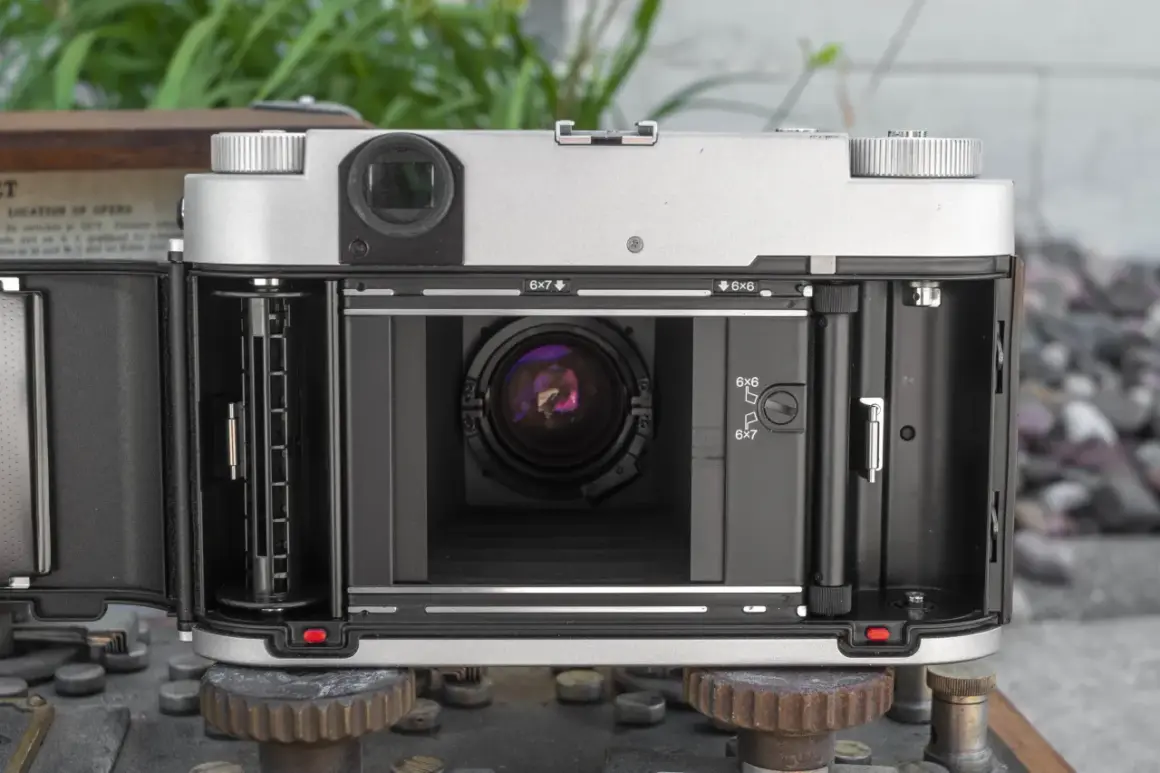
The Fujifilm GF670W is one of those rare film cameras that makes sense only if you care about the image, the handling, and the experience at the same time. In this article I break down what it actually is, how the 55mm wide lens changes the way it sees the world, what it feels like to use in real shooting conditions, and what I would check before paying modern used-market money for one.
What matters most before you buy or shoot one
- It is a fixed-lens medium-format rangefinder, not a lens-swapping system camera.
- It shoots 6x7 and 6x6 on 120 film, with 220 support on paper but little practical relevance in 2026.
- The 55mm f/4.5 lens behaves like a wide-angle view in medium format, which is the whole point of the camera.
- Its leaf shutter syncs flash at all speeds, so it is unusually good for outdoor fill flash and controlled daylight work.
- Used prices are high, so condition, alignment, and completeness matter more than cosmetic hype.
What the GF670W is and what it is not
The GF670W sits in Fujifilm’s GF670 family, but it is the wide-angle version, not the standard 80mm model. In practical terms, that means you get a medium-format rangefinder built around a fixed 55mm lens, with dual-format shooting for 6x7 and 6x6. According to Fujifilm’s own brochure, the lens is an EBC Fujinon 55mm f/4.5, the focus range runs from 0.7m to infinity, and the shutter spans 4 seconds to 1/500 second.
That specification mix tells you almost everything you need to know about the camera’s personality. It is not trying to be a general-purpose modular system. It is trying to be a compact, high-quality, wide-angle film camera that rewards deliberate framing. I read it less as a nostalgia object and more as a very focused tool: one camera, one lens, two negative sizes, and very little fluff.
| Specification | GF670W | Why it matters |
|---|---|---|
| Lens | 55mm f/4.5 EBC Fujinon | Gives a wide-angle look in medium format without extra accessories. |
| Film formats | 6x7 and 6x6 | Lets you choose between fewer, larger frames or a slightly more square composition. |
| Minimum focus | 0.7m | Close enough for environmental portraits, but not a macro tool. |
| Shutter | 4s to 1/500s | Useful for hand-held daylight work and long tripod exposures. |
| Body style | Fixed-lens rangefinder body | More robust than a bellows folder, but less flexible than an interchangeable-lens camera. |
That last point matters. People sometimes group the whole GF670 family together and assume the wide-angle model behaves like a folding bellows camera. It does not. The W version is better thought of as the sturdier, fixed-lens sibling that keeps the same medium-format rangefinder idea but changes the mechanics underneath it. That difference is exactly why it feels so purpose-built.
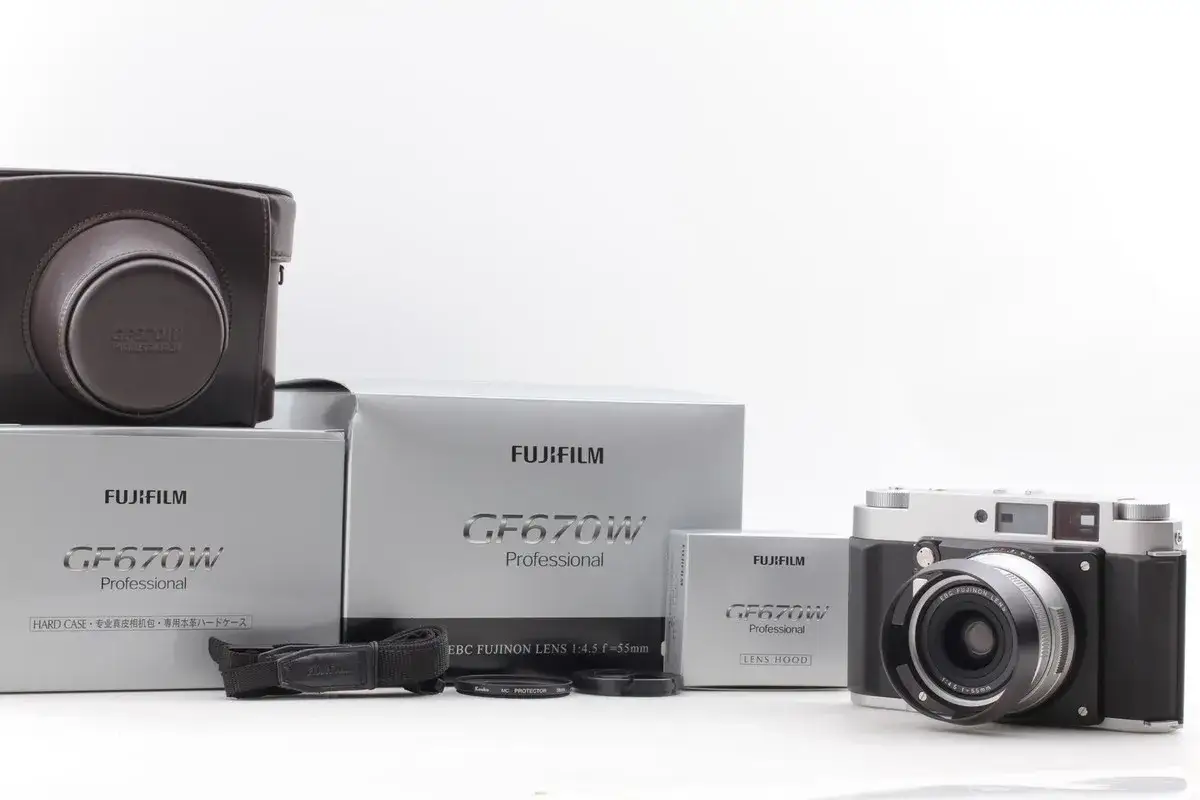
Why the 55mm lens changes the camera’s personality
The wide lens is not just a spec on paper. It changes how you compose, how close you work, and what kind of scenes feel natural. On 6x7, the 55mm lens behaves like a roughly 27mm equivalent field of view; on 6x6, it is closer to a 30mm equivalent. In other words, this camera lives in wide-angle territory, not classic normal-lens territory.
That makes it excellent for landscapes, architecture, travel, and street work where you want context around the subject. It can be very strong for environmental portraits too, but only if you like seeing the subject inside a larger scene rather than isolated from it. I would not choose it if most of my work depended on flattering close headshots, because the perspective will start to feel very wide very quickly.
| Scene type | How the 55mm lens behaves | My take |
|---|---|---|
| Landscapes | Lets you keep foreground, midground, and sky in one frame | One of the best matches for the camera. |
| Architecture | Captures more of a building without forcing you far back | Strong choice if you like clean lines and careful framing. |
| Street | Puts people inside their surroundings | Very good if you prefer context over tight portraits. |
| Portraits | Works best at a little distance with thoughtful composition | Useful, but not the easiest portrait camera in the bag. |
| Close work | 0.7m minimum focus is decent, but still limited | Enough for detail-oriented framing, not for true close-up flexibility. |
The 55mm lens also changes how disciplined you need to be. A wide medium-format frame is generous, but it also exposes bad horizon control, clutter, and sloppy background placement. That is part of the camera’s appeal for me: it does not hide weak composition. It rewards it.
What it feels like to use in the field
The GF670W is not a camera that disappears in your hands, but it is unusually refined for medium format. The rangefinder is bright, the framing is clear, and the coupled focusing system gives you a real mechanical sense of precision. You are not spinning a plastic-feeling focus ring and hoping for the best; you are aligning images in the finder and knowing, very directly, when focus has landed.
It also helps that the shutter is a leaf shutter, which means flash sync works at every speed. That is a big deal if you shoot outdoors and want to add a little fill flash without fighting shutter limits. I also like the practical details: the W version has a shutter indicator lamp below the eyepiece, the camera runs on a single CR2 battery, and Fujifilm lists battery life at around 2,000 exposures under test conditions. For a camera this specialized, that is reassuringly simple.
- Best trait in use: quiet, deliberate operation that feels controlled rather than fussy.
- Main tradeoff: it is compact for medium format, but it is still a substantial camera in absolute terms.
- Most useful control habit: treat the rangefinder patch as your anchor, then compose around it.
- Most overlooked advantage: leaf-shutter flash sync makes daylight fill flash much easier than on many medium-format bodies.
Because the camera is so self-contained, the biggest mistakes are usually practical rather than technical. People forget that a wide lens magnifies composition problems. They forget to bring a spare CR2. They also underestimate how much easier the camera feels when you work with a strap, a hood, and a deliberate shooting rhythm instead of treating it like a quick snapshot machine. That leads straight into film choice and exposure behavior.
Film choices and exposure habits that make it sing
If I were loading this camera today in the United States, I would default to 120 film and stop thinking about 220 unless I had a very specific reason to chase it. The camera supports 120 and 220, but 220 is niche now, while 120 is the practical standard in 2026. On 120, you get 10 frames in 6x7 or 12 in 6x6, which is a healthy reminder to slow down and make each frame count.
The f/4.5 lens means I would think of the GF670W as a daylight or tripod-friendly camera first, and a low-light hand-held camera second. Yes, you can shoot hand-held in softer light, especially with faster film, but this is not the body I would choose if my main goal were available-light work after sunset. It becomes much more convincing when you pair it with thoughtful exposure and a film stock that suits the scene.
| Shooting situation | Film choice | Why I would use it |
|---|---|---|
| Travel and mixed daylight | Color negative ISO 400 | Flexible exposure latitude and easy scanning. |
| Bright landscapes | Color negative ISO 100 | More detail and cleaner tonal separation when light is steady. |
| Black-and-white street | ISO 400 black-and-white | Forgiving, easy to process, and strong for wide compositions. |
| Outdoor portraits with flash | ISO 400 color negative | Lets you balance ambient light with fill flash very naturally. |
| Tripod work at dusk | ISO 100 or slower | Best when you can use the shutter range and the camera’s steadiness properly. |
My rule of thumb is simple: use the camera’s width to build scenes, not just to make them bigger. If you try to make it behave like a portrait specialist or a low-light monster, it starts to feel limited. If you use it for travel, architecture, environmental work, and careful flash-controlled daylight shooting, it starts to look almost overqualified.
What to inspect before paying used-market prices
The GF670W is expensive enough that I would not buy one on reputation alone. In 2026, used asking prices are commonly in the low-to-mid four figures, and clean examples can climb higher if they include the hood, case, and original accessories. That is a lot of money for a film camera, so condition matters in a very literal way.
If I were inspecting one, I would focus on function first and cosmetics second. Cosmetic marks are negotiable. Mechanical issues are not.
| What to check | Why it matters |
|---|---|
| Rangefinder alignment | If the focusing patch is off, the camera loses the precision that justifies its price. |
| Lens clarity | Look for haze, fungus, separation, or excessive cleaning marks that could lower contrast. |
| Shutter behavior | Uneven speeds or inconsistent firing can turn a premium camera into an expensive repair project. |
| Battery compartment | Corrosion here can create intermittent power issues that are easy to overlook during a short test. |
| Viewfinder brightness | The finder is part of the selling point; if it is dim or fogged, focusing suffers immediately. |
| Accessories | The hood, case, caps, and strap can add real value, especially because they are not always easy to replace. |
One practical detail I would not ignore is the body style itself. The fixed-lens W version avoids some of the bellows-related concerns that come with folding cameras, which is one reason some buyers prefer it. If you are comparing it to the standard GF670, that difference is not cosmetic; it changes the maintenance profile and the kind of worry you bring to the purchase. That comparison is where the decision usually becomes clear.
GF670W vs the standard GF670
The wide-angle version is not automatically the better camera. It is the better camera for a specific way of seeing. If you already know you want a broader field of view and a more compact fixed-lens body, the W is the stronger match. If you want a more general-purpose medium-format rangefinder look, the standard GF670 has the easier-to-live-with focal length.
| Category | GF670W | Standard GF670 |
|---|---|---|
| Lens | 55mm f/4.5 | 80mm f/3.5 |
| Perspective | Wide, contextual, more dramatic | Closer to normal view, easier for general subjects |
| Best use | Landscape, architecture, travel, street | Portraits, general purpose shooting, classic medium-format framing |
| Handling | More specialized, more opinionated | More versatile, easier as an all-rounder |
| Ownership logic | Buy if you know you want the wide look | Buy if you want one camera to cover more situations |
If I had to choose in one sentence, I would say this: pick the W if you want a compact wide-angle medium-format camera with real character, and pick the standard model if you want the safer all-purpose option. That is the cleanest way to think about the family, because the camera’s strengths are strong enough that the right answer usually reveals itself quickly.
Why I still think it matters in 2026
What keeps this camera relevant is not just rarity. It is the way it compresses a very specific shooting experience into a body that still feels usable today. It rewards people who like working with framing, distance, and light rather than relying on interchangeable lenses to solve creative uncertainty. It also fits a modern hybrid mindset better than a lot of older film gear, because the negative quality is high enough to scan beautifully while the camera itself remains straightforward to operate.
That said, I would be cautious about romanticizing it. It is not cheap, it is not flexible in the way a system camera is flexible, and it is not the right choice if you mainly want portraits or low-light convenience. But if you want a premium medium-format tool that turns wide-angle film photography into something portable, deliberate, and surprisingly elegant, the GF670W still earns its reputation. In my view, that is exactly why it remains worth understanding, even if you never buy one.