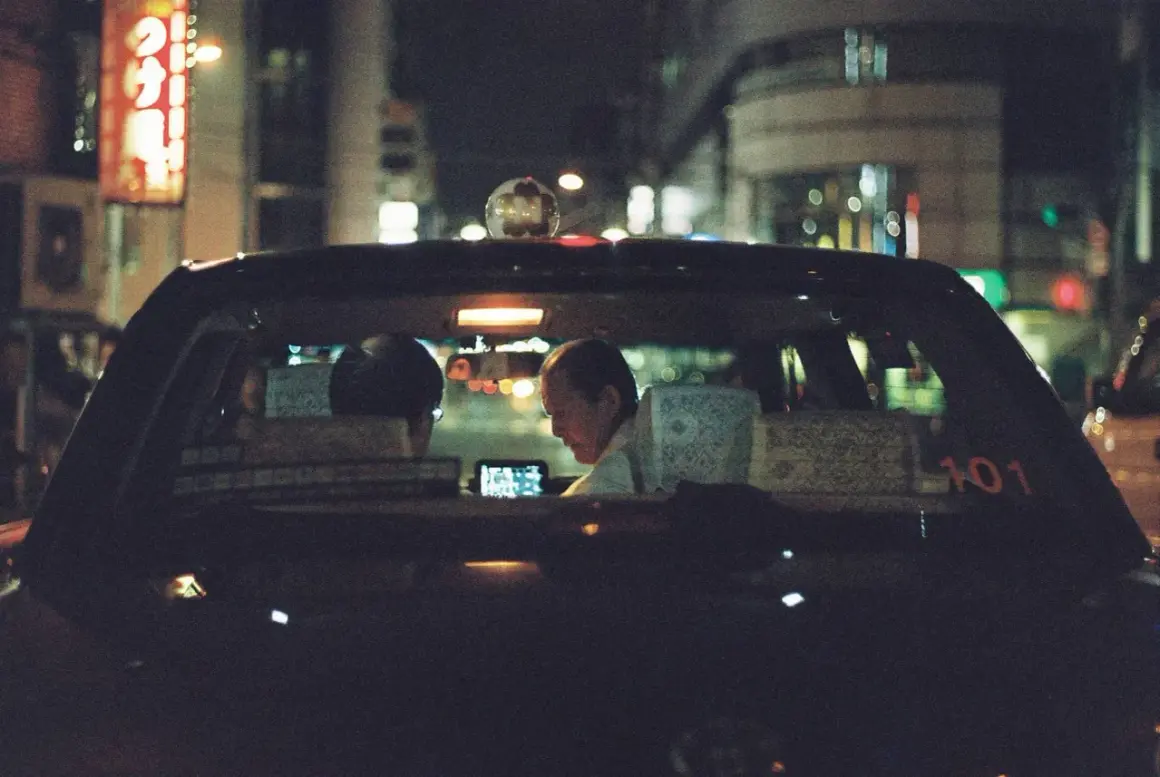
Dim interiors, night streets, concerts, and mixed tungsten light all expose the same truth: film speed is only part of the equation. The best 35mm film for low light depends on whether you want color or black and white, how much grain you can tolerate, and whether you are willing to push the film after exposure. I’m focusing on rolls that make sense for real shooting in 2026, not just the ones that sound good in a forum thread.
The short version is different for color and black and white
- Best natural color: Kodak EKTACOLOR PRO 800 if you want low-light color with believable skin tones.
- Best moody night color: CineStill 800T if you want tungsten-lit streets, neon, and a more cinematic look.
- Best all-round black and white: Ilford HP5 Plus because it is forgiving and pushes well.
- Best for very dark scenes: Ilford Delta 3200 when shutter speed matters more than fine grain.
- Best classic high-speed look: Kodak TRI-X 400 if you want texture without jumping straight to ultra-fast stock.
- Fastest clean-ish B&W option: Kodak EKTAPAN P3200 when you want a high-speed negative with a cleaner feel.
What actually matters when the light drops
Low light is not one problem. It is a trade between speed, grain, and color control. ISO, or exposure index, tells you how much light the film needs; aperture controls how much light your lens can pass; shutter speed decides whether motion is frozen or blurred. In practice, the lens often matters as much as the stock itself. A 50mm f/1.8 or 35mm f/1.4 gives you far more room than a slow kit zoom, even before you touch the film.
I also pay attention to two terms that get tossed around loosely. Box speed is the manufacturer’s recommended rating. Push processing means rating the film faster than box speed and developing it longer to recover density. That can save a frame, but it also changes contrast and grain, so it is a tool, not a free upgrade. That tradeoff is why I separate the actual stock recommendations by color and black-and-white below.
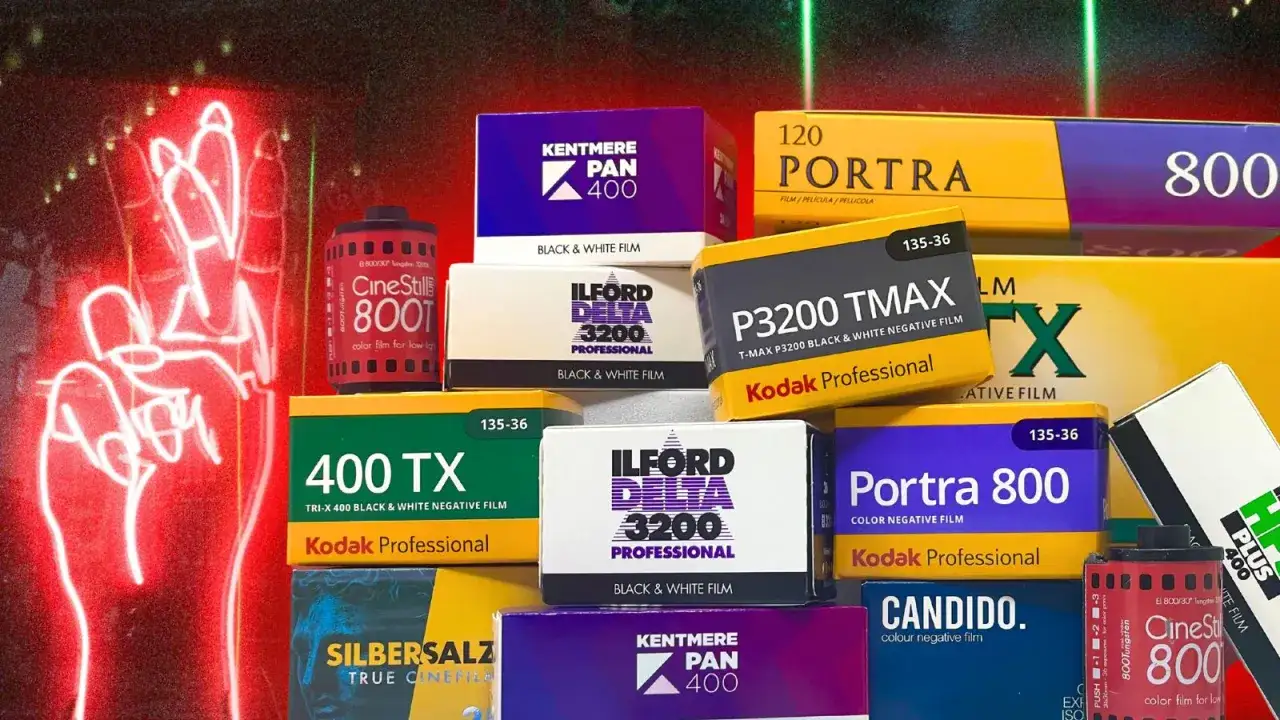
The strongest 35mm films I would put at the top of the list
For color, Kodak’s current still-film lineup places EKTACOLOR PRO 800 in the 800-speed slot, while Ilford’s technical data says HP5 Plus is comfortable from EI 400 to 3200. Those two facts explain why the first is my color pick and the second is my safest all-round black-and-white choice.
| Film | Type and speed | Best for | Why it stands out | Trade-off |
|---|---|---|---|---|
| Kodak EKTACOLOR PRO 800 | Color negative, EI 800 | Indoor portraits, travel, everyday low light | Natural skin tones, balanced color, and strong exposure latitude | Less stylized than 800T and still grainy in very dark scenes |
| CineStill 800T | Color negative, EI 800, tungsten-balanced | Night streets, neon, clubs, mixed practical light | Designed for difficult low light tungsten situations and can be pushed to 3200 ISO | Halation and cool daylight color shift are part of the look |
| Ilford Delta 3200 | Black and white, EI 3200 | Concerts, gigs, street at night, interiors | Exceptionally fast, with a surprisingly controlled grain structure for its speed | High contrast and heavy grain are built into the aesthetic |
| Ilford HP5 Plus | Black and white, EI 400 | Documentary work, available light, flexible all-purpose shooting | Forgiving, easy to expose, and very comfortable when pushed | Not as fast as Delta 3200, so it needs more light or a tripod |
| Kodak TRI-X 400 | Black and white, EI 400 | Classic street work and portraits in available light | Classic grain, sharp detail, and strong latitude with a recognizable look | More texture than cleaner modern high-speed stocks |
| Kodak EKTAPAN P3200 | Black and white, multi-speed, push to 3200+ | Deep low light when you want a cleaner high-speed negative | Designed to be pushed hard while keeping a relatively controlled look | Processing discipline matters more, so it rewards testing |
If I had to separate the group into two camps, I would say this: EKTACOLOR PRO 800 and CineStill 800T solve color problems in different ways, while HP5 Plus, Delta 3200, TRI-X 400, and EKTAPAN P3200 form the black-and-white ladder from forgiving to extremely fast. Once the stock is chosen, the scene itself decides how far you can push it.
How I match the film to the scene
- Indoor portraits with practical lamps: EKTACOLOR PRO 800 gives you natural skin tones and enough speed for handheld work. If the room light is warm and ugly in a good way, CineStill 800T can look even better because it is tungsten-balanced.
- Night streets and neon: CineStill 800T is the obvious creative pick because it is built for difficult low light tungsten situations and can be pushed harder if needed. The halation around bright lights is part of the look, so I would only choose it if I actually want that glow.
- Concerts and clubs: Delta 3200 is the safest black-and-white answer when the subject is moving and flash is banned. If I want a more classic grain structure and the light is a little less punishing, HP5 Plus pushed to 1600 or 3200 can still work.
- Static interiors or architecture: I would often rather mount the camera on a tripod and use slower film than jump straight to the fastest stock. When the subject is not moving, image quality improves quickly once shutter speed stops being the limiting factor.
The real mistake is to pick a film before you decide whether the room is warm, mixed, or neutral. Tungsten-balanced film means the emulsion is tuned for around 3200K light, so it behaves more naturally under household bulbs and practicals than daylight-balanced stock. That does not make daylight-balanced film unusable at night, but it does explain why 800T has a following that goes beyond simple speed. Even so, the exposure choices below usually matter more than the logo on the box.
Exposure choices that matter more than the box speed
With negative film, I usually prefer a little extra exposure over a little less. Starving the shadows is harder to fix than carrying a bit more grain. For handheld people shots, I think of 1/60s as the floor with a 50mm lens and 1/125s as the safer target. With a 35mm lens you can sometimes hold 1/30s, but once your subject moves, the blur arrives faster than most people expect.
Tripod work changes the equation. If the scene is static, a 400-speed film can outperform a 3200-speed film because you are no longer forced to trade shutter speed for grain. That is also where reciprocity failure starts to matter. Reciprocity failure is the point at which film stops responding linearly during long exposures, usually once you are above roughly 1 second. In that zone, I check the film’s data sheet instead of guessing.
- For moving people, keep the shutter fast enough to protect the face and hands before you worry about grain.
- For static scenes, open the aperture first, then slow the shutter, then use a tripod before you jump to a much faster film.
- If you can use flash, a 400-speed stock suddenly becomes far more practical.
That order matters because a fast film cannot undo motion blur, but the right exposure can make a moderate-speed film look surprisingly clean. Push processing helps, but it is not a substitute for basic exposure discipline.
When pushing film helps and when it hurts
I push film when shutter speed is the priority and I can live with more contrast. Each stop is a doubling of light, so 400 to 800 is one stop and 800 to 1600 is another. One stop of push is usually the sweet spot on forgiving black-and-white stocks. Two stops is still useful, but the look gets rougher and the lab process matters more. Three stops is emergency territory, not a default strategy.
- HP5 Plus: one to two stops of push is a realistic low-light move when I want flexibility rather than maximum speed.
- Delta 3200: the stock already lives in high-speed territory, so I treat it as the easiest choice when the light is truly weak.
- TRI-X 400: good when I want a classic look and can accept that pushing will add texture.
- CineStill 800T: the most natural color candidate for pushing if I want to keep shooting in bad light without giving up the cinematic character.
- EKTAPAN P3200: the right choice when I want a black-and-white negative designed to live in this speed range.
Color push is more subjective than black and white. It can work, but the color shifts become part of the image, not just a technical side effect. That is fine if you want the mood. It is less fine if you want neutral skin tones and predictable scans. The lab also has to know the target EI before development, or the whole exercise becomes guesswork.
The mistakes that waste the speed you paid for
- Choosing film before lens: A fast stock with a slow lens still leaves you short on light.
- Ignoring the subject: Grain is not the only problem. If the person moves, blur will ruin the frame first.
- Shooting the wrong color balance: Daylight-balanced film under warm indoor light can look muddy or awkward unless you correct for it.
- Underexposing negative film out of fear: People often protect highlights too aggressively and then wonder why the shadows collapse.
- Not planning for development: Push processing works best when the lab knows what you intended.
I see this most often with photographers who assume that a 3200-speed label solves everything. It does not. A dim club, a shaky hand, and a narrow-aperture zoom can still produce soft, noisy, or simply unusable frames. The better approach is to match speed, optics, and subject movement before the shutter even clicks. With that in mind, here is the setup I would trust first in a real shoot.
The setup I would load first for a real night shoot
- If I want clean color and natural skin: I would start with EKTACOLOR PRO 800.
- If I want mood, neon, and warm practical lights: I would choose CineStill 800T.
- If I want one black-and-white roll that can handle almost anything: I would load HP5 Plus.
- If the room is genuinely dark and handholding is non-negotiable: I would choose Delta 3200.
- If I want a classic street look with room to push: I would pick TRI-X 400.
- If I want the cleaner high-speed B&W option: I would test EKTAPAN P3200 first.
My rule is simple: pick the film for the light you actually have, not the light you wish you had. If the scene is mostly static, a tripod and a slower stock often beat a noisy ultra-fast roll. If the scene moves, choose the fastest film that still matches the color and the mood you want, then expose it honestly and let the film do the rest.